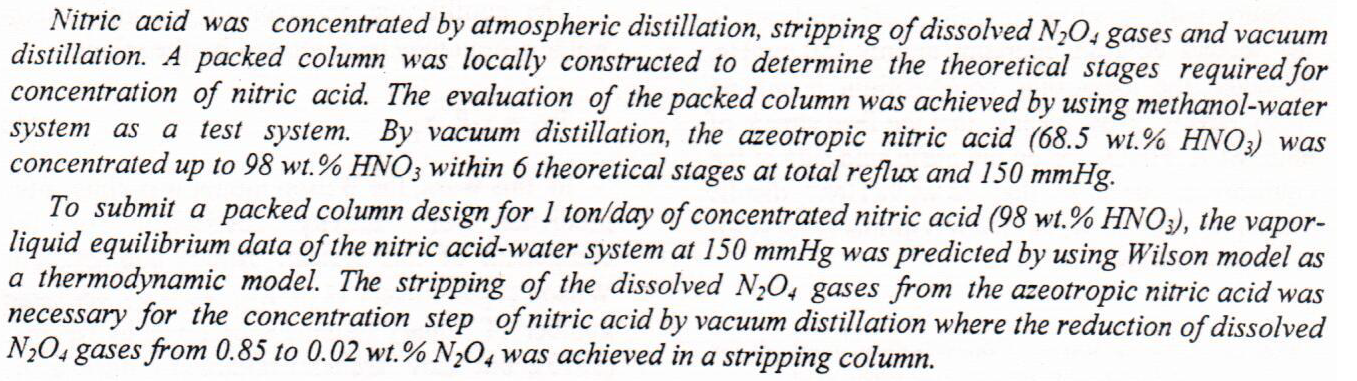
Concentration of Nitric Acid by Vacuum Distillation

New Schiff base, namely [2-(carboxy methylene-amino)-phenyl imino] acetic acid (L) and its some metal complexes [LCo.2H2O], [LNi.2H2O], [LCu].3H2O, [LCd.2H2O], [LHg.2H2O] and [LPb.2H2O], were reported and characterized by elemental analysis, metal content, spectroscopic methods, magnetic moments and conductivity measurements, it is found that the geometrical structures of these complexes are octahedral [Co(II), Ni(II), Cd(II), Hg(II), Pb(II) and square planar Cu(II).The complexes have been found to posses 1:1 (M:L) stoichiometry

KE Sharquie, AA Noaimi, SA Galib, Journal of Cosmetics, Dermatological Sciences and Applications, 2013 - Cited by 4
A new ligand 3-hydroxy-2-(3-(4-nitrobenzoyl) thiouriedo) propanoic acid (NTP) where synthesized by reaction of 4-nitro benzoyl isothiocyanate with serine amino acid. The ligand was characterized by FT-IR, NMR spectra and the elemental analysis. The transition metal complexes of this ligand where synthesize and characterized by UV-Visible spectra, FT-IR, magnetic suscpility, conductively measurement, The general formula [M (NTP) 2] where M+2= (Mn, Co, Ni, Cu, Zn, Cd, Hg,), the form of molecular for these complexes as tetrahedral except Cu has square planer.
Coupling reaction of 4-nitroaniline with 3-aminobenzoic acid provided the corresponding bidentate azo ligand. The prepared ligand was identified by Microelemental Analysis, 1H-NMR, FT-IR, and UV-Vis spectroscopic techniques. Treatment of the prepared ligand with Y(III) and La(III) metal ions in 1:3 M:L ratio in aqueous ethanol at optimum pH yielded a series of neutral complexes with the general formula of [M(L)3]. The prepared complexes were characterized by flame atomic absorption, Elemental Analysis (C, H, N), FT-IR, and UV-Vis spectroscopic methods, as well as conductivity measurements. The nature of the complexes formed were studied following the mole ratio and continuous variation methods; Beer's law obeyed over a concentration range o
... Show MoreNew Schiff bases derivatives [IV]a-e is prepared via condensation of Derythroascorbic acid with p-substituted aldehydes in dry benzene. To obtain these derivatives, the 5,6-O-isopropylidene-L-ascorbic acid[I] was chosen as starting material, compound prepared from the reaction of L-ascorbic acid as starting material. Compound[I] was prepared from the reaction of L-ascorbic acid with dry acetone in the presence of hydrogen chloride. The esterification of hydroxyl groups at C-2 and C-3 positions with excess ofethyl α –chloroacetate in the presence of sodium acetate produce acorresebonding ester [II] , which was condensed with hydrazine hydrate to give new hydrazide [III] . The new Schiff bases [IV]a-e were synthesized by reaction of acid h
... Show MoreIn this work pyrazolin derivatives were prepared from the diazonium chloride salt of 4-aminobenzoic acid. Azo compounds were prepared from the reaction of an ethanolic solution of sodium acetate and calculated amount of active methylene compound namely, acetyl acetone to obtain the corresponding hydrazono derivative (1). Cyclocondensation reaction of compounds (1) with hydrazine hydrate and phenyl hydrazine in boiling ethanol affording the corresponding pyrazoline-5-one derivatives of 4-aminobenzoic acid (2,3). Then compound (3) was reacted with thionyl chloride to give the corresponding acid chloride derivative(4), followed by conversion into the corresponding acid hydrazide derivative (5) carboxylic acid thiosemicarbazide (11), esters
... Show More
Polymer metal complexes of poly ethylene glycol acetal and Ag (I), Cu (II), Ni (II), Mn (II), Co (III) and Hg (II) were prepared from the reaction of PEG with aldehyde derived from Erythro-ascorbic acid (pentulosono-ɣ-lactone-2, 3- enedianisoate). All these compounds were characterized by Thin Layer Chromatography (TLC) and FTIR spectra and aldehyde was also characterized by (U.V-Vis), 1HNMR,13CNMR, and mass spectra. It has been established that, the polymer and its metal complexes showed good activities against four pathogenic bacteria (Escherichia coli ,Klebsiellapneumonae, Staphylococcusaureus, Staphylococcus Albus) and two fungal (Aspergillus Niger,Yeast). The polymer metal complexes showed higher activity than the free polymer. The
... Show More