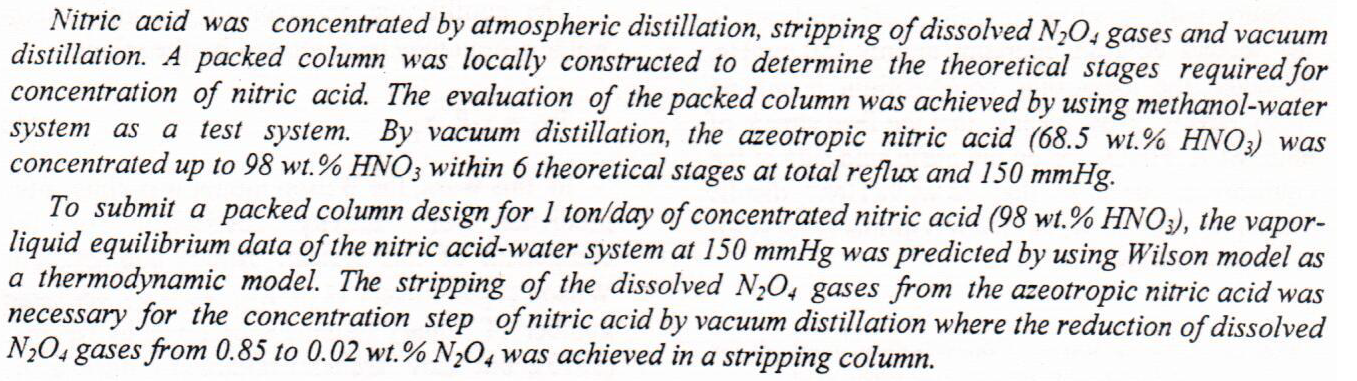
Concentration of Nitric Acid by Vacuum Distillation

A new ligand [3(3(2chloroacetyl) thioureido)pyrazine-2-carboxyliIcacid](CPC)was synthesized by reaction of rized by imicro elmental analysis C.H.N.S.,FT-IR,UV-Vis and 1H-13CNMR spectra, some transition metals complex ofIthis ligand were Prepared and characterized byiFT-IR,UV-Vis spectra conductivity measurements magnetic susceptibility and atomic absorption. From the obtained results the molecular formula of all prepared complexes were[M(CPC)2](M+2i=Mn. Co, Ni, Cu, Zn, Cd and Hg),the proposedi geometrical structure for all complexes were as tetrahedral geometry except copper complex has square planer geometry.
Some metal ions (Mn+2, Co+2, Ni+2, Cu+2, Zn+2, Cd+2 and Hg+2) complexes of quinaldic acid (QuinH) and α-picoline (α-Pic) have been synthesized and characterized on the basis of their , FTIR, (U.V-Vis) spectroscopy, conductivity measurements, magnetic susceptibility and atomic absorption. From the results obtained the following general formula has suggested for the prepared complexes [M(Quin)2( α-Pic)2].XH2O where M+2 = (Mn, Co, Ni, Cu, Zn, Cd and Hg), X = 2, X = zero for (Co+2 and Hg+2) complexes, (Quin-) = quinaldate ion, (α-Pic) = α-picoline. The results showed that the deprotonated ligand (QuinH) by using (KOH) coordinated to metal ions as bidentate ligand through the oxygen atom of the carboxylate group (-COO-) and the nitrogen ato
... Show MoreSynthesis of 2-(4-Acetyl-phenyl)-4-nitro-isoindole-1, 3-dione chalcones were performed by fusion of 3-nitro phthalic anhydride with p-aminoacetophenone. Then the later was grinded with different aromatic aldehydes in the presence of sodium hydroxide to produce new chalcones derivatives A3-10 without using any solvent formation of new N- arylphthailimide chalcones were confirmed by FT-IR,1HNMR, 13CNMR spectroscopy and all final compounds were tested for their antifungal and antibacterial activity some of them showed more biological activity than the standard drugs
 (13)
(13)
 (4)
(4)



A theoretical and protection study was conducted of the corrosion behavior of carbon steel surface with different concentrations of the derivative (Quinolin-2-one), namly (1-Amino-4,7-dimethyl-6-nitro-1H-quinolin-2-one (ADNQ2O)). Theoretically, Density Functional Theory (DFT) of B3LYP/ 6-311++G (2d, 2p) level was used to calculate the optimized geometry, physical properties and chemical inhibition parameters, with the local reactivity to predict both the reactive centers and to locate the possible sites of nucleophilic and electrophilic attacks, in vacuum, and in two solvents (DMSO and H2O), all at the equilibrium geometry. Experimentally, the inhibition efficiencies (%IE) in the saline solution (of 3.5%) NaCl were studied using potentiomet
... Show More
(13)
(4)
In the present work, leaching process studiedusing organic acids (acetic acid and lactic acid) to extract phosphate from the Iraqi Akashat phosphate ore by separation of calcareous materials (mainly calcite). This approach characterized by energy conservation, environmental enhancement by recovery of calcite as calcium sulfate (gypsum), keeping the physical and chemical properties of apatite. Samples were analyzed using X-ray diffraction and FTIR spectrophotometer. From the obtained experimental data it was found that using the two organic acids yields closed purity values of the produced apatite at the optimum conditions, while at different acid concentrations, it was found that the efficiency of acetic acid is higher at the low acid co
... Show MoreThe fatty acid composition in the seed and flower of Ligustrun lucidum and olive oil was studied by Gas Chromatography. Results showed that the main components of seed oil were Palmitic (C16:0) 5,893% ,Palmitolic acid (C16:1)0,398%, Steaeic (C18:0)2,911% ,Oleic (C18:1)74,984%,Linoleic (C18:2) 12,959%,and Linolenic (C18:3) 0,997%. The proportion of unsaturated fatty acid was above 89,338%, so the seed oil of L. lucidum ait belonged to unsaturated oil which possessed promising application. The components of flower oil were Palmitic (C16:0) 65,674% ,Palmitolic acid (C16:1)6,516%, Steaeic (C18:0)2,641% ,Oleic (C18:1)14,707%,Linoleic (C18:2) 3,113%,and Linolenic (C18:3) 2,70%. The proportion of unsaturated fatty acid and saturated fatty acid wa
... Show More
Metal complexes of Cu (II), Fe (III) and Mn (II) with Quinaldic acid (L1) and 1, 10-Phenathroline (L2) are synthesized and characterized by standaral physic- chemical procedures (element analysis, metal analysis, FTIR, Uv-Vis, magnetic moment and conductometeric measurements). On the base of these studies, mononuclear and six coordinated octahedral geometry and nonelectrolyte of these complexes have been proposed. The standard heat of formation (?Hºf) and binding energy (?Eb) for the free ligands and their complexes are calculated by using the PM3 method at 273K of Hyperchem.-8 program. The complexes are more stable than their ligands. Moreover, the electrostatic potential of free ligands are measured to investigate the reactive site of th
... Show More
(2)
New (pentulose-?-lactone-2,3-enedibenzoate barbituric acid) (L) have been synthesized by reaction of (5-C-dimethyl malonyl-pentulose-?-lactone-2,3-enedibenzoate) with urea in alkaline media (sodium methoxide). (Ca+2, Co+2, Ni+2, Cu+2, Zn+2, Cd+2 and Hg+2) complexes of (pentulose-?-lactone-2,3-enedibenzoate barbituric acid) (L) have been prepared and characterized by (1H and 13CNMR), FTIR, (U.V-Vis) spectroscopy, Atomic absorption spectrophotometer (A.A.S), Molar conductivity measurements and Magnetic moment measurements, and the following general formula has been given for the prepared complexes [MLCl2(H2O)].XH2O, where M = (Ca+2, Co+2, Ni+2, Cu+2, Zn+2, Cd+2, Hg+2), X = five molecules with (Cd+2) complex, L = (pentulose-?-lactone-2,3
... Show More
The new liganed Schiff base named [(E)-3-hydroxy-4-((3,4,5- trimethoxybenzylidene)amino) naphthalene-1- sulfonic acid] was synthesized from 3,4,5-trimethoxybenzyldehyde and 1-amino-2-aphthol-4- sulfonic acid in equal molar ratio. A series of new metal complexes' of the common molecular formulation [M(L)2(H2O)2].H2O are synthesized and characterized by IR, UV–Vis spectra, mass spectra, atomic absorption, elemental analyses, chloride content, magnetic susceptibility and conductivity measurements as well as thermo gravimetric analysis (TGA, DSC). Consistent with results of the magnetic and spectral studies, the advised geometrical structures for all of the prepared complexes have been octahedral formula