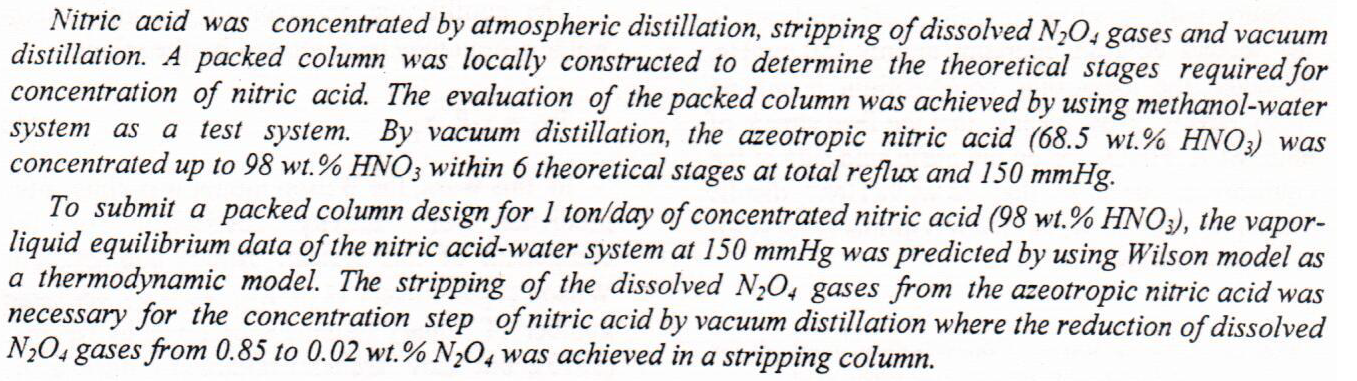
Concentration of Nitric Acid by Vacuum Distillation



The action of high repeated trucks load associated with dramatically elevated ambient temperatures leads to the most harmful distress in asphalt pavements occurred in Iraq known as rutting. Essentially, it is produced from the accumulation of irrecoverable strains, which mainly occurred in the asphalt layers. That visually demonstrated as a longitudinal depression in the wheel paths as well as small upheavals to the sides. Poly Phosphoric Acid (PPA) has been used as a means of producing modified asphalt binders and the interest to use it has increased in recent years. The PPA provides modified asphalt binder, which is relatively cheaply produced compared to polymer-modified asphalt. In this paper, PPA was used by three-percentages 1
... Show More (4)
(4)
Forty patients with acute lymphoblastic leukemia(ALL) were tested for the serum levels of total sialic acid(TSA) and the immunoglobulins before and after treatnemnt with six diffrent chemotherapy protocols while significantly
In this study serum total sailie acid concentration were tested as a scrological marker of discases activity to cvalute the result of the test in the diagonosis oe enteric fever(TSA) was measured in the serum od (50) patines with typhi fever(50)pa-tients
 (2)
(1)
(2)
(1)
In this study, concentrations of radon and uranium were measured for twenty six samples of soil. The radon concentrations in soil samples measured by registrant alpha-emitting radon (222Rn) by using CR-39 track detector. The uranium concentrations in soil samples measured by using registrar fission fragments tracks in CR-39 track detector that caused by the bombardment of U with thermal neutrons from 241 Am-Be neutron source that has flux of 5 ×10³n cm-2 s-1.
The concentrations values were calculated by a comparison with standard samples The results show that the radon concentrations are between (91.931-30.645Bq/m3).
The results show that also the uranium concentrat
(1)
Release of industrial effluents comprising dyes in water bodies is one of the foremost causes of water pollution. Therefore, the proper and proficient treatment of these dyes contaminated left-over material before their release is crucial. Herein, an eco-friendly biological macromolecule Gum-Acacia (GA) integrated Fe3O4 nanoparticles composite hydrogel was manufactured via co-precipitation technique for effective adsorption of Congo red (CR) dye existing in water bodies. The as-prepared magnetic GA/Fe3O4 composite hydrogel was characterized by FTIR, XRD, EDX, VSM, SEM, and BET techniques. These studies discovered the fruitful fabrication of biodegradable magnetic GA/Fe3O4 composite hydrogel possessing porous structure with large surface are
... Show More
(23)
(19)
 (3)
(3)
Spray pyrolysis technique was subjected to synthesized (SnO2)1-x (TiO2: CuO) x Thin films on different substrates like glass and single crystal silicon using. The structure of the deposited films was studied using x-ray diffraction. A more pronounced diffraction peaks of SnO2 while no peaks of (CuO , TiO2 ) phase appear in the X-ray profiles by increasing of the content of (TiO2 , CuO) in the sprayed films. Mixing concentration (TiO2 , CuO) influences on the size of the crystallites of the SnO2 films ,the size of crystallites of the spray paralyzed oxide films change in regular manner by increasing of (TiO
... Show More
(4)
(1)