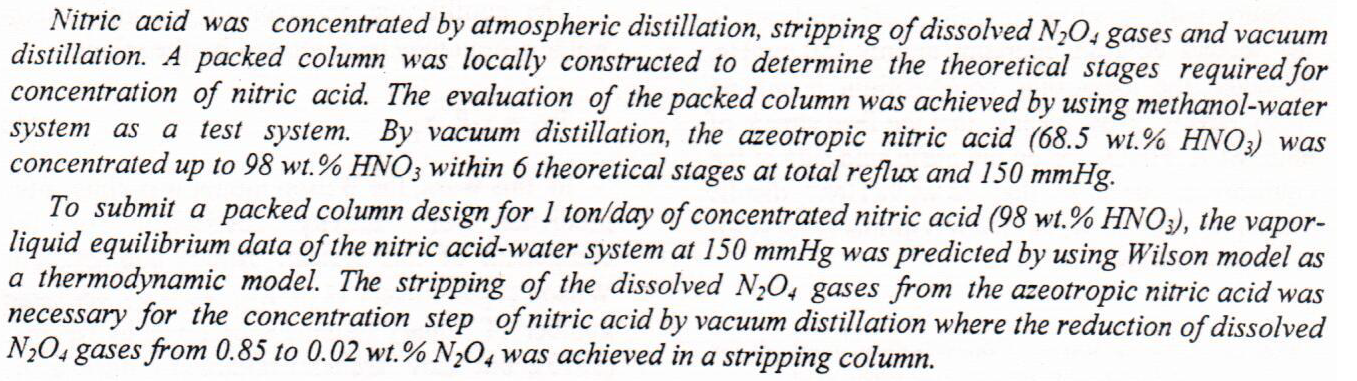
Concentration of Nitric Acid by Vacuum Distillation

Abstract
The Classical Normal Linear Regression Model Based on Several hypotheses, one of them is Heteroscedasticity as it is known that the wing of least squares method (OLS), under the existence of these two problems make the estimators, lose their desirable properties, in addition the statistical inference becomes unaccepted table. According that we put tow alternative, the first one is (Generalized Least Square) Which is denoted by (GLS), and the second alternative is to (Robust covariance matrix estimation) the estimated parameters method(OLS), and that the way (GLS) method neat and certified, if the capabilities (Efficient) and the statistical inference Thread on the basis of an acceptable
... Show More
In this work , an effective procedure of Box-Behnken based-ANN (Artificial Neural Network) and GA (Genetic Algorithm) has been utilized for finding the optimum conditions of wt.% of doping elements (Ce,Y, and Ge) doped-aluminizing-chromizing of Incoloy 800H . ANN and Box-Behnken design method have been implanted for minimizing hot corrosion rate kp (10-12g2.cm-4.s-1) in Incoloy 800H at 900oC . ANN was used for estimating the predicted values of hot corrosion rate kp (10-12g2.cm-4.s-1) . The optimal wt.% of doping elements combination to obtain minimum hot corrosion rate was calculated using genetic alg
... Show More
Our research comes to shed light on Iraqi literature as literature that arose in special circumstances alongside foreign literature. Using comparative research methods, we chose to highlight two distinguished writers, who have their mark in the world of literature. The first is the Iraqi writer Maysaloun Hadi, who is considered an icon of Iraqi feminist literature, and the second is the French writer Le Clézieu, who won the Nobel in 2008. We will see through the research how the two authors expressed their views of modernity and urbanism. And how each of them separately portrayed the psychological and moral projections that formed the essence of man today.
Résumé
Notre recherche abord un des points inc
... Show More
The aim of this study is to explain methods to be followed for the recovery Alsnav Hor, who represents the northwest portion of the Hammar Marsh in the province of Dhi Qar, after the drought in which that happened in 2008. The study included description of the region before the drought, the description of its natural and human environments, the economic events and activities, then the study included drought throughout the region, the environmental impacts caused by drought, its impact on social reality, economic and healthy for its environment, and then reached to the problems of social and economic in the region, depending on the Field studies and documented in the specialized government departments, information analysis for the
... Show MoreAbstract The current study is a theoretical study that aims to underline the role of picture books as a serious genre of children's literature in raising children's understanding of English literature and life concepts; especially for non-English speakers. Unfortunately, most Iraqi people have developed a social phobia of learning English since childhood. This phobia is resulted from the heavy traditional reading and writing assignments as well as hard exams. Therefore, this study suggests incorporating more interesting literary material like picture books that would bring pleasure and help in raising children's love and cognition of English Language. More significantly, it calls to replace the old curriculum with a more vital
... Show More (2)
(2)
The study aims to design an electronic puppet educational theater by Camtasia studio and identify the effectiveness in learning some of the artistic gymnastics skills for first grade, the research curriculum is experimental by designing two equal groups, and the research sample first grade students are distributed among 4 grade, and by the pumpkin determines two divisions (15 from each) representing the experimental group and control group, the main experiment conducted for 8 weeks by two educational units per week after which the post-tests were conducted, SPSS was used to process the results, and it was found that the electronic puppet educational theater contributed by making the learning process enjoyable and interesting and meeting the
... Show MoreAbstract:
The research aims to shed light on the Corona pandemic and its repercussions on the global economy in general, and on the activities of Iraqi economic units in particular. It also aims to show the impact of the auditor’s reporting on the effects of the Corona pandemic on economic units and its reflection on the quality of his reporting. To achieve the objectives of the research, the researcher prepared a questionnaire according to the five-point Likert scale and took into account in its preparation compatibility with the characteristics of the study community, and that the target community for this questionnaire are the economic units listed in the Iraq Stock Exchange that have complet
... Show More
(1)
Abstract The current study is a theoretical study that aims to underline the role of picture books as a serious genre of children's literature in raising children's understanding of English literature and life concepts; especially for non-English speakers. Unfortunately, most Iraqi people have developed a social phobia of learning English since childhood. This phobia is resulted from the heavy traditional reading and writing assignments as well as hard exams. Therefore, this study suggests incorporating more interesting literary material like picture books that would bring pleasure and help in raising children's love and cognition of English Language. More significantly, it calls to replace the old curriculum with a more vital one
... Show More
(2)
Thin films of (CdO)x (CuO)1-x (where x = 0.0, 0.2, 0.3, 0.4 and 0.5) were prepared by the pulsed laser deposition. The CuO addition caused an increase in diffraction peaks intensity at (111) and a decrease in diffraction peaks intensity at (200). As CuO content increases, the band gap increases to a maximum of 3.51 eV, maximum resistivity of 8.251x 10⁴ Ω.cm with mobility of 199.5 cm2 / V.s, when x= 0.5. The results show that the conductivity is ntype when x value was changed in the range (0 to 0.4) but further addition of CuO converted the samples to p-type.
 (9)
(10)
(9)
(10)

