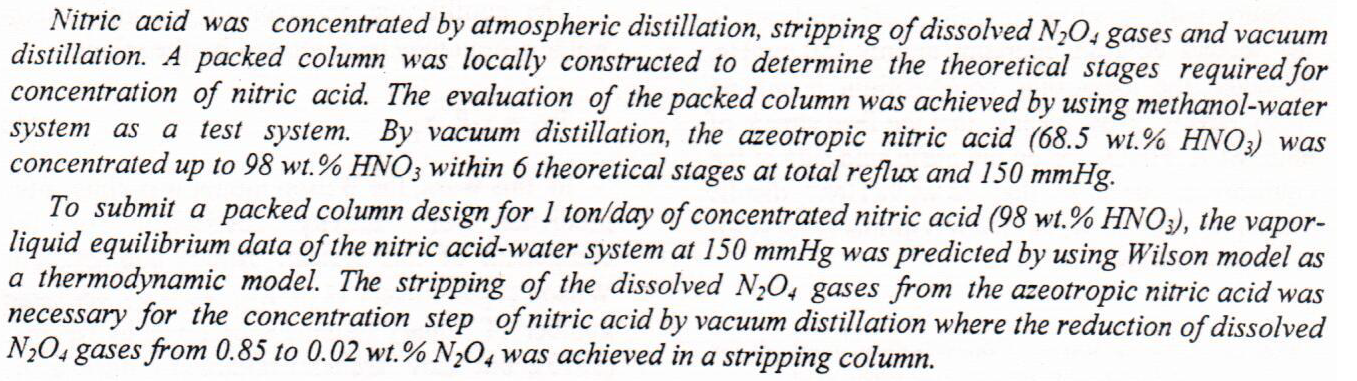
Concentration of Nitric Acid by Vacuum Distillation

This study were implemented on (60) broiler chick with one day age divided into three equal groups , first one was given basal diet while group two and three given adiet contain 0.01% ,0.02% tryptophan respectively for 7 weeks . The results show that the chicks recevd the tryptophan have asigneficant increasment in hemoglobin concentration, red blood cells count, packed cell volume and increased the level of globuline concentration and lymphocyte % which mean that the addition of tryptophan improve blood picture charactores and the immunity of the broiler chickens and this evident from the good health state and decrease the mortality among birds .

Measurements of Hall effect properties at different of annealing temperature have been made on polycrystalline Pb0.55S0.45 films were prepared at room temperature by thermal evaporation technique under high vacuum 4*10-5 torr . The thickness of the film was 2?m .The carrier concentration (n) was observed to decrease with increasing the annealing temperature. The Hall measurements showed that the charge carriers are electrons (i.e n-type conduction). From the observed dependence on the temperature, it is found that the Hall mobility (µH), drift velocity ( d) carrier life time ( ), mean free path (?) were increased with increasing annealing temperature
Background/objectives: Inflammatory mediators such as prostaglandin E2 (PGE2) and nitric oxide (NO) are key indicators of pulp response to mechanical trauma. However, the influence of cavity depth on their release dynamics remains unclear. This study aimed to evaluate the effects of different cavity depths—moderate (without pulp exposure) and deep (with pulp exposure)—on the release of PGE2 and NO in the pulp tissue of rat mandibular incisors at two time intervals (3 and 9 h).Methods: In total, 40 male Wistar rats were divided into two main groups (n = 20) based on cavity depth. A split-mouth design was used, with cavities of different depths prepared on the left mandibular incisors, leaving the right incisors without cavities as
... Show More
 (11)
(11)
 (12)
(12)

Nanostructured Al2O3has been applied as a protective coating against corrosion of the carbon steel (C.S) in seawater environment (3.5% NaCl) at temperatures range (298-328)K. Aluminananoparticles were deposited on carbon steel substrates by cathodic electrophoretic deposition (EPD) with ethanol as suspension medium and poly(acrylic acid) (PAA) as polymeric charging agent. Meanwhile, thesurface morphology was examined using Atomic-force microscopy (AFM). The cross-section AFM showed that the particles sizes for the Al2O3 NPs is around 60-80 nm. The anticorrosion behaviour of coated C.S was investigated in 3.5% NaCl at temperature range 298-328 K by potentiodynamic polarization measurements. Results show that using PAA in suspension coat incr
... Show More
(12)
This article presents the simultaneous adsorption of bimetal Cu2+ and Zn2+ from an aqueous solution using activated carbon synthesized from a plum seed precursor by sulfuric acid and microwave activation: plum seeds chemically activated by 45% (w/w) sulfuric acid with 2:1 ratio for 4 h, then carbonized for 2 h at 700 °C and the product obtained activated in a microwave oven for 20 min at 700 W for final of activation. Plum seeds and activated carbon produced were characterized in terms of their physical and chemical composition using Brunauer–Emmett–Teller measurements, field emission scanning electr
... Show More
(2)
(1)
This research was carried out to determine the impact of heat shock, electric shock and seeds in soaking nitrous acid mutagen solution on three cultivars of faba beans plant (Zaina, Aguadulce and Local) at the year 2012-2013. Factorial experiment was arranged in randomized complete block design (RCBD) with three replicates were used. The results showed that heat shock lead to early plants of 50% in flowering and an increase in the number of branches/plant and the number of seeds/pod compared to other treatments, whereas the seeds soaked in nitrous acid mutagen solution gave the highest plant height, leaf area index, number of pods/plant, seed weight, seed yield kg/ha, and did not differ significantly with treatment of electric shock in the
... Show More
(1)
Pharmaceuticals have been widely remaining contaminants in wastewater, and diclofenac is the most common pharmaceutical pollutant. Therefore, the removal of diclofenac from aqueous solutions using activated carbon produced by pyrocarbonic acid and microwaves was investigated in this research. Apricot seed powder and pyrophosphoric acid (45 wt%) were selected as raw material and activator respectively, and microwave irradiation technique was used to prepare the activated carbon. The raw material was impregnated in pyrophosphoric acid at 80◦C with an impregnation ratio of 1: 3 (apricot seeds to phosphoric acid), the impregnation time was 4 h, whereas the power of the microwave was 700 watts with a radiation time of 20 min. A series o
... Show More
(19)
This work deals with the production of light fuel cuts of (gasoline, kerosene and gas oil) by catalytic cracking treatment of secondary product mater (heavy vacuum gas oil) which was produced from the vacuum distillation unit in any petroleum refinery. The objective of this research was to study the effect of the catalyst -to- oil ratio parameter on catalytic cracking process of heavy vacuum gas oil feed at constant temperature (450 °C). The first step of this treatment was, catalytic cracking of this material by constructed batch reactor occupied with auxiliary control devices, at selective range of the catalyst –to- oil ratio parameter ( 2, 2.5, 3 and 3.5) respectively. The conversion of heavy vacuum gas
... Show More
Many studied were conducted to evaluate the antihepatotoxic and antioxidant activities of Silybum marianum and proved these actions. The Naturally grown seed in Iraqi-Kurdistan Region also were studied for its chemical contents and biological activities. Vegetable oils occur in various plant parts mainly concentrated in the seeds.
In this study comparison was made between the fatty acid patterns of two plant seeds, Silybum marianum and Nigella sativa. Seed sample of Silybum marianum and Nigella sativa were exposed for extraction and isolation of the fatty acid contents using two different solvents (petroleum ether and n-hexane) at 60-80oC using soxhlet apparatus and the oily extract
... Show More
(2)