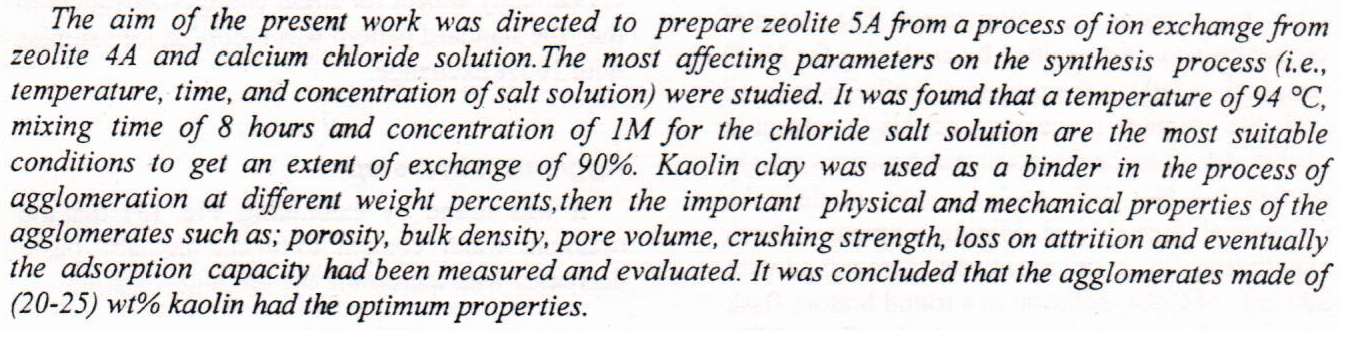
Preparation and Agglomeration of Zeolite 5A from Locally Available Raw Materials

Samarium ions (Sm +3), a rare-earth element, have a significant optical emission within the visible spectrum. PMMA samples, mixed with different ratios of SmCl3.6H2O, were prepared via the casting method. The composite was tested using UV-visible, photoluminescence and thermogravimetric analysis (TGA). The FTIR spectrometry of PMMA samples showed some changes, including variation in band intensity, location, and width. Mixed with samarium decreases the intensity of the CO and CH2 stretching bands and band position. A new band appeared corresponding to ionic bonds between samarium cations with negative branches in the polymer. These variations indicate complex links between the Sm +3 ion and oxygen in the ether group. The optical absorption
... Show MoreNebivolol (NBH) is a third-generation B1-blocker with high selectivity and vasodilation activity. Nevertheless, nebivolol exhibits low oral bioavailability, which may adversely affect its efficacy. Recently, supersaturable self-nanoemulsion (Su-SNE) is an advanced SNE approach that can address low bioavailability The study aims to prepare nebivolol-loaded Su-SNE by reduction the amount of the prepared conventional SNE to half. Besides, an appropriate polymer type and concentration to prevent NBH precipitation upon oral administration have investigated.. A conventional self-nanoemulsion (formula A) was prepared by dissolving NBH in 500 mg vehicle mixture of imwitor®988: cremophor-EL: propylene glycol. Then, eight Su-SNE formul
... Show More (17)
(17)
 (7)
(7)


Nebivolol (NBH) is a third-generation B1-blocker with high selectivity and vasodilation activity. Nevertheless, nebivolol exhibits low oral bioavailability, which may adversely affect its efficacy. Recently, supersaturable self-nanoemulsion (Su-SNE) is an advanced SNE approach that can address low bioavailability The study aims to prepare nebivolol-loaded Su-SNE by reduction the amount of the prepared conventional SNE to half. Besides, an appropriate polymer type and concentration to prevent NBH precipitation upon oral administration have investigated.. A conventional self-nanoemulsion (formula A) was prepared by dissolving NBH in 500 mg vehicle mixture of imwitor®988: cremophor-EL: propylene glycol. Then, eight Su-SNE formulas wit
... Show More
(17)
(7)
The aim of the research is to prepare practical volleyball lessons by using the four pillars strategy for middle school students, and to identify the effect of the four pillars strategy in performing the transmission and volleyball skills in the second intermediate students, to assume that the two researchers assume that there are no statistically significant differences between the results of my skill performance tests Sending and preparing tribal and remote volleyball for the experimental and controlled groups, and there are no statistically significant differences between the results of the performance of the transmission and preparation skills of the volleyball between the two experimental and control groups, and the research co
... Show More
(1)
By- products of corn starch industry were used to prepare media for propagation the lactic acid bacteria as a natural auxotroph. The by- products used were the corn steep water (S) and gluten extract (G) after a proper treatment to get them ready for media preparation. The results showed that it was possible to replace the peptone and meat extract by gluten extract in MRS medium. The growth was approximately similar to that obtained in standard MRS media. Corn steep water (S) was used as well and the growth enhanced by including Tween – 80 at 1% level. The later media named MZ, which was superior for growing standard and local strains and starters. The MZ medium modified by adding acetate and glacial acetic acid similarly to
... Show More
Aceclofenac (AC) is an orally active phenyl acetic acid derivative, non-steroidal anti-inflammatory drug with exceptional anti-inflammatory, analgesic and antipyretic properties. It has low aqueous solubility, leading to slow dissolution, low permeability and inadequate bioavailability. The aim of the current study was to prepare and characterize AC-NS-based gel to enhance the dissolution rate and then percutaneous permeability. NS.s were prepared using solvent/antisovent precipitation method at different drug to polymer ratios (1:1, 1:2, and 1:3) using different polymers such as poly vinyl pyrrolidone (PVP-K25), hydroxy propyl methyl cellulose (HPMC-E5) and poloxamer® (388) as stabilizer
... Show More
(19)
(9)
Lasmiditan (LAS) was formulated as a nanoemulsion based in situ gel (NEIG)with the aim of improving its oral bioavailability via application intranasally. The solubility of LAS in oils, emulsifiers, and co-emulsifiers was determined to identify nanoemulsion (NE)components. Phase diagrams were constructed to identify the area of nanoemulsification. LAS NE was formulated using the spontaneous nanoemulsification method. Four NEs (F19, F24, F31, and F34) containing 7-15 % oleic acid (OA) as an oily phase, 40-55% labrasol (LR), and transcutol (TC) as emulsifier mixture at (1:1), (2:1), (3:1), and (1:2) ratio with 30-53 % (w/w) aqueous phase, having suitable optical transparency of 95–98%, globule size of 104-140 nm and polydisper
... Show More
(10)
(10)
Background: Polymethylmethacrylate (PMMA) has relatively unsatisfactory mechanical properties such as low flexural strength and impact strength also dimensional instability. Material and method: Zirconium silicate nanoparticles were coated with a layer of trimethoxysilylpropylmethacrylate (TMSPM) before sonication in monomer (MMA) with the percentages 1% and 1.5% by weight then mixed with powder using conventional procedure, (150) samples were prepared and divided into three groups, each group consisted of (50) samples, the first group prepared from PMMA without addition (control), another group with the addition of 1% wt Zrsio4 nanoparticles (experimental) and the third one with 1.5% wt Zrsio4 nanoparticles (experimental). Each group
... Show MoreMixed ligand metal complexes of CrIII, FeIII,II, NiII and CuII have been synthesized using 5-chlorosalicylic acid (5-CSA) as a primary ligand and L-Valine (L-Val) as secondary ligand. The metal complexes have been characterized by elemental analysis, electrical conductance, magnetic susceptibility measurements and spectral studies. The electrical conductance studies of the complexes indicate their electrolytic nature. Magnetic susceptibility measurements revealed paramagnetic nature of the all complexes. Bonding of the metal ion through –OHand –COOgroups of bidentate to the 5-chlorosalicylic acid and through –NH2 and –COOgroups of bidentate to the L-valine by FT-IR studies . The agar diffusion method has been used to study the antib
... Show MoreMixed ligand metal complexes of CrIII, FeIII,II, NiII and CuII have been synthesized using 5-chlorosalicylic acid (5-CSA) as a primary ligand and L-Valine (L-Val) as secondary ligand. The metal complexes have been characterized by elemental analysis, electrical conductance, magnetic susceptibility measurements and spectral studies. The electrical conductance studies of the complexes indicate their electrolytic nature. Magnetic susceptibility measurements revealed paramagnetic nature of the all complexes. Bonding