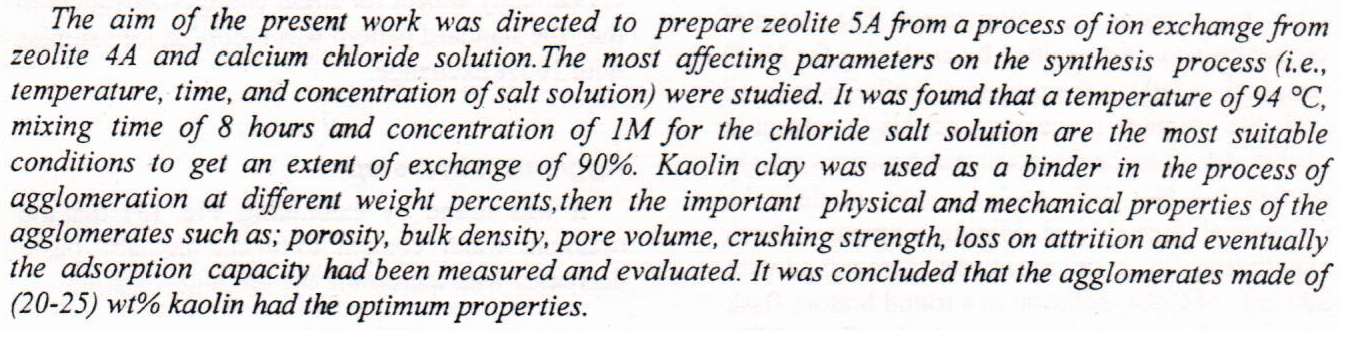
Preparation and Agglomeration of Zeolite 5A from Locally Available Raw Materials

In this research we prepared shiff bases unilateral claw( benzyl imine aniline ) and Bilateral claw ( benzayal-2-imine phenol ) in high purity reach to 98% , which it's prepared from aromatic amine with aldehydes, it's solid,thermosetting, not dissolved in water in general. Diagnosed prepared article by using infra red spectroscopy (IR) which shows azomethen grop at 1640cm-1 At this diagnosis we suggest tetra headral mechanism in this Circumstances For a reaction.

In order to evaluate the effect of seed size, plant growth regulators and some chemical materials on seed vigour and seedling growth of rice (Oryza sativa L.) an experiment was conducted in 2015 at Laboratories of Agriculture and Marshes College, University of Thi-Qar. Factorial experiment in CRD was used with four replications in two factors. The first factor included three seed sizes (4.6-5.1, 5.2-5.7 and 5.8-6.3 mm). The second factor was seeds soaking treatments (KNO3 6 gl-1, CaCl2 20 gl-1, salicylic acid 20 mg l-1, cytokinin 40 mg l-1, gibberllic acid 400 mg l-1, ascorbic acid 40 mg l-1 and seeds soaked in distilled water). The results showed that the largest seed size influenced significantly and gave the higher averages of germinatio
... Show MoreNanomaterials, including nanoparticles such as iron oxide nanoparticles, have received great attention from researchers due to their unique properties and applications. There are several diverse methods, including chemical, physical, and green biological methods, to prepare iron oxide nanoparticles. The green method was chosen because it is safer, purer, and less toxic compared to other methods. Therefore, the green method is a promising and environmentally friendly method in the near future. The aqueous extract of Iraqi orange leaves was used to prepare nano iron oxide, it was examined structurally and spectrally by several techniques (X-ray diffraction- XRD, Fourier transform infrared - FT-IR, field emission scanning electron micr
... Show More

 (8)
(8)
 (6)
(15)
(6)
(15)
Background: Polymeric composites have been widely used as dental restorative materials. A fundamental knowledge and understanding of the behavior of these materials in the oral cavity is essential to improve their properties and performance. The goal of this study was to measure water sorption of four composite resins containing different filler and resin matrix contents. Materials and method: Resin composite specimens giomer (Beautifil II) Filtek™ P90, Filtek™ Z350 XT, and Tetric N Ceram were prepared in a cylindrical mould of 3mm thickness and 6mm diameter (n=10) and light cured . All specimens placed in silica-gel desiccators at 37˚C for seven days, a constant weight was obtained. All samples were immersed in deionized distill
... Show MoreBackground: The microhardness of a composite resin is a vital parameter that is used to determine its clinical behavior. Measuring the microhardness of a composite resin has been used as an indirect method to assess its degree of conversion and extent of polymerization. The purpose of this in vitro study was to evaluate the effect of three curing distances (0, 2, and 4 mm) on the microhardness of the top and bottom surfaces of three types of flowable bulk-fill composite resins (smart dentin replacement, Opus bulk fill flow, and Tetric N). Material and method: Sixty-three specimens from the three types of composite resins (n=21) were fabricated using Teflon mold with a 4mm depth and a 5 mm internal diameter and cured for 20 seconds. For e
... Show More
(3)
(1)
Background: Fracture of different types of acrylic denture base is a common problem associated with dental prosthesis. Studies suggested that the repair strength may be improved by several means including surface treatment with chemical agents. The aim of the study was to evaluate the effect of surface treatment with acrybond-bonding agent and monomer on fractured denture base in respect to transverse, tensile and shear bond strength and evaluation of the mode of failure by light microscope. Materials and methods: Two hundred seventy specimens were prepared and divided into 3 groups according to the material used (regular conventional, rapid simplified and high impact) heat cure acrylic. The specimen in each groups were prepared specificall
... Show MoreAl-Si alloys which are widely used in engineering applications due to their outstanding properties can be modified for more enhancements in their properties. Current work investigated the ability of these alloys to be modified by casting them through the addition of nanoparticles. So, Multi-wall carbon nanotubes (CNT) and titanium carbide ceramic particles (TIC) with size of (20 nm) were added with different amounts started from (0.5 up to 3%) weight to cast alloy A356 that was considered to be the base metal matrix, then stirred with different speeds of (270, 800, 1500, 2150) rpm at 520 °C for one minute. The results showed change in microstructure’ shape of the casted alloys from the dendritic to spherical gra
... Show More