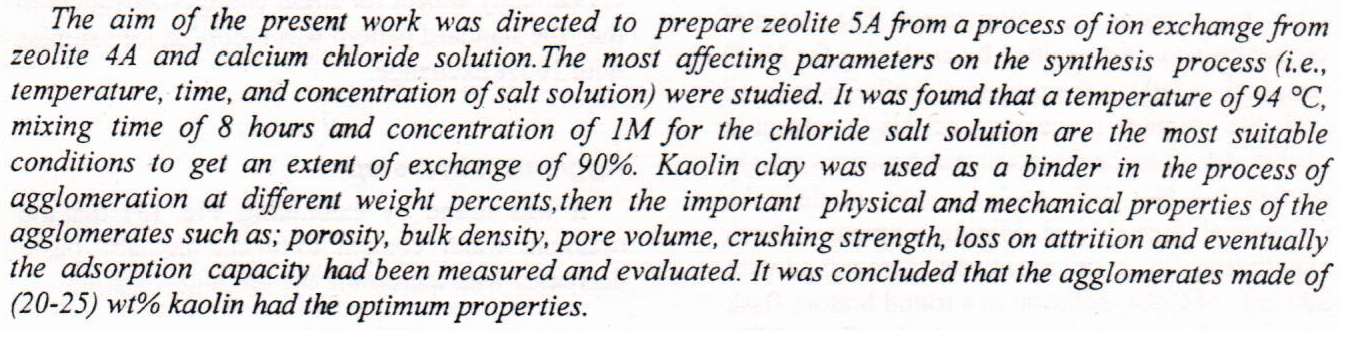
Preparation and Agglomeration of Zeolite 5A from Locally Available Raw Materials

Magnetic plaster kiln dust (MPKD) was synthesized as a unique, low-cost composite reused of byproduct plaster kiln dust (PKD), which is considered a source of air pollution. The FESEM, EDS, XRD, FTIR, VSM, and BET tests were used to characterize the MPKD. The characterization revealed that the MPKD was nanotubes non-agglomerated and super-paramagnetic with a high specific surface area (102.7 m2/g). Compared with the specific area of other materials (composites), the MPKD could be considered a promising substance in the field of water/wastewater treatment.
 (1)
(1)

Clotrimazole (CLO) is an antimycotic imidazole derivative applied locally for the treatment of vaginal yeast infections. In this study, CLO was formulated as vaginal mucoadhesive hydrogel, using different types of mucoadhesive polymers to ensure prolonged contact between active ingredient and vaginal mucosa.
Physicochemical properties of the prepared formulas were evaluated as a visual inspection, pH, swelling index, spreadability, and mucoadhesive characteristics, in addition to an in-vitro drug release. The influence of type and concentration of polymers as CMC-Na (1.5, 2.5, and 3.5%w/w), carbopol 940( 0.25, 0.5, and 1 %w/w) and poloxamer 407 (15, 25, 30%w/w) on CLO release from the prepared gels were also invest
... Show More
(2)
The effective surface area of drug particle is increased by a reduction in the particle size. Since dissolution takes place at the surface of the solute, the larger the surface area, the further rapid is the rate of drug dissolution. Ketoprofen is class II type drug according to (Biopharmaceutics Classification System BCS) with low solubility and high permeability. The aim of this investigation was to increase the solubility and hence the dissolution rate by the preparation of ketoprofen nanosuspension using solvent evaporation method. Materials like PVP K30, poloxamer 188, HPMC E5, HPMC E15, HPMC E50, Tween 80 were used as stabilizers in perpetration of differ
... Show More
(11)
Nanosponges (NS) of etodolac(ETO) was prepared using the emulsion solvent diffusion method ; the effects of drug: polymer ratio, the effect of level concentration of internal phase and stirring time and other variables that effect on the physical characteristics of NS were investigated and characterized, The selected formula was lyophilized then incorporated into hydrogel ; which also evaluated .The results show that the formulation that contain Drug: PVA:EC in ratio 1:3:2 is the best with smallest particle size 40.2±0.098 with polydispersibility0.005 and in vitro release 97.6±0.11%, , ETO NS Carbopol hydrogel produced a significant(p<0.05) improvement of the in vitro release than pure ETO hydrogel.
 (22)
(12)
(22)
(12)

Purpose: The diagnosis and determine the level of balance between the time available for life and work with the doctors in the hospitals of t the six hospitals in the City of Medicine.
Design / methodology / Approach: It has been relying on ready-scale, to make sure the diagnosis and determine the level of balance between the time available for life and work, where they were distributed on Form 42 doctors in the six hospitals in the City of Medicine, were analyzed by software (Nvivo and SPSS v.22).
Results: The results showed that there is a good level of balance between the time available for life and work with the doctors.
Research limitations: The diffi
... Show More
MCM-48 zeolites have unique properties from the surfaces and structure point of view as it’s shown in the results ,and unique and very sensitive to be prepared, have been experimentally prepared and utilized as a second-generation/ acid - catalyst for esterification reactions of oleic acid as a model oil for a free fatty acid source with Ethanol. The characterization of the catalyst used in the reaction has been identified by various methods indicating the prepared MCM-48 is highly matching the profile of common commercial MCM-48 zeolite. The XRF results show domination of SiO2 on the chemical structure with 99.1% and agreeable with the expected from MCM-48 for it's of silica-based, and the SEM results show the cubic c
... Show More
(5)
A numerical method (F.E.)was derived for incompressible viscoelastic materials, the aging and
environmental phenomena especially the temperature effect was considered in this method. A
treatment of incompressibility was made for all permissible values of poisons ratio. A
mechanical model represents the incompressible viscoelastic materials and so the properties can
be derived using the Laplace transformations technique .A comparison was made with the other
methods interested with viscoelastic materials by applying the method on a cylinder of viscoelastic material surrounding by a steel casing and subjected to a constant internal pressure, as well as a comparison with another viscoelastic method and for Asphalt Concrete pro
The hydroconversion of Iraqi light straight run naphtha was studied on zeolite catalyst. 0.3wt.%Pt/HMOR catalyst was prepared locally and used in the present work. The hydroconversion performed on a continuous fixed-bed laboratory reaction unit. Experiments were performed in the temperature range of 200 to 350°C, pressure range of 3 to 15 bars, LHSV range of 0.5-2.5h-1, and the hydrogen to naphtha ratio of 300.
The results show that the hydroconversion of Iraqi light straight naphtha increases with increase in reaction temperature and decreases with increase in LHSV.
High octane number isomers were formed at low temperature of 240°C. The selectivity of hydroisomerization improved by increasing reaction pressu
... Show MoreThe catalytic activity of faujasite type NaY catalysts prepared from local clay (kaolin) with different Si/Al ratio was studied using cumene cracking as a model for catalytic cracking process in the temperature range of 450-525° C, weight hourly space velocity (WHSV) of 5-20 h1, particle size ≤75μm and atmospheric pressure. The catalytic activity was investigated using experimental laboratory plant scale of fluidized bed reactor.
It was found that the cumene conversion increases with increasing temperature and decreasing WHSV. At 525° C and WHSV 5 h-1, the conversion was 42.36 and 35.43 mol% for catalyst with 3.54 Si/Al ratio and Catalyst with 5.75 Si/Al ratio, respectively, while at 450° C and at the same WHSV, the conversion w
In the present study the performance of drying process of dffirent solid materials by batch fluidized bed drying
under vacuum conditions was investigated. Three, different solid materials, namely; ion exchange resin-8528,
aspirin and paracetamol were used. The behavior of the drying curves as well as the rate of drying of these
materials had been studied. The experiments were caried out in a 0.0381 m column diameter fluidized by hot
air under yacuum conditions. Four variables affecting on the rate of drying were studied' these variables are
vacuum pressure (100 - 500 mm Hg), air temperature (303-323 K), particle size (0.3-0.8 mm) and initial
moisture content (0.35-0.55 g/g solid)-for resin and (0.1-0.2 g/g soltid) for a