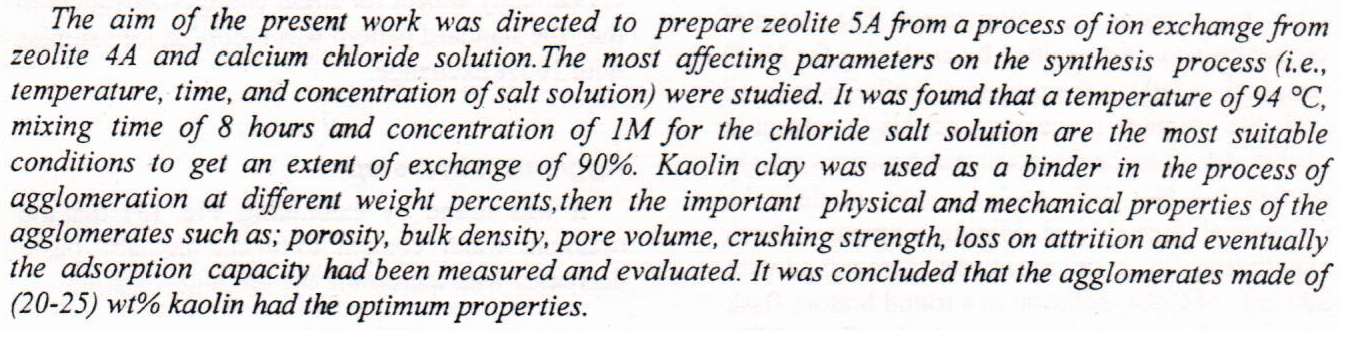
Preparation and Agglomeration of Zeolite 5A from Locally Available Raw Materials

In this work, silver (Ag) self-metallization on a polyimide (PI) film was prepared through autocatalytic plating. PI films were prepared through the solution casting method, followed by etching with potassium hydroxide (KOH) solution, sensitization with tin chloride (SnCl2), and the use of palladium chloride (PdCl2) to activate the surface of PI. Energy-dispersive X-ray analysis (EDX) showed the highest peak in the (Ag) region and confirmed the presence of AgNPs. The diffraction peaks at 2θ = 38.2°, 44.5°, 64.6°, and 78.2° represented the 111, 200, 220, and 311 planes of Ag, respectively. The FT–IR an
... Show More (6)
(6)
 (2)
(2)



In this study, polymeric ultrafiltration (UF) membranes were prepared by phase inversion method to obtain both antibacterial and organic antifouling properties. The membranes were cast from a solution of polyvinylidene fluoride (PVDF) and formative silver (Ag) nanoparticles were successfully immobilized on a polymer. This was done using a solvent N, N-dimethylformamide (DMF) which is a solvent for the PVDF polymer meanwhile it is a reducing agent for silver ion. The effect of silver nanoparticles additives on the performance of polymeric ultrafiltration membrane was verified. Chemical composition and morphology of the surfaces of the membranes were characterized by Fourier transform infrared spectroscopy
... Show More
(9)
Some new heterocyclic compounds containing, cyclohexenone, indazole, isoxazoline, pyrmidine and pyrazoline ring system were prepared from chalcones (1a,b). The starting chalcones (1a,b) were obtained by a base catalyzed condensation of appropriately substituted benzaldehydes and 2-acetylbenzofuran. The reaction of the prepared chalcones with ethylacetoacetate/hydrazine hydrate, hydroxylamine hydrochloride, urea, thiourea, hydrazine hydrate, phenyl hydrazine or hydrazide derivatives gave the mentioned heterocycles. All synthesized compounds have been characterized by physical and spectral methods.
Zinc Oxide (ZnO) is probably the most typical II-VI
semiconductor, which exhibits a wide range of nanostructures. In
this paper, polycrystalline ZnO thin films were prepared by chemical
spray pyrolysis technique, the films were deposited onto glass
substrate at 400 °C by using aqueous zinc chloride as a spray
solution of molar concentration of 0.1 M/L.
The crystallographic structure of the prepared film was analyzed
using X-ray diffraction; the result shows that the film was
polycrystalline, the grain size which was calculated at (002) was
27.9 nm. The Hall measurement of the film studied from the
electrical measurements show that the film was n-type. The optical
properties of the film were studied using
(42)
(38)
Four batches of sertraline HCl microspheres were prepared using a poly (D-L-lactide-co-glycolide) (PLGA) polymer ( Mw. 9, 27, 30 and 83 KDa) as a delivery system. The microspheres were prepared by a dispersion/solvent extraction-evaporation method and characterized for drug loading by UV, particle size by laser diffractometry and surface morphology by scanning electron microscopy (SEM). The in vitro sertraline HCl release was studied. Spherical microspheres with a mean diameter of 21 to 26 µm loaded with 24.6 – 38.2% were produced. The in vitro drug release was shown to be depend on polymer molecular weight and also on the drug loading. Differential scanning calorimetry (DSC) was employed to investigate the physical state
... Show More
In this research four steps of the new derivatives of Naproxen drug have been made which are known as a high medicinal effectiveness; the first step involved converting Naproxen into the corresponding ester (A) by reaction Naproxen with methanol absolute in presence H2SO4. While the second step involved treatment methyl Naproxen ester (A) with hydrazine hydrate 80% in presence of ethanol .The third reaction requires synthesis of Schiff bases (C1-C10) by condensation. of Naproxen hydrazide (B) with many substituted aromatic aldehydes . Finally, the fourth step synthesized new tetrazole derivatives ( D1- D10) by the reaction of the prepared Schiff bases (in the third step) with Sodium azide in THF as a solvent .The prepared compounds wer
... Show More
(3)
This study was carried out to prepare and characterize domperidone nanoparticles to enhance solubility and the release rate. Domperidone is practically insoluble in water and has low and an erratic bioavailability range from 13%-17%. The domperidone nanoparticles were prepared by solvent/antisolvent precipitation method at different polymer:drug ratios of 1:1 and 2:1 using different polymers and grades of poly vinyl pyrolidone, hydroxy propyl methyl cellulose and sodium carboxymethyl cellulose as stabilizers. The effect of polymer type, ratio of polymer:drug, solvent:antisolvent ratio, stirring rate and stirring time on the particle size, were investigated and found to have a significant (p? 0.05) effect on particle size. The best formul
... Show More
(21)
Objective: To assess the major anti-tuberculosis drugs available to patients at primary health care centers in Baghdad city. Methodology: A descriptive cross-sectional study design is carried out in order to achieve the objectives of the study by using the assessment technique in primary health care centers from December 29th, 2014 to July 10 th, 2015. probability sampling is select based on the study design. Eighteen primary health care centers are select according to criteria of sample to the study and for the purpose of the study, is select (6) sectors and (11) Primary Health Care Centers (PHCC) from Bagh
A method has been demonstrated to synthesise effective zeolite membranes from existing crystals without a hydrothermal synthesis step.
(29)
(26)