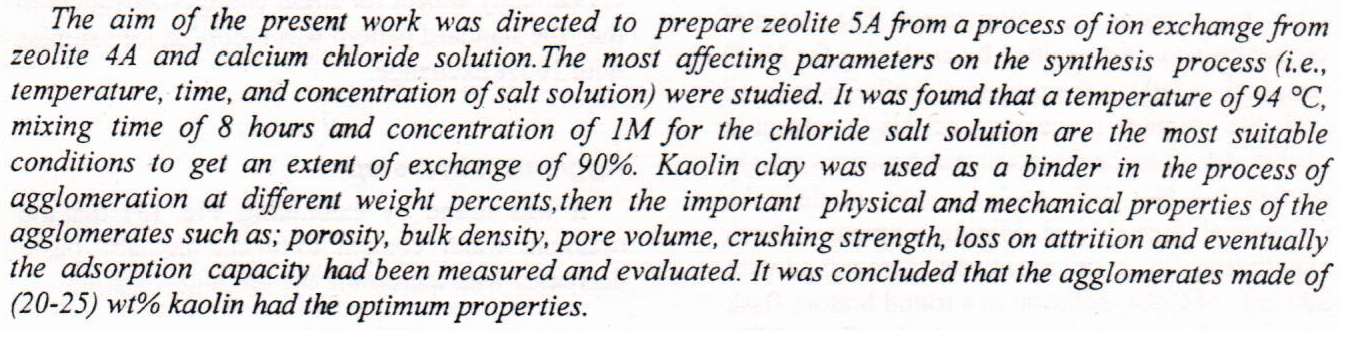
Preparation and Agglomeration of Zeolite 5A from Locally Available Raw Materials

The purpose of my thesis is to synthesis two new bidentate ligands which were used to prepare series of metal complexes by reacting the ligands with (M+2 = Mn, Co, Ni, Cu, Cd and Hg) Succinyl chloride was used as starting material to synthesis two bidentate ligands (L1) and (L2) by reaction it with 4-chloroaniline (L1) and (4-aminoacetophenone) (L2) in dichloromethane as a solvent, that are: (L1) = N1,N4-bis (4-chloro phenyl ) succinamide (L2) =N1,N4-bis(4-acetylphenyl)succinamide The new ligands were characterize by using spectroscopic study (Fourier-transform infrared spectroscopy (FT-IR), electronic spectra ( UV-Vis) ,nuclear magnetic resonance(1H,13C-NMR), Mass spectra
... Show MoreThe formation of a Schiff-base with N2O2 donor atoms derived from the hydrazine segment and its metal complexes are reported. The Schiff-base ligand; N’-((1R,2S,4R,5S,Z)-2,4-diphenyl-3-azabicyclo[3.3.1]nonan-9-ylidene)furan-2-carbohydrazide (HL) was prepared from the reaction of furan-2-carbohydrazide with (1R, 2R, 4R, 5S)-2,4-diphenyl-3-azabicyclo[3.3.1]nonan-9-one (M1) in ethanol medium. The reaction of the title ligand with selected metal ions Cr(III), Mn(II), Ni(II), Cu(II), Zn(II) and Cd(II) gave complexes with the general formula [M(L)Cl2], (where: M = Cr(III), Mn(II), Ni(II), Cu(II), Zn(II) and Cd(II)). Spectroscopic analyses Fourier transform infrared (FT-IR), Nuclear Magnetic Resonance (NMR) Carbon-13 nuclear magnetic res
... Show More (6)
(6)
 (3)
(3)


The study aimed to know the degree of availability of integrated preparation criteria in the Arabic Teacher training Program in Syrian universities from the viewpoint of university students of the Educational qualification diploma, and the degree of availability of these standards in the outputs of the preparation program. To achieve the Goals of the study, a list of integrated preparation criteria was prepare comprising (110) indicators, distributed to (11) criteria. The list was applied to a randomly chosen sample of (45) educational qualification diploma students. The results of the study showed that the Standards for integrated preparation are provided in a medium degree overall in the program for preparing teachers of Arabic languag
... Show More
Antibacterial activity of CNSs against Staphylococcus aureus and Escherichia coli was estimated. Higher inhibition zone of 18 mm and 20 mm were observed against S. aureus and E.coli, respectively, at a concentration of 2 mg/ml of carbon nanosphere after 24 hrs of incubation at 37 ºC. In vitro cytotoxicity experiment was performed on two parasite strains of Leishmania donovani and Leishmania tropica by using MTT assay. L. donovani revealed more sensitiv to the CNSs than L. tropica. An intermediate level of cytotoxicity of 51.31 % was observed when 2.4 mg/ml of CNSs was incubated with L. donovani, while weak cytotoxicity of 37.20 % was shown when the
... Show More
(2)

ABSTRACT
The effect of adding raw bacteriocin produced by Lactobacillus bulgaricus to cheese curd at an amount of (5 and 10 and 15) mL/kg cheese as a biological preservative to prolong the shelf life of soft cheese, in addition to the control treatment, knowing that each 1 mL of bacteriocin filter contains 15 units/ mL of bacteriocin. The results of the physicochemical, microbial and sensory tests for cheese stored at refrigerator temperature for a period (zero) to (21) d of adding bacteriocin showed the superiority of the treatment of cheese added to 15 mL/kg cheese of bacteriocin over the rest of the other treatments during the storage period, wh
... Show MoreThe preparation of activated carbon (AC) from date stones by using microwave assisted K2CO3 activation was investigated in this paper. The influence of radiation time, radiation power, and impregnation ratio on the yield and methylene blue (MB) uptake of such carbon were studied. Based on Box-Wilson central composite design, two second order polynomial models were developed to correlate the process variables to the two responses. From the analysis of variance the significant variables on each response were identified. Optimum coditions of 8 min radiation time, 660 W radiation power and 1.5 g/g impregnation ratio gave 460.123 mg/g MB uptake and 19.99 % yield. The characteristics of the AC were examined by pore structure analysis, and scan
... Show MoreThis study was done to find a cheap, available and ecofriendly materials that can remove eosin y dye from aqueous solutions by adsorption in this study, two adsorbent materials were used, the shells of fresh water clam (Cabicula fluminea) and walnut shells. To make a comparison between the two adsorbents, five experiments were conducted. First, the effects of the contact time, here the nut shell removed the dye quickly, while the C. flumina need more contact time to remove the dye. Second, the effects of adsorbent weight were examined. The nut shell was very promising and for all used adsorbent weight, the R% ranged from 94.87 to 99.29. However C. fluminea was less effective in removing the dye with R% ranged from 47.59 to 55.39. The thi
... Show More
(5)
(3)
Two types of adsorbents were used to treat oily wastewater, activated carbon and zeolite. The removal efficiencies of these materials were compared to each other. The results showed that activated carbon performed some better properties in removal of oil. The experimental methods which were employed in this investigation included batch and column studies. The former was used to evaluate the rate and equilibrium of carbon and zeolie adsorption, while the latter was used to determine treatment efficiencies and performance characteristics. Expanded bed adsorber was constructed in the column studies. In this study, the adsorption behavior of vegetable oil (corn oil) onto activated carbon and zeolite was examined as a function of the concentr
... Show MoreThe objective of this study is to determination the content of some heavy metals (lead, cadmium, chromium) in colored tattoo stickers. twelve kinds of colored tattoo stikcers were collected from Baghdad markets, it was estimated heavy metals using atomic absorption spectrophotometer (Shimadzu A5000). The results indicated the concentrations of lead in all samples (1.61_1.00 mg / kg) and chromium in the three samples (0.85_0.97 mg / kg) while other samples are free of chromium , and cadmium. These elements are the components of printing inks and dyes in tattoo stickers, and this does not conform to the health and safety conditions for the packaging of food according to the organizations of the health and safety of
... Show More