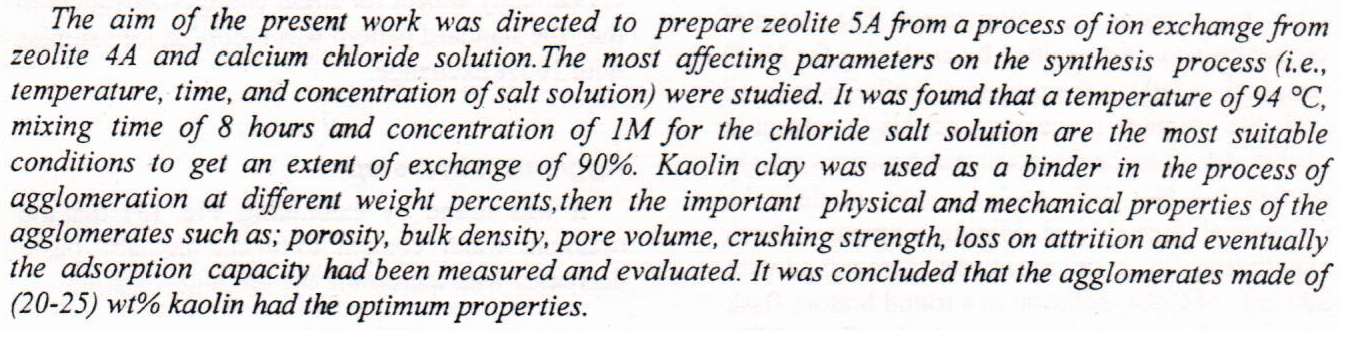
Preparation and Agglomeration of Zeolite 5A from Locally Available Raw Materials

A new Species of the Cerambycinae belonging to the genus Hesperophanes was found new to the fauna of Iraq and Science. H. testaceus was studied in details and the male genitalia were illustrated. Type's paratypes and the locality of this newly described Species were mentioned.
SYNTHESIS AND CHARACTERISATION OF NEWCo(II), Zn(II) AND Cd(II) COMPLEXES DERIVED FROM OXADIAZOLE LIGAND AND 1,10-PHENANTHROLINE AS Co-LIGAND
 (1)
(1)

In this work, prepared new ligand namely 5-(2,4-dichloro-phenyl)-1,3,4-oxadiazole-2-(3H)-thion, was obtained from the 2,4-dichlorobenzoyl chloride with hydrazine, after that reaxtion with CS2/KOH in methanol.
The ligand [Potassium (E)-(4-(((2-((1-(3-aminophenyl) ethylidene) amino)-4-oxo-1, 4-dihydropteridin-6-yl) methyl) amino) benzoyl)-L-glutamate] was prepared from the condensation reaction of folic acid with (3-aminoacetophenone) through Schiff reaction to give a new Schiff base ligand [H2L]. The ligand [H2L] was characterized by elemental analysis CHN, atomic absorption (AA),(FT-IR),(UV-Vis), TLC, ES mass (for spectroscopes), molar conductance, and melting point. The new Schiff base ligand [H2L], reacts with Mn (II), Co (II), Ni (II), Cu (II), Cr (III) and Cd (II) metal ions and (2-aminophenol),(metal: derivative ligand: 2-aminophenol) to give a series of new mixed complexes in the general formula:-K3 [M2 (HL)(HA) 2],(where M= Mn (II) and Cd
... Show MoreThis research concentrate on cultivated Iraqi Agave attenuata dried leaves and roots, because of little studies on this plant especially on the root that lead to the eager of study and comparison of phytochemical constituents between leaves and root. Extraction of bioactive constituents was carried out using several solvents with increasing polarity (n-hexane, ethyl acetate and methanol) by soxhlet apparatus. Steroidal saponins in Agave genus is well documented in many species, lightening the minds in this research on extraction method which is specific for steroidal saponins. Phytochemical screening was done by GC/MS for n-hexane fraction, qualitative and quantitative estimation of several bioactive constituents (caffe
... Show More
(14)
 (2)
(2)

A total of 60 cotton swabs are collected from patients suffering from burn wound and surgical site infections admitted to Baghdad Teaching Hospital and Burn Specialist Hospital in Baghdad city during 9/2013 to 11/2013. All cotton swabs are cultured initially on blood agar and MacConkey agar and subjected for standard bacteriological procedures for bacteriological diagnosis. Twenty samples out of sixty are identified as Pseudomonas aeruginosa by conventional methods. The results of antibiotic susceptibility test illustrate that the antibiotics resistance rate of Pseudomonas aeruginosa isolates is as follows:100% (2020) for ceftriaxone, cefepime and carbencillin, 70% (14/20) for amikacin, 65%(13/20) for tobramycin, ceftazidim and gentamycin,
... Show More
(1)
From the sustainability point of view a combination of using water absorption polymer balls in concrete mix produce from Portland limestone cement (IL) is worth to be perceived. Compressive strength and drying shrinkage behavior for the mixes of concrete prepared by Ordinary Portland Cement (O.P.C) and Portland limestone cement (IL) were investigated in this research. Water absorbent polymer balls (WAPB) are innovative module in producing building materials due to the internal curing which eliminates autogenous shrinkage, enhances the strength at early age, improve the durability, give higher compressive strength at early age, and reduce the effect of insufficient external curing. Polymer balls (WAPB) had been used in the mixes of thi
... Show MoreBackground: A great dental and biomedical interest had been paid to silver nanoparticles because of their antimicrobial activity. Objective: To evaluate the antimicrobial and cytotoxic activity of a newly developed Nano-silver fluoride that was synthesized from moringa oleifera leaf extract against S. mutants. Material and method: The green synthesis method was used to prepare Nano-silver fluoride from moringa oleifera leaf extract. The minimum inhibitory concentration and the minimum bactericidal concentration were evaluated using brain heart infusion plates, while the cytotoxicity was evaluated by the hemolytic activity. Results: Nano-silver fluoride had a bactericidal and bacteriostatic effect (MIC was 60 ppm and MBC was 120 pp
... Show More
(10)
(6)