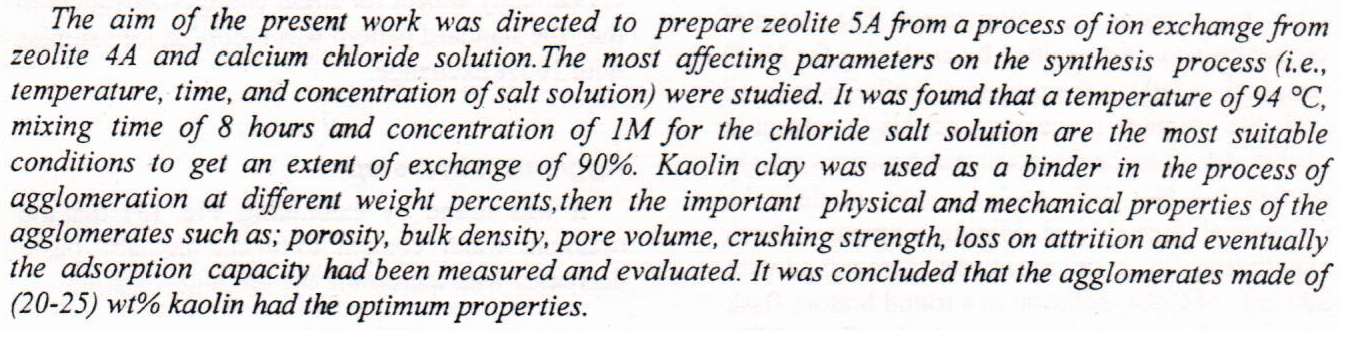
Preparation and Agglomeration of Zeolite 5A from Locally Available Raw Materials

Metal complexes of Mn(II), Co(II), Ni(II), Cu(II), Cd(II), Zn(II), Hg(II), Pd(II), and Pt(II) with Schiff base ligand (LH) derived from 2,5-dichloroaniline and 2-hydroxy-5-metheylbenzalaldehyde were synthesized and characterized using a variety of spectrophotometric techniques The findings of the spectroscopic analysis indicated that (LH) behaved as a binary coordinating agent to the metal ion by the N and O atoms, and the geometry shape of the complexes was octahedral, with the exception of the Pd and Pt complexes, which had a square planar geometry. Using the DPPH radical scavenging method, we investigated the antimicrobial activity of the compound against Staphylococcus aureus and Escherichia coli, as well as the antifungal activity of t
... Show MoreThe mixed ligand complexes of Schiff base ligand (Z)-2-(((4-bromo-2-methylphenyl) imino) methyl)-4-methylphenol (L) with some metals ion (II); Mn(1), Co(2), Ni(3), Cu(4), Zn(5) Cd(6) and Hg(7) and 1,10-Phenanthroline (phen) were Synthesis and characterized by the mass and 1HNMR spectrometry (ligand Schiff base), the FTIR, UV-visible and the flame atomic absorption (A.A) spectrum, the C.H.N analysis and the chlorine content, in addition to measuring the magnetic sensitivity of the complexes. All the complexes had octahedral geometry. The bioactivity activity for compounds against; Rhizopodium, Staphylococcus aureus and Escherichia coli, the compounds showed different efficacy towards these microorganisms
In the present research the flame retardancy to buildings and industrial foundations which are manufacturing from advanced polymeric composite material was increased by coating it with surface layer included flame retardant material. A(3mm) thick antimony tetroxide was used as a coated layer to retard and prevent the flame spread to the coating surface of polyester resin (SIROPOL 8340-PI) reinforced with hybrid fibers as a woven roving (°45-°0) consist of carbon and kevlar (49) fibers, and exposed it to direct flame generated from gas torch at temperature of (2000ºC), at different exposed distance (10,15,20mm)and study the rang of resistance for this layer and its ability to protec
... Show MoreThe aim of this paper was to investigate the removal efficiencies of Zn+2 ions from wastewater by adsorption (using tobacco leaves) and forward osmosis (using cellulose triacetate (CTA) membrane). Various experimental parameters were investigated in adsorption experiment such as: effect of pH (3 - 7), contact time (0 - 220) min, solute concentration (10 - 100) mg/l, and adsorbent dose (0.2 - 5)g. Whereas for forward osmosis the operating parameters studied were: draw solution concentration (10 - 150) g/l, pH of feed solution (4 - 7), feed solution concentration (10 - 100) mg/l. The result showed that the removal efficiency by using adsorption was 70% and the removal efficiency by using forward osmosis was 96.2 %.
... Show MoreAbstract Background: Multidrug-resistant bacteria (MDR) often contaminate hospital environment and cause serious illnesses. Quorum Sensing (QS) regulates a variety of downstream cellular processes, including antibiotics resistance mechanisms and biofilm formation, and causes harm to the host. This study investigates antibacterial susceptibility and biofilm formation of pathogenic bacteria in hospital environment. Methods: Hundred bacterial isolates were collected from various environments in the Medical City hospital. The antimicrobial susceptibility technique was evaluated through disk diffusion method. Next, biofilms formation was detected by the microliter plate assay. Finally, PCR was used to analyze the frequency of QS system gene
... Show More (2)
(2)

Many stone tools were found on a hill south of the Hor Al-Dalmaj which is located in the central part of the alluvial plain of Mesopotamia, between the Tigris and Euphrates Rivers. The types of rocks from which the studied stone tools were made are not found in the alluvial plain, because it consists of friable sand, silt, and clay. All existing sediments were precipitated in riverine environments such as point bar, over bank, and floodplain sediments. The collected stone tools were described with a magnifying glass (10 x) and a polarized microscope after they were thin sectioned. Microscopic analysis showed that these stone tools are made of sedimentary, volcanic igneous and metamorphic rocks, such as: sandstones, limestones, chert, con
... Show More
(1)

A qualitative chemical test was performed on functional groups extracted from fenugreek plant and its extracts (aqueous, alcoholic and volatile oil). Results revealed that fenugreek seeds contain the main functional groups, while extracts are varied accorodihg to their content of functional groups qualitatively and quantitively. Moreover, inhibition activity was tested for extracts of fenugreek seeds (aqueous, alcoholic and volatile oil). against gram negative (Salmonella typhimurium, Escherichia coli and Pseudomonas aeruginosa) and gram positive (Staphylococcus aureus) by the ager well diffusion method. Data have revealed that inhibition activity was different in accoradance with extract solvent and the tested microorgan. Oil extract (15)%
... Show MoreTitanium oxide nanoparticles-modified smectite (SMC-nTiO2) as a low-cost adsorbent was investigated for the removal of Rhodamine B (RhB) from aqueous solutions. The adsorbents (SMC and SMC-nTiO2) were characterized by scanning electron microscopy, Fourier transforms infrared spectroscopy, and energy-dispersive X-ray spectroscopy. The effects of various parameters like contact time, adsorbent weight, pH, and temperatures were examined. Three kinetic equations (pseudo-first-order (PFO), pseudo-second-order (PSO), and intra-particle diffusion) were used to evaluate the experimental kinetic of the data and the results showed that the adsorption process is in line with the PSO kinetic model. Adsorption equilibrium isotherms were modeled using La
... Show MoreCitrus fruit contain variety of flavonoids such as Hesperidin (the principal flavonoid in oranges and grapefruit). Hesperidin is found in high concentration in fruit peel of oranges and in substantially lower concentration in juice of these fruits. Hesperidin was extracted from oranges peel by treating the peels with calcium hydroxide. HPLC technique was used to determine hesperidin. Hesperidin was saperated and purified in a purity of about 90.1-95.7% and yield about 1.5 %w/w from oranges peel dry powder. Both hesperidin and oranges peel extract showed significan antibacterial activity. Sensitivity to hesperidin and oranges peel extracts were not similar for the chosen bacteriaCrude orange peel extract gave a various antimicro
... Show More (1)
(1)
