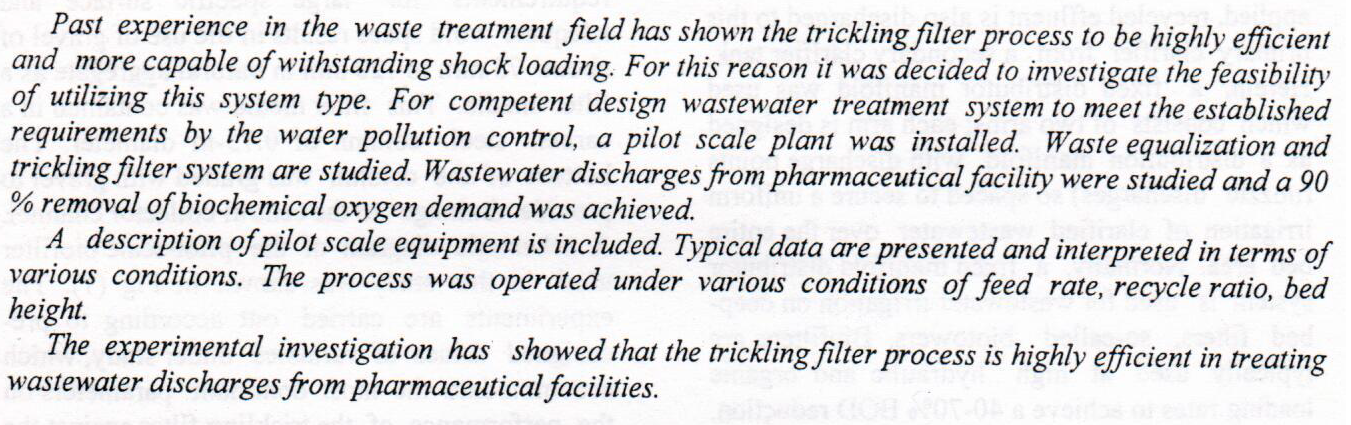
Study the Characteristic Performance of Trickling Filter for Pharmaceutical Waste Treatment

 (1)
(1)


The electrode in the microbial fuel cell has a significant effect on cell performance. The treatment of the electrode is a crucial step to make the electrode surface more habitable for bacteria growth, thus, increases the power production as well as waste treatment. In the current study, two graphite electrodes were treated by a microwave. The first electrode was treated with 100W microwave energy, while the second one was treated with 600W microwave energy. There is a significant enhancement in the surface of the graphite anode after the pretreatment process. The results show an increase in the power density from 10 mW/m2 to 15 mW/m2 with 100w treatment and to 13.47 mW/m2 with 600w treatment. An organic
... Show More (4)
(3)
(4)
(4)
(3)
(4)

Objectives: This study aimed to evaluate and compare the effect of plasma treatment versus conventional treatment on the micro shear bond strength (μSBS), surface roughness, and wettability of three different CAD/CAM materials. Materials and methods: Sixty cylindrical specimens (5 mm diameter ×3 mm height) were prepared from three different CAD/CAM materials: Group A: Zirconia, Group B: Lithium disilicate, and Group C: Resin nano-ceramic. Each group was subdivided into two subgroups according to surface treatment used: Subgroup I: Conventional treatment, zirconia was sandblasted with Al2O3, while lithium disilicate and resin nano-ceramic were etched with hydrofluoric acid. Subgroup II: Plasma treatment, the surface of each material was tr
... Show More
(19)
(13)
KE Sharquie, AA Noaimi, AM Oweid, JSSDDS, 2009 - Cited by 2
A spectrophotometric method has been proposed for the determination of two drugs containing phenol group [phenylephrine hydrochloride (PHP) and salbutamol sulphate (SLB)] in pharmaceutical dosage forms. The method is based on the diazotization reaction of metoclopramide hydrochloride (MCP) and coupling of the diazotized reagent with drugs in alkaline medium to give intense orange colored product (?max at 470 nm for each of PHP and SLB). Variable parameters such as temperature, reaction time and concentration of the reactants have been analyzed and optimized. Under the proposed optimum condition, Beer’s law was obeyed in the concentration range of 1-32 and 1-14 ?g mL-1 for PHP and SLB, respectively. The limit of detection (LOD) and l
... Show More
(2)
(1)
Two simple, rapid, and useful spectrophotometric methods were suggest or the determination of sulphadimidine sodium (SDMS) with and without using cloud point extraction technique in pure form and pharmaceutical preparation. The first method was based on diazotization of the Sulphdimidine Sodium drug by sodium nitrite at 5 ºC, followed by coupling with α –Naphthol in basic medium to form an orange colored product . The product was stabilized and its absorption was measured at 473 nm. Beer’s law was obeyed in the concentration range of (1-12) μg∙ml-1. Sandell’s sensitivity was 0.03012 μg∙cm-1, the detection limit was 0.0277 μg∙ml-1, and the limit of Quantitation was 0.03605μg
... Show More
(11)
(5)