Preferred Language
Articles
/
ijcpe-584
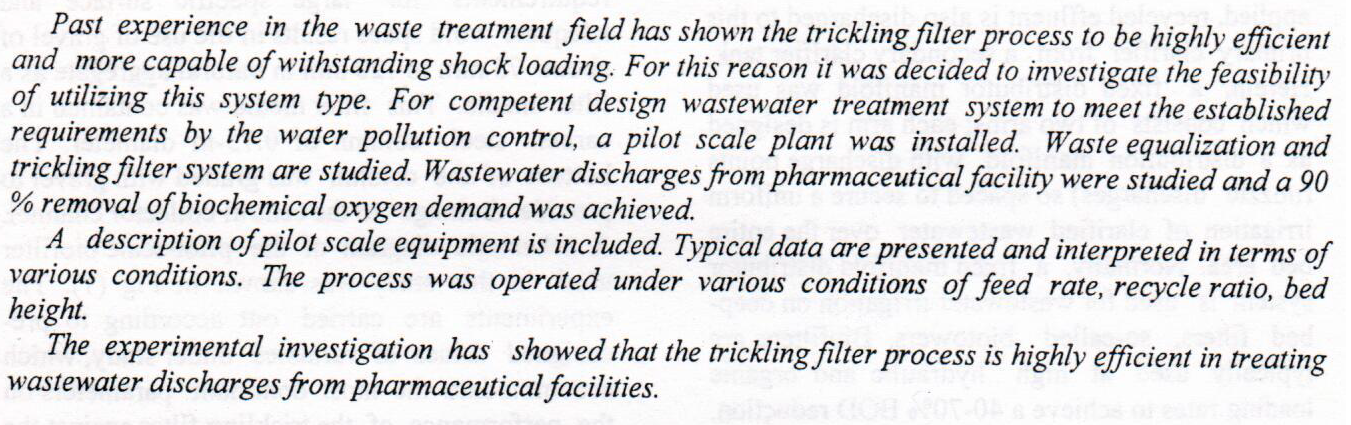
Study the Characteristic Performance of Trickling Filter for Pharmaceutical Waste Treatment
...Show More Authors

View Publication Preview PDF
Quick Preview PDF
Publication Date
Fri Nov 11 2022
Journal Name
Al-nisour Journal For Medical Sciences
Spectrophotometric determination of sulfamethoxazole in pure and pharmaceutical formulations
...Show More Authors

New, easy, simple, and fast spectral method for estimation of sulfamethoxazole (SMZ) in pure and pharmaceutical forms. The proposed method is based on the azotization of the drug compound by sodium nitrite in an acidic medium and then coupling with 2,3dimethyl phenol reagent (DMP) in a basic medium to yield an orange-coloured dye which shows λmax at 402 nm. Different affection of the optimization reaction has been completed, following the classical univariate sequence. The concentration of sulfamethoxazole about (1-15) μg. mL-1 with molar absorptivity of (14943.461) L.mol1 .cm-1 that obeyed Beer’s law. The detection and quantification limits were (0.852, 2.583) μg. mL-1 respectively, while the value of Sandell’s sensitivity (

... Show More
Preview PDF
Publication Date
Wed Jan 01 2020
Journal Name
International Journal Of Pharmaceutical Research
Spectrophotometric Evaluation of Paracetamol in Bulk and Pharmaceutical Preparations
...Show More Authors

View Publication Preview PDF
Scopus Crossref
Publication Date
Thu Oct 01 2020
Journal Name
Journal Of Engineering
Electrocoagulation for Treatment of Simulated Blowdown Water Of Cooling Tower
...Show More Authors

This study investigates the results of electrocoagulation (EC) using aluminum (Al) electrodes as anode and stainless steel (grade 316) as a cathode for removing silica, calcium, and magnesium ions from simulated cooling tower blowdown waters. The simulated water contains (50 mg/l silica, 508 mg/l calcium, and 292 mg/l magnesium). The influence of different experimental parameters, such as current density (0.5, 1, and 2 mA/cm2), initial pH(5,7, and 10), the temperature of the simulated solution(250C and 35 0C), and electrolysis time was studied. The highest removal efficiency of 80.183%, 99.21%, and 98.06% for calcium, silica, and magnesium ions, respectively, were obtained at a current de

... Show More
View Publication Preview PDF
Crossref (5)
Crossref
Publication Date
Tue Jun 01 2021
Journal Name
Journal Of Engineering
A Comparative Study of a Moving Bed Biofilm Reactor and Bio-shaft Technology for a Wastewater Treatment Process: A review
...Show More Authors

In addition to the primary treatment, biological treatment is used to reduce inorganic and organic components in the wastewater. The separation of biomass from treated wastewater is usually important to meet the effluent disposal requirements, so the MBBR system has been one of the most important modern technologies that use plastic tankers to transport biomass with wastewater, which works in pure biofilm, at low concentrations of suspended solids. However, biological treatment has been developed using the active sludge mixing process with MBBR. Turbo4bio was established as a sustainable and cost-effective solution for wastewater treatment plants in the early 1990s and ran on minimal sludge, and is easy to maintain. This

... Show More
View Publication Preview PDF
Crossref
Publication Date
Sun Jun 01 2008
Journal Name
Baghdad Science Journal
Study the Effect of thickness on the Optical Properties Performance of active polymeric laser media
...Show More Authors

The paper include study the effect thickness of the polymeric sample which is manufactured by thermo press way. The sample was used as an active tunable R6G laser media. The remarks show that, when the thickness of the samples is increased, with the same concentration, the spectrum will shift towards the short wavelength, & the quantum fluorescence yield will increased. The best result we obtained for the quantum fluorescence yield is (0.68) at the sample, with thickness (0.304mm) in Ethanol solvent, while when we used the Pure Water as a solvent, we found that the best quantum fluorescence yield is (0.63) at (0.18mm) thickness of the sample.

View Publication Preview PDF
Crossref
Publication Date
Wed Mar 10 2021
Journal Name
Baghdad Science Journal
Study the Effect of solvent on the Optical Properties Performance of active polymeric laser media
...Show More Authors

The paper include studies the effect of solvent of dye doped in polymeric laser sample which manufactured in primo press way, which is used as an active (R6G) tunable dye lasers. The remarks show that, when the viscosity of the solvent (from Pure Water to Ethanol), for the same concentration and thickness of the performance polymeric sample is increased, the absorption spectrum is shifts towards the long wave length (red shift), & towards short wave length (blue shift) for fluorescence spectrum, also increased the quantum fluorescence yield. The best result we obtained for the quantum fluorescence yield is (0.882) with thickness (0.25mm) in Ethanol solvent in concentration (2*10-3mole/liter), while when we used the Pure Water as a solvent,

... Show More
View Publication Preview PDF
Crossref
Publication Date
Mon Feb 01 2016
Journal Name
Chemistry And Materials Research
Simple RP-HPLC Method for Estimation of Furosemide, Carbamazepine, Diazepam and Carvedilol in Bulk and Pharmaceutical Dosage Forms
...Show More Authors

A simple reverse-phase high performance liquid chromatographic method for the simultaneous analysis (separation and quantification) of furosemide (FURO), carbamazepine (CARB), diazepam (DIAZ) and carvedilol (CARV) has been developed and validated. The method was carried out on a NUCLEODUR® 100-5 C18ec column (250 x 4.6 mm, i. d.5μm), with a mobile phase comprising of acetonitrile: deionized water (50: 50 v/v, pH adjusted to 3.6 ±0.05 with acetic acid) at a flow rate 1.5 mL.min-1 and the quantification was achieved at 226 nm. The retention times of FURO, CARB, DIAZ and CARV were found to be 1.90 min, 2.79 min, 5.39 min and 9.56 min respectively. The method was validated in terms of linearity, accuracy, precision, limit of detection and li

... Show More
Publication Date
Sat Sep 30 2023
Journal Name
Iraqi Journal Of Chemical And Petroleum Engineering
Review of the Mechanisms for Preventing, Diagnosing, and Treatment of Pipe Sticking in Drilling Operations
...Show More Authors

Stuck pipe is a prevalent and costly issue in drilling operations, with the potential to cost the petroleum industry billions of dollars annually. To reduce the likelihood of this issue, efforts have been made to identify the causes of stuck pipes. The main mechanisms that cause stuck pipes include drill cutting of the formation, inappropriate hole-cleaning, wellbore instability, and differential sticking forces, particularly in highly deviated wellbores. The significant consequences of a stuck pipe include an increase in well costs and Non-Productive Time (NPT), and in the worst-case scenario, the loss of a wellbore section and down-hole equipment, or the need to sidetrack, plug, or abandon the well. This paper provides a comprehensive

... Show More
View Publication Preview PDF
Crossref (3)
Crossref
Publication Date
Wed Dec 01 2021
Journal Name
Journal Of Molecular Liquids
The development of new homogenous and heterogeneous catalytic processes for the treatment of low grade palm oil
...Show More Authors

Low grade crude palm oil (LGCPO) presents as an attractive option as feedstock for biodiesel production due to its low cost and non-competition with food resources. Typically, LGCPO contains high contents of free fatty acids (FFA), rendering it impossible in direct trans-esterification processes due to the saponification reaction. Esterification is the typical pre-treatment process to reduce the FFA content and to produce fatty acid methyl ester (FAME). The pre-treatment of LGCPO using two different acid catalysts, such as titanium oxysulphate sulphuric acid complex hydrate (TiOSH) and 5-sulfosalicylic acid dihydrate (5-SOCAH) was investigated for the first time in this study. The optimum conditions for the homogenous catalyst (5-SOCAH) wer

... Show More
Scopus (15)
Crossref (15)
Scopus Clarivate Crossref
Publication Date
Sat Aug 15 2015
Journal Name
Iraqi Dental Journal
Standardized Protocol for Endodontic Treatment (Iraqi Endodontic Society)
...Show More Authors

The establishment of a high quality service in oral health care achieved by a member of dental professional is an important feature of any system of peer review in dentistry. This protocol attempts to discuss two crucial elements (I) suitability and feasibility of treatment modality and (II) quality of treatment performed to Iraqi patients. The Iraq endodontic society is designing a standardized protocol for endodontic treatment following the quality guidelines of European society of Endodontology (2006) to meet the highest standard of care generally given by competent practitioners. The Iraqi endodontic society has the expertise and professional responsibility clinically relevant to empower the dental profession through creating significan

... Show More
View Publication Preview PDF
Crossref (3)
Crossref


