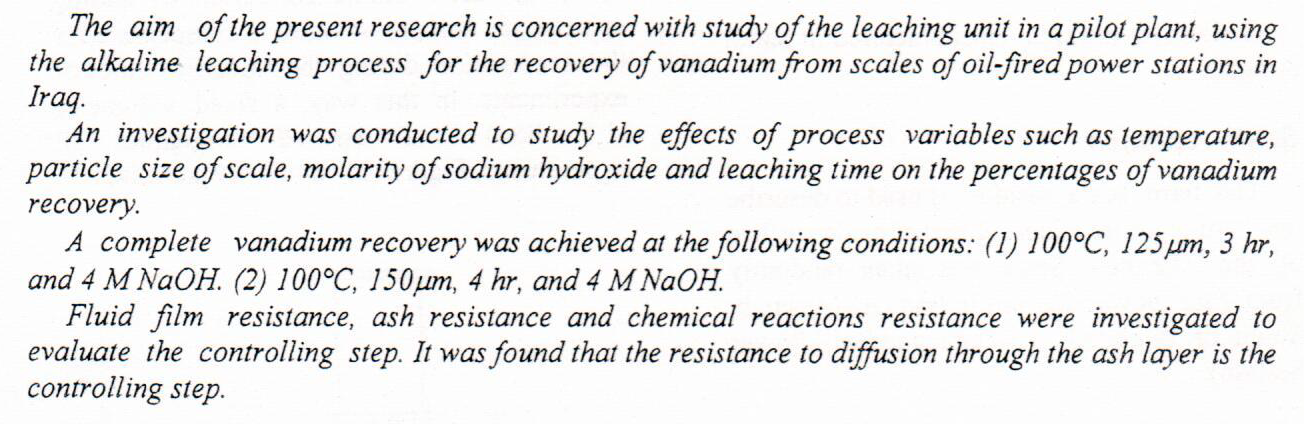
Recovery of Vanadium from Scale Residues of Oil-Fired Power Stations

 (12)
(12)
 (9)
(9)



For the most reliable and reproducible results for calibration or general testing purposes of two immiscible liquids, such as water in engine oil, good emulsification is vital. This study explores the impact of emulsion quality on the Fourier transform infrared (FT-IR) spectroscopy calibration standards for measuring water contamination in used or in-service engine oil, in an attempt to strengthen the specific guidelines of ASTM International standards for sample preparation. By using different emulsification techniques and readily available laboratory equipment, this work is an attempt to establish the ideal sample preparation technique for reliability, repeatability, and reproducibility for FT-IR analysis while still considering t
... Show More
(12)
(11)
In this research, the effect of reinforcing epoxy resin composites with a filler derived from chopped agriculture waste from oil palm (OP). Epoxy/OP composites were formed by dispersing (1, 3, 5, and 10 wt%) OP filler using a high-speed mechanical stirrer utilizing a hand lay-up method. The effect of adding zinc oxide (ZnO) nanoparticles, with an average size of 10-30 nm, with different wt% (1,2,3, and 5wt%) to the epoxy/oil palm composite, on the behavior of an epoxy/oil palm composite was studied with different ratios (1,2,3, and 5wt%) and an average size of 10-30 nm. Fourier Transform Infrared (FTIR) spectrometry and mechanical properties (tensile, impact, hardness, and wear rate) were used to examine the composites. The
... Show More
(7)
Background. Bone healing is a complex and dynamic process that represents a well-orchestrated series of biological events of cellular recruitment, proliferation, and differentiation. The use of medicinal plants in bone healing has attracted increasing interest because of their lower side effects. Punica granatum seed oil (PSO) contains high levels of phenolic compounds, promotes osteoblast function, and plays an important role in bone remodeling. A gelatin sponge (Spongostan) is a hemostatic agent that is extensively applied as scaffolds in engineering and as drug carriers in the medical field. This study aimed to evaluate the effectiveness of PSO for bone healing enhancement. Twenty adult male New Zealand rabbits, weighing an avera
... Show More
(10)
An investigation was conducted for dewaxing of lubricating oil fraction by urea to reduce the pour point.In this study mixture of 45 % methyl ethyl ketone (MEK) and 55 % toluene was used as a solvent. The studied variables are mixing time (10-70 min), solvent to oil volume ratio (0.5:1- 2:1), urea to wax weight ratio (2- 6) and constant mixing speed 1500 rpm. By analysis of the experimental results, the best operating conditions achieved are mixing time 40 min, solvent/oil 2:1 volume ratio, and urea/wax 4:1 weight ratio. At these conditions the pour point of the lubricating oil decreases from 24 ° C to -13 °C.
(4)
(3)
The variety of clean energy sources has risen, involving many resources, although their fundamental principles remain consistent in terms of energy generation and pollution reduction. The using of hydropower system for energy production also has a dynamic impact in which it utilizes to harness the water for the purpose of energy production. As it is important to overcome the problem of accidents in the highway and rural areas in the case of server rainfall and flood by implementation a smart system that used for energy production. This paper aims to develop a controlled hydropower system installed in the drainage sinks allocated in highway roads used for producing. The proposed system consists of storage unit represented by pipes used for t
... Show More
(2)
(1)
The objective of an Optimal Power Flow (OPF) algorithm is to find steady state operation point which minimizes generation cost, loss etc. while maintaining an acceptable system performance in terms of limits on generators real and reactive powers, line flow limits etc. The OPF solution includes an objective function. A common objective function concerns the active power generation cost. A Linear programming method is proposed to solve the OPF problem. The Linear Programming (LP) approach transforms the nonlinear optimization problem into an iterative algorithm that in each iteration solves a linear optimization problem resulting from linearization both the objective function and constrains. A computer program, written in MATLAB environme
... Show More
(2)