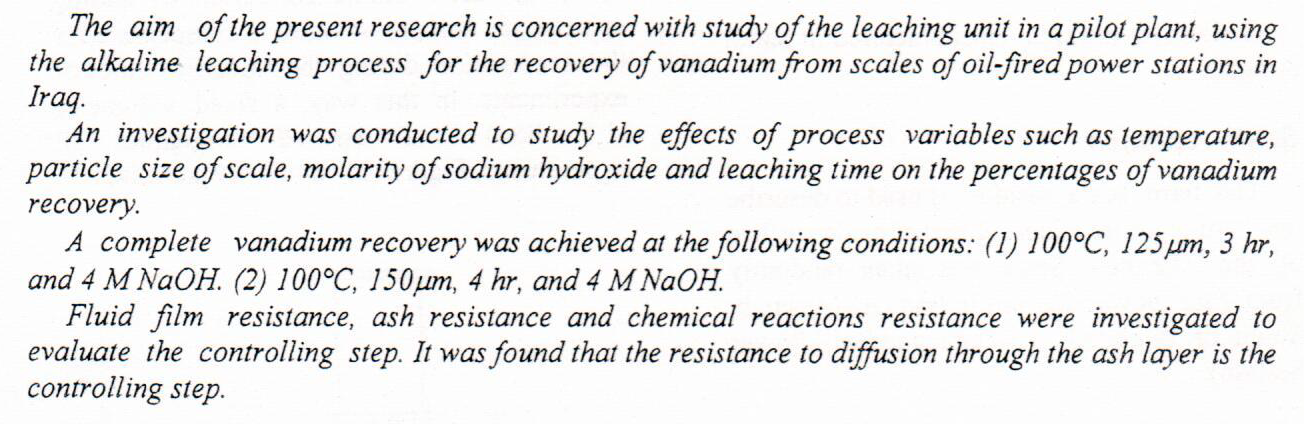
Recovery of Vanadium from Scale Residues of Oil-Fired Power Stations

 (4)
(4)
 (3)
(3)


The risk of significant concern is resistance to antibiotics for public health. The alternative treatment of metallic nanoparticles (NPs), such as heavy metals, effects on antibiotic resistance bacteria with different types of antibiotics of - impossible to treat using noval eco-friendly synthesis technique nanoparticles copper oxide (CuO NPs) preparation from S. epidermidis showed remarkable antimicrobial activity against S.aureus Minimum inhibitory concentra range (16,32,64,256,512) µg/ml via well diffusion method in vitro, discover those concentrations effected in those bacteria and the best concentration is 64 µg/ml, characterization CuO NPs to prove this included atomic force microscope, UV, X-ray Diffraction and TEM, and ant
... Show More
(12)
(7)
The research talks about the most important challenges facing Muslim youth of their ideological, social and economic types, and the youth is facing several problems, the most important of which are the intellectual and social invasion to which the Islamic nation has been exposed and ways to address them from a Quranic perspective and find solutions to these problems and these challenges in accordance with Islamic Sharia and the texts of the Holy Quran. From three topics and several demands, during which the researcher tried to find solutions to each challenge through the verses of the Noble Qur’an.
The availability of low- cost adsorbent namely Al-Khriet ( a substance found in the legs of Typha Domingensis) as an agricultural waste material, for the removal of lead and cadmium from aqueous solution was investigated. In the batch tests experimental parameters were studied, including adsorbent dosage between (0.2-1) g, initial metal ions concentration between (50-200) ppm (single and binary) and contact time (1/2-6) h. The removal percentage of each ion onto Al-Khriet reached equilibrium in about 4 hours. The highest adsorption capacity was for lead (96%) while for cadmium it was (90%) with 50 ppm ions concentration, 1 g dosage of adsorbent and pH 5.5. Adsorption capacity in the binary mixture were reduce at about 8% for lead a
... Show MoreKE Sharquie, AA Noaimi, HA Al-Mudaris, Journal of Cosmetics, Dermatological Sciences and Applications, 2012 - Cited by 6
This research consists of two parts, the first part concern with analyzing the collected data of BOD and COD values in discharge waste water from Al-Dora refinery during 2010 to find the relationship between these two variables The results indicates that there
is a high correlation between BOD and COD when using a natural logarithm model (0.86 ln(COD)) with correlation coefficient of 0.98. This relationship is useful in predicting the BOD value using the COD value. The second part includes analyzing collected data from the same site in order to find a relationsip between BOD and other parameters COD, Phenol(phe), Temperature(T), Oil, Sulphat(SO4),pH and Total dissolved solids( TDS) discharged from the refinery. The results indicated
(1)
The research talks about the most important challenges facing Muslim youth of their ideological, social and economic types, and the youth is facing several problems, the most important of which are the intellectual and social invasion to which the Islamic nation has been exposed and ways to address them from a Quranic perspective and find solutions to these problems and these challenges in accordance with Islamic Sharia and the texts of the Holy Quran. From three topics and several demands, during which the researcher tried to find solutions to each challenge through the verses of the Noble Qur’an.
RA Ali, LK Abood, Int J Sci Res, 2017 - Cited by 2
This study was conducted with the aim to extract and purify a polyphenolic compound “ Resveratrol†from the skin of black grapes Vitis vinifera cultivated in Iraq. The purified resveratrol is obtained after ethanolic extraction with 80% v/v solution for fresh grape skin, followed by acid hydrolysis with 10% HCl solution then the aglycon moiety was taken with organic solvent
( chloroform). Using silica gel G60 packed glass column chromatography with mobile phase benzene: methanol: acetic acid 20:4:1 a
... Show More
(1)
(3)