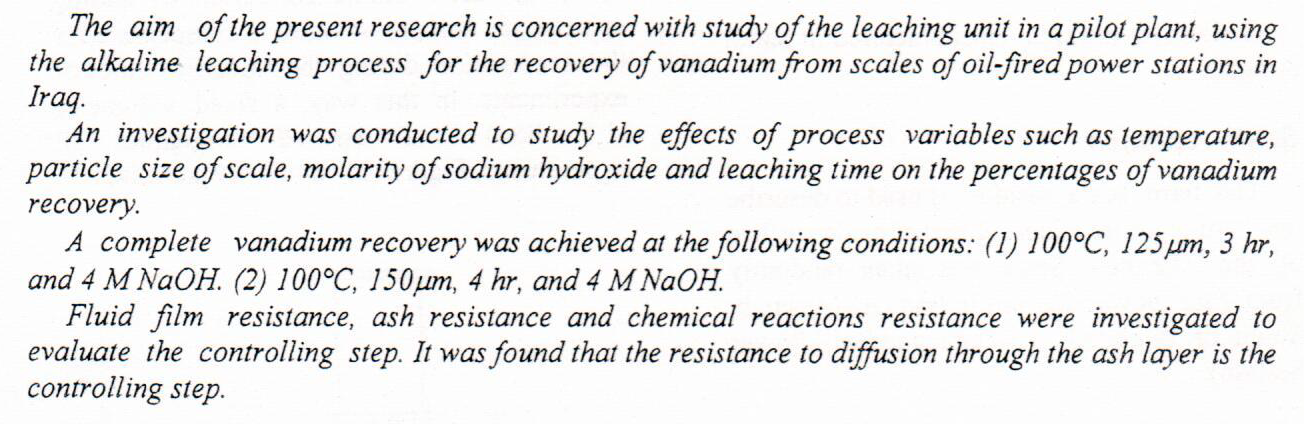
Recovery of Vanadium from Scale Residues of Oil-Fired Power Stations

For this research, the utilisation of electrocoagulation (EC) toremove theciprofloxacin (CIP) and levofloxacin (LVX) from aqueous solutions was examined. The effective removal efficiencies are 93.47% for CIP and 88.00% for LVX, under optimum conditions. The adsorption isotherm models with suitable mechanisms were applied to determine the elimination of CIP and LVX utilizingtheEC method. Thefindingsshowed the adsorption of CIP and LVX on iron hydroxide flocs followed the Sips isotherm, with correlation coefficient values (R2) of 0.939 and 0.937. Threekinetic models were reviewed to determine the accurate CIP and LVX elimination methods using the EC method. The results showed that itfittedfor the second-order model, which indicated that the c
... Show More (51)
(51)
 (37)
(37)



In this study, the photodegradation of Congo red dye (CR) in aqueous solution was investigated using Au-Pd/TiO2 as photocatalyst. The concentration of dye, dosage of photocatalyst, amount of H2O2, pH of the medium and temperature were examined to find the optimum values of these parameters. It has been found that 28 ppm was the best dye concentration. The optimum amount of photocatalyst was 0.09 g/75 mL of dye solution when the degradation percent was ~ 96 % after irradiation time of 12 hours, while the best amount of hydrogen peroxide was 7μl/75 mL of dye solution at degradation percent ~97 % after irradiation time of 10 hours, whereas pH 5 was the best value to carry out the reaction at the highest degradation percent. In additio
... Show More
(20)
(13)
In this study, the photodegradation of Congo red dye (CR) in aqueous solution was investigated using Au-Pd/TiO2 as photocatalyst. The concentration of dye, dosage of photocatalyst, amount of H2O2, pH of the medium and temperature were examined to find the optimum values of these parameters. It has been found that 28 ppm was the best dye concentration. The optimum amount of photocatalyst was 0.09 g/75 mL of dye solution when the degradation percent was ~ 96 % after irradiation time of 12 hours, while the best amount of hydrogen peroxide was 7μl/75 mL of dye solution at degradation percent ~97 % after irradiation time of 10 hours, whereas pH 5 was the best value to carry out the reaction at the highest deg
... Show More
(20)
(13)
For this research, the utilisation of electrocoagulation (EC) toremove theciprofloxacin (CIP) and levofloxacin (LVX) from aqueous solutions was examined. The effective removal efficiencies are 93.47% for CIP and 88.00% for LVX, under optimum conditions. The adsorption isotherm models with suitable mechanisms were applied to determine the elimination of CIP and LVX utilizingtheEC method. Thefindingsshowed the adsorption of CIP and LVX on iron hydroxide flocs followed the Sips isotherm, with correlation coefficient values (R2) of 0.939 and 0.937. Threekinetic models were reviewed to determine the accurate CIP and LVX elimination methods using the EC method. The results showed that itfittedfor the second-order model, which indicated that the c
... Show More
(37)
In this study, the photodegradation of Congo red dye (CR) in aqueous solution was investigated using Au-Pd/TiO2 as photocatalyst. The concentration of dye, dosage of photocatalyst, amount of H2O2, pH of the medium and temperature were examined to find the optimum values of these parameters. It has been found that 28 ppm was the best dye concentration. The optimum amount of photocatalyst was 0.09 g/75 mL of dye solution when the degradation percent was ~ 96 % after irradiation time of 12 hours, while the best amount of hydrogen peroxide was 7μl/75 mL of dye solution at degradation percent ~97 % after irradiation time of 10 hours, whereas pH 5 was the best value to carry out the reaction at the highest degradation percent. In additio
... Show More
(20)
(13)
(22)
(10)
(2)
(2)
This study aims to investigate the academic leaders’ perceptions towards the degree of availability of the dimensions of organizational immunity systems at the University of Tabuk, as well as to reveal the statistically significant differences between the average responses of the study sample members about the degree of availability of these dimensions at their university due to the variables of (gender, leadership position, and college specialization). To achieve the objectives of the study, a descriptive survey method was used. The study population consisted of (200) male and female leaders who were academic leaders at the University of Tabuk. A questionnaire was used as a tool for collecting data, which its validity and reliability
... Show MoreThe goal of current research is to identify the difficulties in the application of modern physics in the middle schools of the province of Baghdad schools from the perspective of teachers of physics trends, sample search of (127) teachers, Karkh Third Directorate, and use Researcher questionnaire data collection tool after applying it to teachers who have experience (5) years and more after confirmation of the validity and reliability of the scale (the tool) researcher has used the averages for the purpose of interpreting the results. the results showed that the difficulties have been in the order following: (difficulties related educational environment of modern trends of teaching, curriculum-related dif
... Show MoreTime is very important in educational institutions. It is also one of our contemporary problem ‚as time is a clear – cut and limited factor‚ it demands that administrators should monitor it by administering and monitoring the principles of time.
Hence‚ the researcher attempts to identify the skills of administrating time and the reasons that cause the waste of time of the Heads of Departments at university of Baghdad.
Significance of the research:
Time is very important to all educational administrators and one of them is the institutions of Higher education. One of the
... Show More