Extraction of Iron from Al-Hussainyat Iron Ore using Acid Leaching
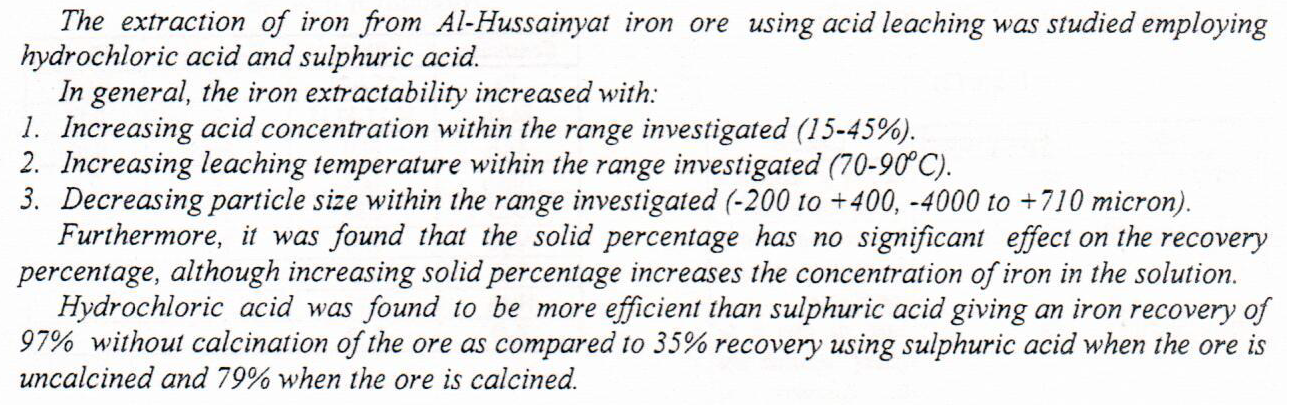

RA Ali, LK Abood, Int J Sci Res, 2017 - Cited by 2
 (5)
(5)
 (4)
(4)


The apricot plant was washed, dried, and powdered after harvesting to produce a fine powder that was used in water treatment. created an alcoholic extract from the apricot plant using ethanol, which was then analysed using GC-MS, Fourier transform infrared spectroscopy, and ultraviolet-visible spectroscopy to identify the active components. Zinc nanoparticles were created using an alcoholic extract. FTIR, UV-Vis, SEM, EDX, and TEM are used to characterize zinc nanoparticles. Using a continuous processing procedure, zinc nanoparticles with apricot extract and powder were employed to clean polluted water. Firstly, 2 g of zinc nanoparticles were used with 20 ml of polluted water, and the results were Tetra 44% and Levo 32%; after
... Show More
(3)
(4)
In the recent years the research on the activated carbon preparation from agro-waste and byproducts have been increased due to their potency for agro-waste elimination. This paper presents a literature review on the synthesis of activated carbon from agro-waste using microwave irradiation method for heating. The applicable approach is highlighted, as well as the effects of activation conditions including carbonization temperature, retention period, and impregnation ratio. The review reveals that the agricultural wastes heated using a chemical process and microwave energy can produce activated carbon with a surface area that is significantly higher than that using the conventional heating method.
(6)
(4)
This work has been done with using of epoxy resin mixed with Granite powder were weighted by percent volume (5,10,15, and 20)%and then mixed with epoxy polymer to compose polymer composite. Hand lay-up technique is used in fabrication of the composite samples. Hardness test was carried out for the proper samples in both normal condition and after immersion in HCL (1 M and 2 M) solutions for periods ranging up to 10 weeks. After comparing the results between the polymer and their composite, the hardness increased with increasing Granite weight percent, it was found that Hardness were greater for the composites before immersion compared with their values after immersion.
A Modified version of the Generlized standard addition method ( GSAM) was developed. This modified version was used for the quantitative determination of arginine (Arg) and glycine ( Gly) in arginine acetyl salicylate – glycine complex . According to this method two linear equations were solved to obtain the amounts of (Arg) and (Gly). The first equation was obtained by spectrophotometic measurement of the total absorbance of (Arg) and (Gly) colored complex with ninhydrin . The second equation was obtained by measuring the total acid consumed by total amino groups of (Arg) and ( Gly). The titration was carried out in non- aqueous media using perchloric acid in glacial acetic acid as a titrant. The developed metho
... Show More
Esterification reaction is most important reaction in biodiesel production. In this study, oleic acid was used as a suggested feedstock to study and simulate production of biodiesel. Batch esterification of oleic acid was carried out at operating conditions; temperature from 40 to 70 °C, ethanol to oleic acid molar ratio from 1/1 to 6/1, H2SO4 as the catalyst 1 and 5% wt of oleic acid, reaction time up to 180 min. The optimum conditions for the esterification reaction were molar ratio of ethanol/oleic acid 6/1, 5%wt H2SO4 relative to oleic acid, 70 °C, 90 min and conversion of oleic 0.92. The activation energy for the suggested model was 26625 J/mole for forward reaction and 42189 J/mole for equilibrium constant. The obtained results s
... Show MoreThe study dosage ethanol in the total content of acid sialic TC and acid sialic associated fat (LBSA) in blood serum and congener brain Dkor Jerd eggs study included dosage 20 animals of male rat Ald ethanol daily for a period of four weeks and concentrations 20% and 30%, 40%, 50% and size of dose 5mlThe results of the study showed that levels of TSA homogeneous in the brain and blood serum significantly reduced Ankhvaza
Background: Toxin-producing Shiga Escherichia coli has been identified as a new foodborne pathogen that poses a significant health risk to humans. Shiga toxin-producing Escherichia coli can be found in raw cow milk and its derivatives. A small number of Escherichia coli strains that produce shiga toxin are pathogenic. Aim of study: The study aimed to see if there were any virulence genes in 50 milk samples that were typical of Entero-haemorrhagic E. coli and evaluate the Myrtus communis effects on these bacteria. Materials and Method: Milk samples were used to isolate E. coli bacteria (n= 27), biochemically analyzed, and genetically screened for virulence genes using a multiplex (PCR). The hydro-alcoholic extraction of Myrtus communis leave
... Show More
(2)
Praise be to God who created the soul, perfected it, and inspired it with its immorality and piety. He says in His Noble Book: ﭤ Fajr: 27-30 Glory be to You, O God! O Lord, on whom I have chosen for You as a beloved from myself and the soul of the two worlds, may our master Muhammad be sacrificed for him, who enlightened the horizons with his introduction to enlightenment. It soon ends with the end of pleasure, which is the opposite of the pleasure of thought and meaning, as it is permanent and continuous, and from here we see that the Messenger of God, may God’s prayers and peace be upon him, urges us in various places to seek knowledge and fortify the soul and thought in a way that raises one’s status and protects him from the st
... Show More