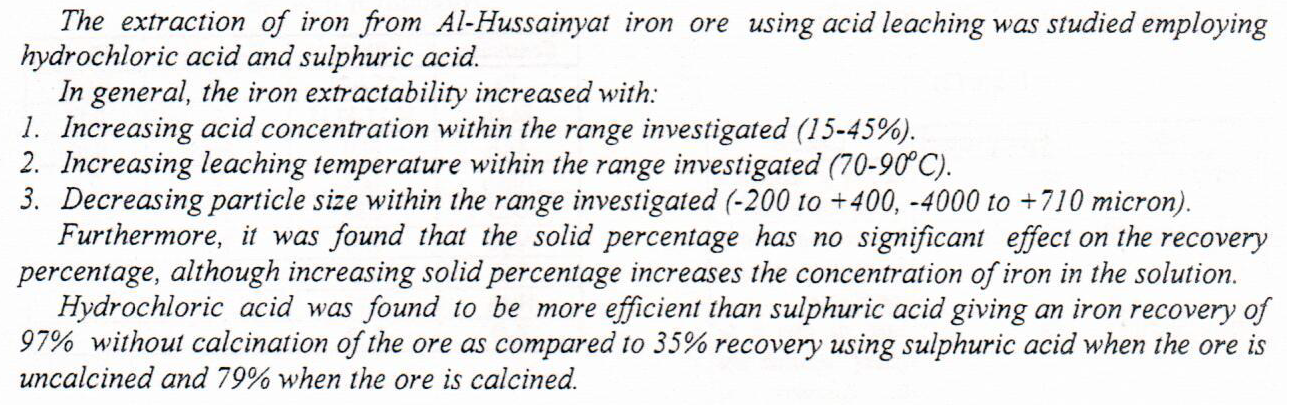
Extraction of Iron from Al-Hussainyat Iron Ore using Acid Leaching

Development of a precise and delicate reaction has been acquired for the determination of vancomycin hydrochloride using batch and cloud point extraction (CPE) methods. The first method is based on the formation of azo dye as a result of diazotized dapsone coupled with vancomycin HCl (VAN) in a basic medium. The sensitivity of this reaction was enhanced by utilizing a nonionic surfactant (Triton X-114) and the cloud point extraction technique (second method). The azo dye formed was extracted into the surfactant-rich phase, dissolved in ethanol and detected at λmax 440 nm spectrophotometrically. The reaction was investigated using both batch and CPE methods (with and without extraction), and a simple comparison between the two
... Show More (7)
(7)
 (4)
(4)


Objective: To evaluate two kinds of extraction (aqueous and ethanolic) for coriander using seeds, leaves and stems and
studying their antibacterial activity against nine different microorganisms.
Methodology: Coriander was selected to carry out this study. Seeds, leaves and stems were collected from local markets in
Baghdad then dried in shade for at least 10 days and grinded to fine powder. Aqueous hot extracts for 1hr. at (50
c) and
cold extracts for 24 hrs at (4
c) were performed by using seeds, leaves and stems then studied antibacterial effect against
nine different microorganisms by using well diffusion technique. Cold aqueous extracts of coriander seeds for 48 hrs. and
72 hrs and ethanolic extraction
Abstract: Background: High percentage of diabetes patients complain from post extraction hemorrhage. Many types of hemostatic materials are used to stop bleeding after teeth extraction: diode lasers are good hemostatic agents owing to their highly absorption by hemoglobin therefore they are used in soft tissue procedures with relatively no effects on dental hard tissues due to their poorly absorption by water and hydroxyapatite. Objectives: The aim of this study is to evaluate the efficiency of diode laser to assist the clot formation after tooth extraction for type II diabetes patients with minimum temperature elevation to prevent periodontal destruction. Materials and methods: From 12 type II diabetes patients (7 males and 5 females wi
... Show Moreبسبب محدودية الموارد الطبيعية، فأن سكان الخليج ومنذ القدم وجهوا جلّ نشاطاتهم توجهاً بحرياً: صيد الاسماك وصناعة اللؤلؤ العنصر الرئيس في حجم التشغيل، وتكوين الفائض الاقتصادي في المنطقة آنذاك.
لقد تزايدت أهمية هذا النشاط بخاصة بعد النصف الثاني من القرن التاسع عشر، لرواج تجارة اللؤلؤ عالمياً، وأنفتاح الخليج على الدول الاوروبية التي شهدت نهضة صناعية متسارعة، وحيث وصلت الخليج العديد من بضائع
... Show More
(23)

In this study, the photodegradation of Congo red dye (CR) in aqueous solution was investigated using Au-Pd/TiO2 as photocatalyst. The concentration of dye, dosage of photocatalyst, amount of H2O2, pH of the medium and temperature were examined to find the optimum values of these parameters. It has been found that 28 ppm was the best dye concentration. The optimum amount of photocatalyst was 0.09 g/75 mL of dye solution when the degradation percent was ~ 96 % after irradiation time of 12 hours, while the best amount of hydrogen peroxide was 7μl/75 mL of dye solution at degradation percent ~97 % after irradiation time of 10 hours, whereas pH 5 was the best value to carry out the reaction at the highest degradation percent. In additio
... Show More
(20)
(13)
Evaporation is one of the major components of the hydrological cycle in the nature, thus its accurate estimation is so important in the planning and management of the irrigation practices and to assess water availability and requirements. The aim of this study is to investigate the ability of fuzzy inference system for estimating monthly pan evaporation form meteorological data. The study has been carried out depending on 261 monthly measurements of each of temperature (T), relative humidity (RH), and wind speed (W) which have been available in Emara meteorological station, southern Iraq. Three different fuzzy models comprising various combinations of monthly climatic variables (temperature, wind speed, and relative humidity) were developed
... Show More
In this study, the photodegradation of Congo red dye (CR) in aqueous solution was investigated using Au-Pd/TiO2 as photocatalyst. The concentration of dye, dosage of photocatalyst, amount of H2O2, pH of the medium and temperature were examined to find the optimum values of these parameters. It has been found that 28 ppm was the best dye concentration. The optimum amount of photocatalyst was 0.09 g/75 mL of dye solution when the degradation percent was ~ 96 % after irradiation time of 12 hours, while the best amount of hydrogen peroxide was 7μl/75 mL of dye solution at degradation percent ~97 % after irradiation time of 10 hours, whereas pH 5 was the best value to carry out the reaction at the highest degradation percent. In additio
... Show More
(20)
(13)
In the present research the flame retardancy to buildings and industrial foundations which are manufacturing from advanced polymeric composite material was increased by coating it with surface layer included flame retardant material. A(3mm) thick antimony tetroxide was used as a coated layer to retard and prevent the flame spread to the coating surface of polyester resin (SIROPOL 8340-PI) reinforced with hybrid fibers as a woven roving (°45-°0) consist of carbon and kevlar (49) fibers, and exposed it to direct flame generated from gas torch at temperature of (2000ºC), at different exposed distance (10,15,20mm)and study the rang of resistance for this layer and its ability to protec
... Show MoreCoagulation - flocculation are basic chemical engineering method in the treatment of metal-bearing industrial wastewater because it removes colloidal particles, some soluble compounds and very fine solid suspensions initially present in the wastewater by destabilization and formation of flocs. This research was conducted to study the feasibility of using natural coagulant such as okra and mallow and chemical coagulant such as alum for removing Cu and increase the removal efficiency and reduce the turbidity of treated water. Fourier transform Infrared (FTIR) was carried out for okra and mallow before and after coagulant to determine their type of functional groups. Carbonyl and hydroxyl functional groups on the surface of
... Show More