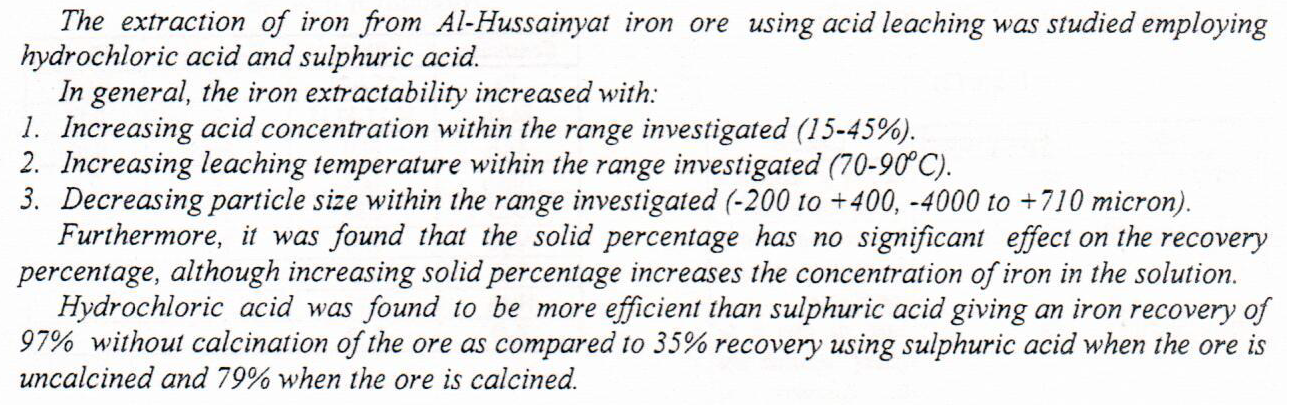
Extraction of Iron from Al-Hussainyat Iron Ore using Acid Leaching

 (8)
(8)
 (2)
(2)


Electrocoagulation is an electrochemical method for treatment of different types of wastewater whereby sacrificial anodes corrode to release active coagulant (usually aluminium or iron cations) into solution, while simultaneous evolution of hydrogen at the cathode allows for pollutant removal by flotation or settling. The Taguchi method was applied as an experimental design and to determine the best conditions for chromium (VI) removal from wastewater. Various parameters in a batch stirred tank by iron metal electrodes: pH, initial chromium concentration, current density, distance between electrodes and KCl concentration were investigated, and the results have been analyzed using signal-to-noise (S/N) ratio. It was found that the r
... Show MoreCorrosion- induced damage in reinforced concrete structure such as bridges, parking garages, and buildings, and the related cost for maintaining them in a serviceable condition, is a source of major concern for the owners of these structures.
Fly ash produced from south Baghdad power plant with different concentrations (20, 25 and 30) % by weight from the cement ratio were used as a corrosion inhibitor as a weight ratio from the cement content.
The concrete batch ratio under study was (1:1.5:3) cement, sand and gravel respectively which is used in Iraq. All the raw materials used were locally manufactured.
Concrete slabs (250x250x70) mm dimensions were casted, using Poly-wood molds. Two steel bars were embedded in the central po
In The Name of Allah Most Gracious Most Merciful
Scholars, past and present, have paid attention to the books of Fasting and Hajj, and they have compiled literature on that, and they have written treatises and researches. The best days, and as for the pilgrimage, it is one of the great pillars of Islam, which God Almighty has distinguished by making its rituals in the best of places, which is the Sacred House of God.
A mercury porosimeter has been used to measure the intrusion volume of the three types mercury positive lead acid-battery plates. The intrusion volumes were used to calculate the pore diameter, pore volume, pore area, and pore size distribution. The variation of the pore area in positive lead acid-battery plates as well as of the pore volume has the following sequence. Paste positive > Uncured positive > Cured positive
(5)
Amino acids are the basic building block for peptides and proteins. They are raw materials for generating hormones, purines, pyrimidines and vitamins. Amino acids also provide the body with energy through their carbon structures. The study analyzed the amino acid in the kidneys of the albino mice embryo at 17 and 19 gestation days, using a high-performance liquid chromatography device (HPLC). Samples were obtained after removing them from the embryo and placing them in an ice bath to prevent cell lysis and acid loss. The study found 18 amino acids in the kidneys of the albino mice embryo. They are Asparagine (Asn), Glutamine (Glu), Serine (Ser), Glycine (Gly), Threonine (Thr), Histidine (His), Cysteine (Cys), Alanine (Ala), Proline
... Show More
(1)
(1)
Vitamins play an important role in the human health, and thus they are the kind of major nutrients in the body. Chemical products perform numerous physiological functions and can jeopardize health jointly in their absence and surplus. Therefore, it is necessary to establish methods for observation vitamin levels in various molds. In this review paper, the most methods of determination used are high performance liquid chromatography (HPLC), spectrophotometric and potentiometric techniques by listed the value of : slope, linear range, correlation coefficient, detection limit, the max of wavelength and PH and compared with these methods.
A mercury porosimeter has been used to measure the intrusion volume of the three types mercury positive lead acid-battery plates. The intrusion volumes were used to calculate the pore diameter, pore volume, pore area, and pore size distribution. The variation of the pore area in positive lead acid-battery plates as well as of the pore volume has the following sequence. Paste positive > Uncured positive > Cured positive
