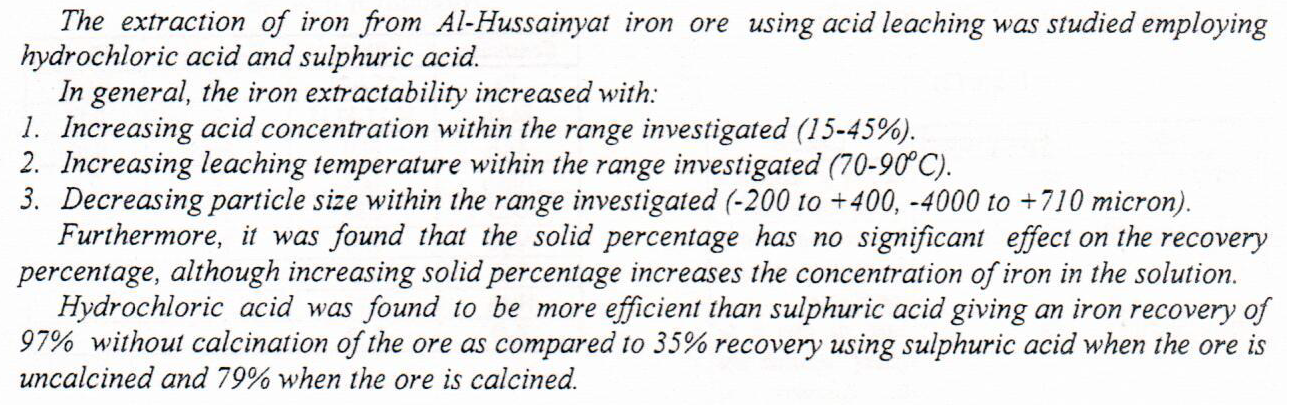
Extraction of Iron from Al-Hussainyat Iron Ore using Acid Leaching

 (7)
(7)
 (6)
(6)



Nanomaterials, including nanoparticles such as iron oxide nanoparticles, have received great attention from researchers due to their unique properties and applications. There are several diverse methods, including chemical, physical, and green biological methods, to prepare iron oxide nanoparticles. The green method was chosen because it is safer, purer, and less toxic compared to other methods. Therefore, the green method is a promising and environmentally friendly method in the near future. The aqueous extract of Iraqi orange leaves was used to prepare nano iron oxide, it was examined structurally and spectrally by several techniques (X-ray diffraction- XRD, Fourier transform infrared - FT-IR, field emission scanning electron micr
... Show More
(1)
Iron , Cobalt , and Nickel powders with different particle sizes were subjected to sieving and He-Ne laser system to determine the particle size . 1wt% from each powders was blended carefully with 99wt% from Iraqi oil . Microscopic examination were carried for all samples to reveal the particle size distribution . A Siemens type SRS sequential wavelength dispersive(WDS) X-ray spectrometer was used to analyze all samples , and the XRF intensity were determined experimentally and theoretically for all suspended samples , Good agreement between theoretical and experimental results were found .
Avery large numbers of articles are made by powder metallurgical methods using electrolytically reduced metal powders. Iron powder is one of these powders which play an important role in this field. Its preparation by electrolytic method is economic in comparison with the traditional methods (Atomization and carbonyl processes).
An electrochemical cell consisting of two electrodes (stainless steel cathode and iron anode, 99.9%) was used to study the electrolytic preparation of iron powder with particle size less than 106µm directly as powde1y form. Ferrous sulphate electrolyte was used containing sodium chloride as a stabilizing agent. The produced powder was thoroughly washed with an acidified distilled water and absolute ethan
... Show MoreA competitive adsorption of Cu2+, Ni2+, and Cd2+ ions from a synthetic wastewater onto nanomaterial was studied.(Fe3O4) nanoparticles obtained from US Research Nanomaterials, Inc., Houston, TX 77084, (USA), was used as nanosorbent. Experimental parameters included pH, initial metal concentrations, and temperature were studied for nanosorbent. The uptake capacity 11.5, 6.07 and 11.1 mg/g for Cu2+, Ni2+and Cd2+, respectively, onto nanosorbent . The optimum pH values was 6 and the contact time was 50 min. for Cu2+, Ni2+and Cd2+, respectively. The equilibrium isotherm for
... Show MoreNano-crystalline iron oxide nanoparticles (magnetite) was synthesized by open vessel ageing process. The iron chloride solution was prepared by mixing deionized water and iron chloride tetrahydrate. The product was characterized by X-Ray, Surface area and pore volume by Brunauer-Emmet-Teller, Atomic Force Microscope (AFM) and Fourier Transform Infrared Spectroscopy(FTIR) . The results showed that the XRD in compatibility of the prepared iron oxide (magnetite) with the general structure of standard iron oxide, and in Fourier Transform Infrared Spectroscopy, it is strong crests in 586 bands, because of the expansion vibration manner related to the metal oxygen absorption band (Fe–O bonds in the crystals of iron ox
... Show MoreDensity functional theory (DFT) calculations were used to evaluate the capability of Glutamine (Gln) and its derivative chemicals as inhibitors for the anti-corrosive behavior of iron. The current work is devoted to scrutinizing reactivity descriptors (both local and global) of Gln, two states of neutral and protonated. Also, the change of Gln upon the incorporation into dipeptides was investigated. Since the number of reaction centers has increased, an enhancement in dipeptides’ inhibitory effect was observed. Thus, the adsorption of small-scale peptides and glutamine amino acids on Fe surfaces (1 1 1) was performed, and characteristics such as adsorption energies and the configuration with the highest stability and lowest energy were ca
... Show More
(16)
(13)
This work aimed to study the effect of laser surface treatment on the mechanical characteristics and corrosion behaviour of grey cast iron type A159. Many technical applications used conventional surface treatment, but laser surface hardening has recently been used to enhance the surface properties of many alloys. The mechanical characteristics, including microstructure, microhardness, and wear resistance of A159 grey cast iron, were studied, in addition to corrosion behaviour. The experimental laser parameters in this work were 0.9, 1.2, and 1.5 KW power with continuous wave carbon dioxide lasers with scanning speeds of 10 and 12 mm/s were used. The results found that phase-transitional alterations in microstructure were influenced by lase
... Show More
(3)
Investigation of the adsorption of Chromium (VI) on Fe3O4 is carried out using batch scale experiments according to statistical design using a software program minitab17 (Box-Behnken design). Experiments were carried out as per Box-Behnken design with four input parameters such as pH (2-8), initial concentration (50–150mg/L), adsorbent dosage (0.05–0.3 g) and time of adsorption (10–60min). The better conditions were showed at pH: 2; contact time: 60 min; chromium concentration: 50 mg/L and magnetite dosage: 0.3 g for maximum Chromium (VI) removal of (98.95%) with an error of 1.08%. The three models (Freundlich, Langmuir, and Temkin) were fitted to experimental data, Langmuir isotherm has bette
... Show MoreThe study searches for the possibility of using duckweed Lemna spp. to reduce the concentration of heavy metals (zinc and iron) in the wastewater of Baghdad by culturing two different densities of the plant with a fresh weights 5 and 10 g/l and without the plant under optimum uncontrolled conditions. The result showed that there was a significant differences at the possibility level of (p? 0.05) for the three treatments, as the highest percentages for zinc removal in the second day for the plant treatment of 5 g/l were 66.40%, while the highest percentage of iron removal were in the tenth days for the plant treatment 10 g/l were 80 %, and noticed that the increase of the heavy metals concentrations accumulated in the plant after bei
... Show More