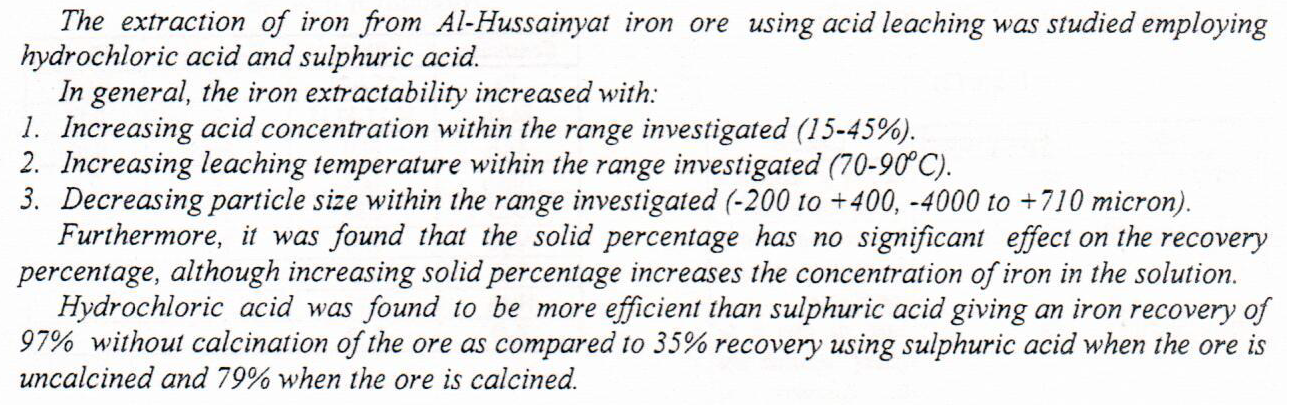
Extraction of Iron from Al-Hussainyat Iron Ore using Acid Leaching

The current research discusses the jurisprudence of the argumentative meaning in the Qur’an, and it is one of the general methods of responses in the Qur’an, as well as the argumentative approach to the recitations of the readers and directing their meanings. I have chosen a model for three verses from Surat Al-An’am, in which there are seven frequent recitations and seven odd ones, on a topic related to theology and faith; It forms the centerpiece of the argument verses in Surat Al-An'am; It contains the jurisprudence of dealing with infidels and dissenters, turning away and forbidding insulting what they claim besides God in the event of corruption, and God Almighty’s decree and wisdom in the occurrence of unbeli
... Show More (44)
(44)
 (40)
(40)


 (2)
(2)
(2)
(2)
In this paper the process of metal ions extraction (Zn(II) and Cu(II)) was studied in PEG-KCl aqueous two phase system was investigated without using an extracting agent. The experimental runs were performance at constant temperature (25 oC), constant mixing time (30 min), and constant PH of the solution (about 3). The effect of KCl salt concentration (from 10% to 25%), volumetric phase ratio of PEG solution to KCl solution (from 0.5 to 2), and the initial metal ion concentration (from 0.25 ml to 2 ml of 1 gm/L solution) were investigated on the percent extraction of Zn(II) and Cu(II). The results indicated that the percent extraction of metal ions increase with increasing of salt concentration and phase ratio, and slightly de
... Show MoreABSTRACT This study presents an efficient approach for the separation and preconcentration of norepinephrine (NOR) from pharmaceutical formulations, environmental water, and human urine samples using a dispersive micro – solid phase extraction (DμSPE) technique employing magnetic nanoadsorbents. Two adsorbents, Fe3O4@TTAB and Fe3 O4@SiO2@TTAB, were prepared by functionalising iron oxide and silicacoated iron oxide nanoparticles with the cationic surfactant tetradecyltrimethylammonium bromide (TTAB). NOR was first converted into a sensitive diazonium dye via reaction with diazotised sulphamethazine and then extracted using mixed ademicelle – hemimicelle magnetic solid-phase extraction, followed by spectrophotometric quantification. Key
... Show More
(1)
A procedure for the mutual derivatization and determination of thymol and Dapsone was developed and validated in this study. Dapsone was used as the derivatizing agent for the determination of thymol, and thymol was used as the derivatizing agent for the determination of Dapsone. An optimization study was performed for the derivatization reaction; i.e., the diazonium coupling reaction. Linear regression calibration plots for thymol and Dapsone in the direct reaction were constructed at 460 nm, within the concentration range of 0.3-7 μg ml-1 for thymol and 0.3-4 μg ml-1 for Dapsone, with limits of detection 0.086 and 0.053 μg ml-1, respectively. Corresponding plots for the cloud point extraction of thymol and Dapsone were constructed
... Show More
(3)
In this research an Artificial Neural Network (ANN) technique was applied for the prediction of Ryznar Index (RI) of the flowing water from WTPs in Al-Karakh side (left side) in Baghdad city for year 2013. Three models (ANN1, ANN2 and ANN3) have been developed and tested using data from Baghdad Mayoralty (Amanat Baghdad) including drinking water quality for the period 2004 to 2013. The results indicate that it is quite possible to use an artificial neural networks in predicting the stability index (RI) with a good degree of accuracy. Where ANN 2 model could be used to predict RI for the effluents from Al-Karakh, Al-Qadisiya and Al-Karama WTPs as the highest correlation coefficient were obtained 92.4, 82.9 and 79.1% respectively. For
... Show MoreNew schiff bases series (VIII) a-e and 1,3-thiazolidin-4-one derivatives (IX) a-e containing the 1,2,4-triazole and 1,3,4-thiazazole rings were synthesized and screening their biological activities. These compounds were identified via Fourier transform infrared (FT-IR) spectra, some via Proton nuclear magnetic resonance (1H-NMR) and mass spectra. The biological results indicated that all of these compounds did not reveal antibacterial effectiveness against (Escherichia coli and Klebsiella species) (G-). Some of these compounds showed moderate antibacterial activity against (Staphylococcus aureus, and Staphylococcus epidermidis) (G+), and all compounds exhibited moderate activity against Candida albicans.
(1)
This research has tackled a scientific figure belongs to Koofi grammatical school. He is Abdullah Al-Tuaal who has occupied the fourth layer among the Koofi grammarians. There was a confusion between him and another Koofi grammarian from the same layer (Mohammed Bin Qaadim) in some old references. This research has clarified this confusion to affirm that they are two different grammarians.This research also tackles the scientific status of Al-Tuaal and the grammatical views that have been ascribed to him in addition to the analysis and discussion of these views. All this in the light of what has been mentioned in grammar books about the issues in which these views were stated.
Two different oxidative desulfurization strategies based on oxidation/adsorption or oxidation/extraction were evaluated for the desulfurization of AL-Ahdab (AHD) sour crude oil (3.9wt% sulfur content). In the oxidation process, a homogenous oxidizing agent comprising of hydrogen peroxide and formic acid was used. Activated carbons were used as sorbent/catalyst in the oxidation/adsorption process while acetonitrile was used as an extraction solvent in the oxidation/extraction process. For the oxidation/adsorption scheme, the experimental results indicated that the oxidation desulfurization efficiency was enhanced on using activated carbon as catalyst/sorbent. The effects of the operating conditions (contact time, temperat
... Show More