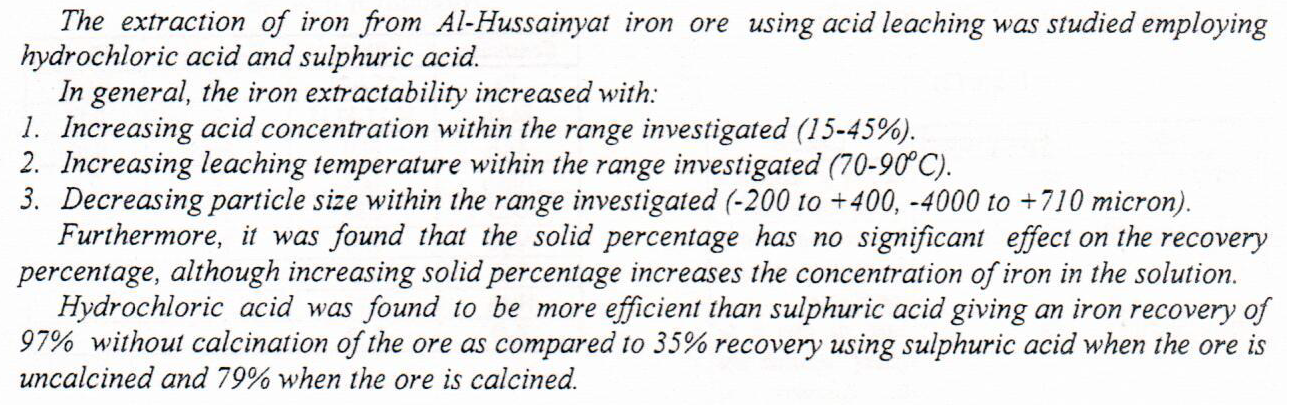
Extraction of Iron from Al-Hussainyat Iron Ore using Acid Leaching

 (17)
(17)
 (13)
(13)


Herein, date palm (Phoenix dactylifera) bunch (DPB) waste was transformed into activated carbon (DPAC) adsorbent by using microwaveinduced ZnCl2 activation for 15 min at a power of 600 W. Several analytical methods were used to explain the physicochemical parameters of DPBAC including XRD, pHpzc, BET, SEM–EDX, and FTIR. Afterwards, the adsorptive performance of DPBAC was thoroughly investigated for the removal of two structurally different organic dyes namely methyl violet (MV) and fuchsin basic (FB). The key adsorption parameters, including the dose of DPBAC (A: 0.02–0.06 g), the solution pH (B: 4–10), and the contact time (C: 2–20 min) were statistically optimized using the Box-Behnken design with response surface methodology (RSM
... Show More
(3)
(2)
(5)
(3)

The author addresses the issue of the linguoculturological component in the process of teaching Russian to Arabic students, focuses on the peculiarities of the national character of students. The author also refers to the long-standing ties of Russian and Arab cultures, thus emphasizing the relevance of this aspect for the current state and situation of the Russian language in Arab countries.
Автор статьи обращается к вопросу лингвокультурологической составляющей в процессе преподавания русского языка арабским студентам, останавливается на особенностях национального хара
... Show More
(5)
(3)
(9)
(1)
Abstract Depending on their protective properties against different cases of Colorectal Cancer (CRC), vitamins C, D, and E are the main focus of this research. CRC is one of the global public health concerns. 30 healthy individuals provided serum samples, whereas the group of CRC patients was divided into three, totaling 90 individuals. Group I consisted of 30 newly diagnosed cases of CRC. Group II 30 consisted of consisted of 30 CRC patients who were administered three cycles of chemotherapy. Group III consisted of 30 diagnosed CRC patients who also have non-alcoholic fatty liver disease (NAFLD). The concentrations and groups of vitamins C, D, and E were evaluated using ELISA. The levels of Vitamin C were significantly lower (p &l
... Show More
(3)
Industrial machining workshops generate substantial quantities of aluminum wire offcuts and filings that cannot be re-entered into bulk metal recycling circuits, posing both a resource management challenge and a potential environmental burden. This study demonstrates a closed-loop valorization route in which this low-grade aluminum waste is converted into nanostructured aluminum oxide (Al2O3) nanoparticles (NPs) by two scalable synthesis pathways (i) chemo-thermal calcination of precipitated Al(OH)₃ at 1000 °C and 1200 °C for 1 and 4 h, and (ii) direct chemical precipitation via AlCl3/Na2CO3 reaction, and then deployed as a functional additive in water-based drilling fluids (WBDFs) used by the oil and gas industry. Comprehensive chara
... Show More
(2)
(1)
(17)
(15)
(12)
(5)