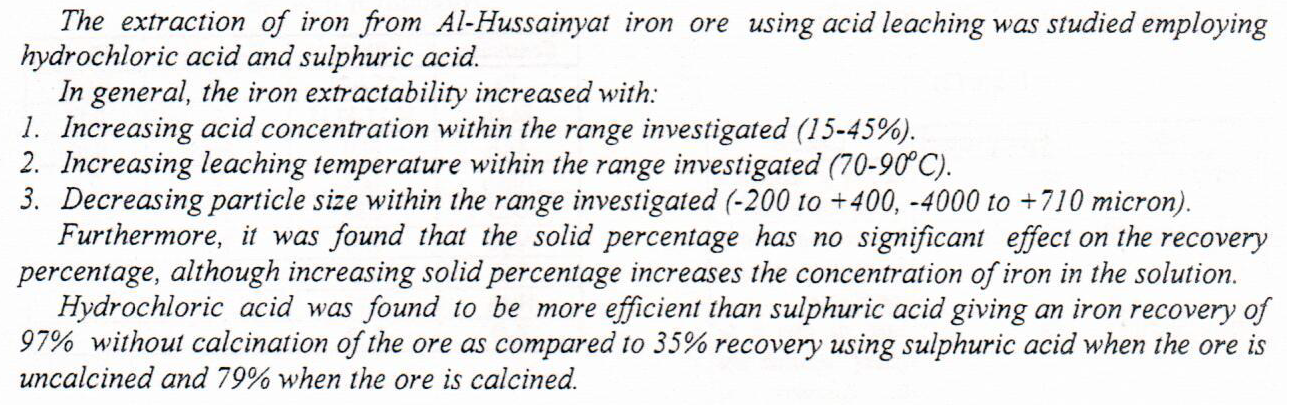
Extraction of Iron from Al-Hussainyat Iron Ore using Acid Leaching

Mixed ligand complexes of bivalent metal ions, viz ; M= Co(II),Ni(II),Cu(II), Zn(II), Cd (II), and Hg(II) of the composition [M(Anth)2(TMP)] in 1:2:1 molar ratio, (where . AnthrH= Anthranilic acid (C7H7NO2) and Trimethoprime (TMP) = (C14H18N4O3) have been synthesized and characterized by repeated melting point determination, Solubility, Molar conductivity (Λm ),determination the percentage of the metal (M%) in the complexes by (AAS), FT-IR, magnetic susceptibility measurements [μeff (BM)] and electronic spectral data. The two ligands and their metal complexes have been screened for their bacterial activity against selected microbial strains (Gram +ve) & (Gram -ve).
Mixed ligand complexes of bivalent metal ions, viz ; M= Co(II),Ni(II),Cu(II), Zn(II), Cd (II), and Hg(II) of the composition [M(Anth)2(TMP)] in 1:2:1 molar ratio, (where . AnthrH= Anthranilic acid (C7H7NO2) and Trimethoprime (TMP) = (C14H18N4O3) have been synthesized and characterized by repeated melting point determination, Solubility, Molar conductivity (Λm ),determination the percentage of the metal (M%) in the complexes by (AAS), FT-IR, magnetic susceptibility measurements [µeff (BM)] and electronic spectral data. The two ligands and their metal complexes have been screened for their bacterial activity against selected microbial strains (Gram +ve) & (Gram -ve).
 (11)
(11)
 (8)
(8)



The aim of this study is to propose mathematical expressions for estimation of the flexural strength of plain concrete members from ultrasonic pulse velocity (UPV) measurements. More than two hundred pieces of precast concrete kerb units were subjected to a scheduled test program. The tests were divided into two categories; non-destructive ultrasonic and bending or rupture tests. For each precast unit, direct and indirect (surface) ultrasonic pulses were subjected to the concrete media to measure their travel velocities. The results of the tests were monitored in two graphs so that two mathematical relationships can be drawn. Direct pulse velocity versus the flexural strength was given in the first relationship while the second equation des
... Show MoreThe aim of this study is to propose mathematical expressions for estimation of the flexural strength of plain concrete members from ultrasonic pulse velocity (UPV) measurements. More than two hundred
pieces of precast concrete kerb units were subjected to a scheduled test program. The tests were divided into two categories; non-destructive ultrasonic and bending or rupture tests. For each precast unit, direct and indirect (surface) ultrasonic pulses were subjected to the concrete media to measure their travel velocities. The results of the tests were mointered in two graphs so that two mathematical relationships can be drawn. Direct pulse velocity versus the flexural strength was given in the first relationship while the second equati
Fifty three hydatid cysts were collected from different hosts, sheep, goats and cattle , from many slaughterhouse in Salahadin and Baghdad , while human's hydatid cysts samples were collected from Tikrit educational hospital and Tofiqe civilian hospital patients . The study included a biochemical comparison of some hydatid cyst fluid criteria such as, glucose, total protein, pH, glutamate pyrovate transaminase enzyme (GPT) , glutamate oxaloacetate transaminase enzyme (GOT) , acid phosphatase (ACP) , Alkaline Phosphatase (ALP) , and also studied protoscolices viability,the current study showed the differences in chemical composition of hydatid cyst fluids back to host type and parasite strain .
(1)
Four new species of Thrips (Thripidae) Chirothrips imperatus sp. nov.; Frankliniella megacephala sp. nov.; Retithrips bagdadensis sp. nov; Taeniothrips tigridis sp. Nov.; from middle of Iraq, are described and illustrated with their hosts.
Twenty isolates of Serratia marcescens were isolated from inflammation of the urinary tract (UTI)., These isolates were found to produce hemolysin as indicated by blood agar plates in which the hemolysis of red blood cell indicate a positive result. Isolates were selected according to their hemolysis activity by measuring absorbance of hemoglobin at 405 nm that released from red blood cell. Hemolysin was completely purified using 50-75% saturation of ammonium sulphate followed by ion exchange chromatography with DEAE-cellulose then gel filtration chromatography by sepharose 4B. Accordingly molecular weight for the purified toxin was estimated as 45 KD.
