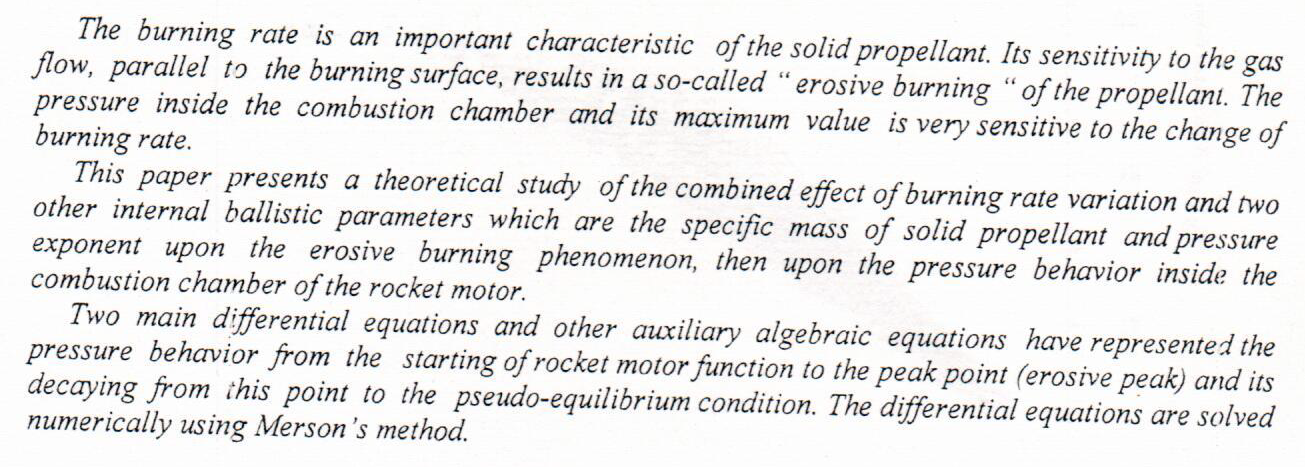
Combined Effect of Some Internal Ballisting Parameters on the Pressure Behavior of Solid Propellant Rocket Motor

 (138)
(138)
 (126)
(126)


 (3)
(2)
(3)
(2)
Background: Lactobacillus rhamnosus GG bacteria is a type of probiotic belonging to the Lactobacillus family; a beneficial bacteria found in the intestines. This study aimed to prepare soymilk from soybean seeds and to produce fermented milk using the probiotic bacteria L. Rhamnosus GG, supplemented with whey and some medicinal plants and to study the storage qualities. Methods: In This study Different lactic ferments were prepared, including: Treatment soybean and whey, in which soybean milk and whey were used in different percentage (30, 50 and 70%) and the probiotic bacteria starter Lactobacillus rhamnosus GG was added to this treatments, with the addition of some medicinal medicinal plants such as garlic, mint and paprika at a r
... Show More
Isolation of fungi was performed from February to July, 2019. One hundred clinical specimens were collected from King Abdullah Hospital (KAH) Bisha, Saudi Arabia. Samples were collected from twenty patients of different ages (30 - 70 years old) ten males and ten females. The samples were collected from patients with the two types of diabetics. Specimens included blood, hair, nail, oral swabs and skin. Specimens were inoculated on Sabourauds Dextrose agar containing chloramphenicol. Thirteen fungal species were isolated and identified. The isolated species were: Aspergillus flavus, A. niger, A. terrus, A. nidulans, A. fumigatus, Candida albicans, C. krusei, C. parapsilosis, C. Tropicalis, Curvularia lunata, Fusarium solani, Penicill
... Show More
(5)
(2)
1. Anti-social behavior Baghdad University students.
2. Know the differences in anti's social behavior according to gender, specialization.
3. Know-the need for love at Bagdad University students.
4. Know the relationship between anti-social behavior and the need to love.
The research sample consisted of (100) students, the researcher numbers tools to measure anti behavior and the need to love.
The results showed that college students have an anti-social behavior is weak and they need to love and there is no correlation between them Function relationship. Researcher has shown a number of recommendations and proposals.
The optimal combination of aluminum quality, sufficient strength, high stress to weight ratio and clean finish make it a good choice in driveshafts fabrication. This study has been devoted to experimentally investigate the effect of applying laser shock peening (LSP) on the fatigue performance for 6061-T6 aluminum alloy rotary shafts. Q-switched pulsed Nd:YAG laser was used with operating parameters of 500 mJ and 600 mJ pulse energies, 12 ns pulse duration and 10 Hz pulse repetition rate. The LSP is applied at the waist of the prepared samples for the cyclic fatigue test. The results show that applying 500 mJ pulse energy yields a noticeable effect on enhancing the fatigue strength by increasing the required number of cycles to fracture the
... Show More
(2)
(1)
The main objective of this paper is to study the behavior of Non-Prismatic Reinforced Concrete (NPRC) beams with and without rectangular openings either when exposed to fire or not. The experimental program involves casting and testing 9 NPRC beams divided into 3 main groups. These groups were categorized according to heating temperature (ambient temperature, 400°C, and 700°C), with each group containing 3 NPRC beams (solid beams and beams with 6 and 8 trapezoidal openings). For beams with similar geometry, increasing the burning temperature results in their deterioration as reflected in their increasing mid-span deflection throughout the fire exposure period and their residual deflection after cooling. Meanwhile, the existing ope
... Show More
(20)
Experimental work has been performed on three capillary tubes of different lengths and diameters using R-12 and R-134a. The test also studies the effect of discharge and speed of evaporator fan. The results clearly showed that refrigerant type and discharge significantly influence the temperature drop across the capillary tube. While the speed of evaporator fan has small effect. Experimental results showed that the temperature gradient for the two refrigerants are the same, but after approximatly one meter the temperature gradient of R-134a is steeper than R-12.
In this paper, a numerical model for fluid-structure interaction (FSI) analysis is developed for investigating the aeroelastic response of a single wind turbine blade. The Blade Element Momentum (BEM) theory was adopted to calculate the aerodynamic forces considering the effects of wind shear and tower shadow. The wind turbine blade was modeled as a rotating cantilever beam discretized using Finite Element Method (FEM) to analyze the deformation and vibration of the blade. The aeroelastic response of the blade was obtained by coupling these aerodynamic and structural models using a coupled BEM-FEM program written in MATLAB. The governing FSI equations of motion are iteratively calculated at each time step, through exchanging data between
... Show More
(13)