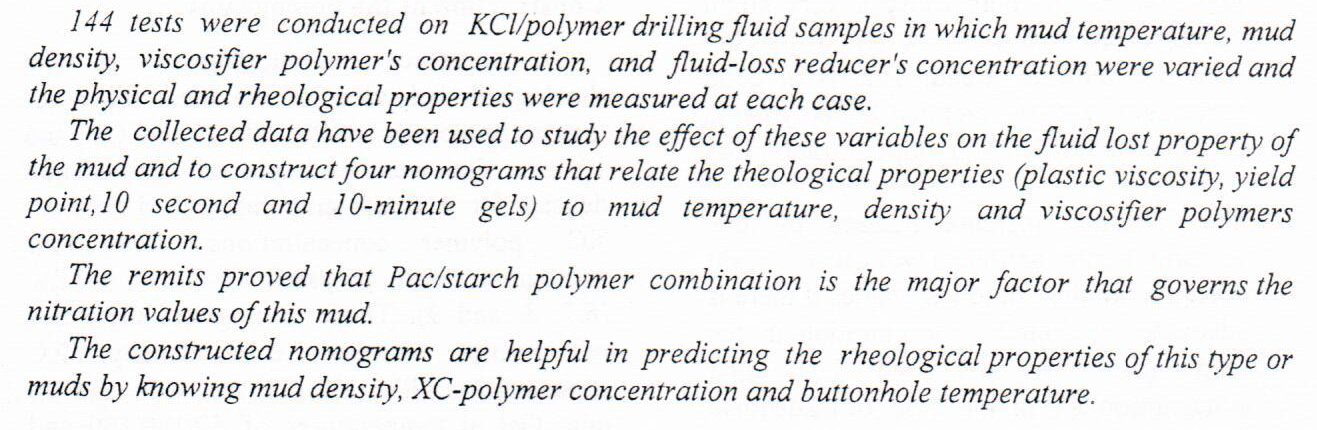
Construction of Nomograms Describing the Effect of Different Variables on the Behavior of a KCl/Polymer Drilling Fluid

FG Mohammed, HM Al-Dabbas, Iraqi journal of science, 2018 - Cited by 6
 (11)
(11)

Waste materials might be utilized in various applications, such as sustainable roller compacted concrete pavements (RCCP), to lessen the negative environmental consequences of construction waste. The impacts of utilizing (brick, thermostone, granite, and ceramic) powders on the mechanical characteristics of RCCP are investigated in this study. To achieve this, the waste materials were crushed, grounded, and blended before being utilized as filler in the RCCP. After the mixes were prepared, compressive strength, splitting tensile strength, flexural strength, water absorption, density, and porosity were all determined. According to the research results, adding some of these powders, mainly brick and granite powder, enhances the mechanical
... Show More (5)
(5)

Ethanol as a solvent, a precursor of titanium isopropoxide and a stabilizer of either hydrochloric acid or ammonium hydroxide was used to prepare a titanium dioxide aqueous solution. The aqueous solutions with different values of pH and the morphology of the resultant reaction of the nanoparticles of titanium dioxide were investigated. The X-ray diffraction showed that at low temperatures and with acidic solutions, rutile structures are more favorable to grow on titanium dioxide synthesized, while at low and average temperatures and with base solutions, anatase phase is more pronounced. The crystalline form and the re-confirmation of the crystallite size growth were observed by the scanning electron microscopy. The atomi
... Show More
(5)
This paper presents theoretical parametric study of the curvature ductility capacity for reinforced concrete column sections. The study considers the behavior of concrete and reinforcing steel under different strain rates. A computer program has been written to compute the curvature ductility taking into account the spalling in concrete cover. Strain rate sensitive constitutive models of steel and concrete were used for predicting the moment-curvature relationship of reinforced concrete columns at different rate of straining. The study parameters are the yield strength of main reinforcement, yield strength of transverse reinforcement, compressive strength of concrete, spacing of ties and the axial load. The results indicated that hi
... Show More
(1)
The applications of Multilevel Converter (MLC) are increased because of the huge demand for clean power; especially these types of converters are compatible with the renewable energy sources. In addition, these new types of converters have the capability of high voltage and high power operation. A Nine-level converter in three modes of implementation; Diode Clamped-MLC (DC-MLC), Capacitor Clamped-MLC (CC-MLC), and the Modular Structured-MLC (MS-MLC) are analyzed and simulated in this paper. Various types of Multicarrier Modulation Techniques (MMTs) (Level shifted (LS), and Phase shifted (PS)) are used for operating the proposed Nine level - MLCs. Matlab/Simulink environment is used for the simulation, extracting, and ana
... Show More
(2)
A study of characteristics of the lubricant oils and the physical properties is essential to know the quality of lubricant oils. The parameters that lead to classify oils have been studied in this research. Three types of multi-grades lubricant oils were applied under changing temperatures from 25 oC to 78oC to estimate the physical properties and mixture compositions. Kinematic viscosity, viscosity gravity constant and paraffin (P), naphthenes (N) and aromatics (A) (PNA) analysis are used to predict the composition of lubricants oil. Kinematic viscosity gives good behaviors and the oxidation stability for each lubricant oils. PNA analysis predicted fractions of paraffin (XP), naphthenes (XN),
... Show More
(2)
Rutting is a predominant distress in asphalt pavements, particularly in hot climatic regions. This study systematically investigated the high-temperature performance of hot mix asphalt modified with five nanomaterials, namely, nano-silica (NS), nano-alumina (NA), nano-titanium (NT), nano-zinc (NZ), and carbon nanotubes (CNTs), under consistent laboratory conditions. Modification dosages were selected up to 10% for NS, NA, and NT, and up to 5% for NZ and CNTs. The experimental methodology comprised the following: (i) binder rheological characterization through rotational viscosity, G*/sinδ, and multiple stress creep recovery (MSCR) to quantify rutting susceptibility; (ii) chemical and microstructural assessments using Fourier transf
... Show More
(3)
(3)
Background : surface area anatomy is a proportional point to the retention of complete denture, in past there was no quantitative method to evaluate the surface area, nowadays the size and shape of maxillary arch is measured by different electronically and mathematical devices. A study was therefore, undertaken to measure surface area of upper dental cast that was taken by different final impressions. Materials and methods: twenty patients were examined. All of them had a healthy palate with no singe of injury, trauma, or deformity. Casts were taken by three different final impressions; zinc oxide, additional silicon, and poly ether. And two different devices were used; the computerized one and the Aluminum foil measure. Age, se
... Show MoreAn investigation was conducted effect of addition co- solvent on solvent extraction process for two types of a lubricating oil fraction (spindle) and (SAE-30) obtained from vacuum distillation unit of lube oil plant of Daura Refinery. In this study two types of co-solvents ( formamide and N-methyl, 2, pyrrolidone) were blended with furfural to extract aromatic hydrocarbons which are the undesirable materials in raw lubricating oil, in order to improve the viscosity index, viscosity and yield of produced lubricating oil. The studied operating condition are extraction temperature range from 70 to 110 °C for formamide and 80 to 120 °C for N-methyl, 2, pyrrolidone, solvent to oil ratio range from 1:1 to 2:1 (wt./wt.) for furfural with form
... Show More