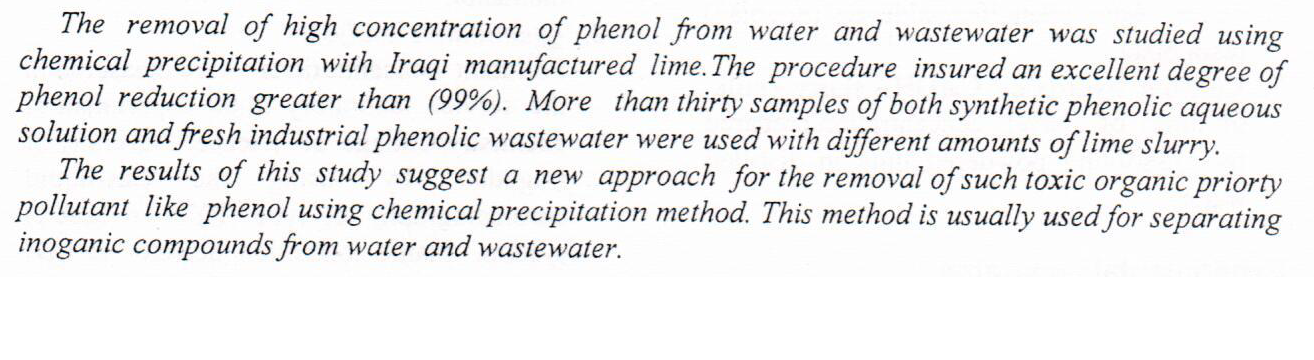
Removal of Phenol from Water and Wastewater by Chemical Precipitation with Lime

Most approaches to combat antibiotic resistant bacteria concentrate on discovering new antibiotics or modifying existing ones. However, one of the most promising alternatives is the use of bacteriophages. This study was focused on the isolation of bacteriophages that are specific to some of commonly human pathogens namely E. coli, Streptococcus pyogenes, Staphylococcus aureus, Proteus mirabilis, Pseudomonas aeruginosa, Salmonella spp. and Klebsiella pneumoniae. These bacteriophages were isolated from sewages that were collected from four different locations in Kirkuk City. Apart from S. pyogenes, bacteriophages specific to all tested bacteria were successfully isolated and tested for their effectiveness by spot test. The most effective
... Show More (4)
(4)
 (2)
(2)


Water is an essential aspect of life and important in evolution. Recently the potable water quality topic has received much attention. The study aims to determine drinking water quality in Al-Najaf City by collecting samples throughout Al-Najaf city and comparing the results with the Iraqi guidelines (IQS 417) and World Health Organization (WHO) guidelines, as well as to calculate the WQI. Samples were tested in the laboratory between December 2021 and June 2022. The results showed that multiple parameters exceeded the allowable limits during both testing periods; during winter months, the results of TDS and turbidity exceeded the upper limits in multiple locations. Total hardness values also
... Show More
(103)
(95)

Oily wastewater is one of the most challenging streams to deal with especially if the oil exists in emulsified form. In this study, electrospinning method was used to prepare nanofiberous polyvinylidene fluoride (PVDF) membranes and study their performance in oil removal. Graphene particles were embedded in the electrospun PVDF membrane to enhance the efficiency of the membranes. The prepared membranes were characterized using a scanning electron microscopy (SEM) to verify the graphene stabilization on the surface of the membrane homogeneously; while FTIR was used to detect the functional groups on the membrane surface. The membrane wettability was assessed by measuring the contact angle. The PVDF and PVDF / Graphene membranes efficiency
... Show More
(1)
Previous experimental studies have suggested that hot mixed asphalt (HMA) concrete using hydrated lime (HL) to partially replace the conventional limestone dust filler at 2.5% by the total weight of all aggregates showed an optimum improvement on several key mechanical properties, fatigue life span and moisture susceptibility. However, so far, the knowledge of the thermal response of the modified asphalt concrete and thermal influence on the durability of the pavement constructed are still relatively limited but important to inform pavement design. This paper, at first, reports an experimental study of the tensile fatigue life of HMA concrete mixes designed for wearing layer application. Tests were conducted under three different temperatur
... Show More
(3)
This study has been performed to study the inhibitory effects of crude plant extracts of Bay (laurus nobilis) leaves against some bacterial isolates represented by Staphylococcus aureus, Staphylococcus epidermids, Proteus vulgaris, Bacillus subtilis, Escherichia coli, and Pseudomonas aeroginosa in vitro. The results showed that percentages of essential chemical of laurus nobilis leaves which represented by moisture, total oil, total ash, crude protein, crude fibers, carbohydrites and caloric values in dry weight are 5.96, 4.28, 14.2, 8.75, 24.8, 76.99%, and 284.92 kcal/100g respectively, the percentages of some major and minor mineral elements of laurus nobilis leaves powder which represented by Mg, Fe, Cu, Pb, Cd and As, are: 0.211, 0.1
... Show MoreObjective: To identify of the effect of the different concentrations of the special liquid (for mixing the investment, Gilvest)
and mixed with water/powder ratio on setting time of phosphate–bonded investment.
Method and materials: The present study is (60) specimens made from phosphate bonded investment divided into (4)
groups (control and experimental groups), (15) specimens for each group. The Gillmore needle device is used to setting
time of phosphate bonded investment mixed with different concentration of Gilvest and water.
Results: Showed that there is a high significant difference (P<0.01) between each groups in the ANOVA test and a
significant difference (P<0.05) between the group (A) and control group i
(18)
Interested current Research measuring damage currency Swap by converting The ministry of higher Education and scientific Research money The Iraqi dinar To U.S dollar by Trade Bank Of Iraq , And that The damage Generated resulting from Deferent Between the Exchange Rate adopted From Central Bank of Iraq and Market Exchange Rate adopted by The Trade Bank Of Iraq , and Which led to the greet damage ( losses ) in Bearing by the ministry, which led to the reduction of the financial allocations for licensed curriculum outside of Iraq , and this in turn leads to reduction in the number of students Sender ( scholarships ) outside Iraq.
Where the estimated loss (damage) that suffer by the Ministry of H
... Show More
CUPPER(||)AND MERCURY (||)Complexes WITH SCHIFF BASE LIGAND FROM BENZIDIN WITH ISATIN AND BENZOIN:SYNTHESIS,SPECTRAL CHARACTERIZATION, THERMAL STUDIES AND BIOLOGICAL ACTIVITIES