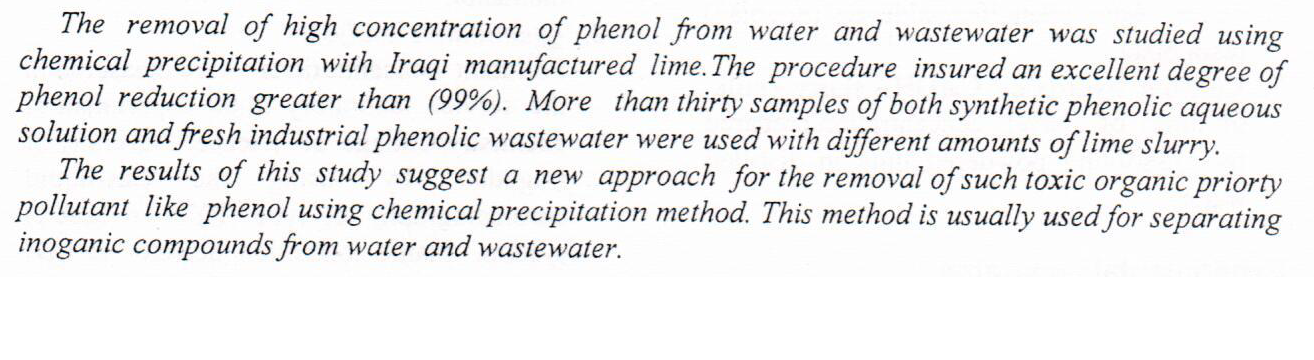
Removal of Phenol from Water and Wastewater by Chemical Precipitation with Lime

Kinetics study on the phenol oxidation by catalytic wet air oxidation (CWAO) using CuO.NiO/Al2O3 as heterogeneous catalyst is presented. 4 g/l phenol solution of pH 7.3 was oxidized in a trickle bed reactor with gas flow rate of 80% stochiometric excess (S.E).. In order to verify the proposed kinetics, a series of CWAO experimental tests were done at two temperatures (140 and 160° C), oxygen partial pressures (9 and 12 bar), and weight hourly space velocity (WHSV) (1, 1.5, 2, 2.5, and 3 h-1). According to Power Law, the reaction orders are found to be approximately 1 and 0.5 with respect to phenol concentration and oxygen solubility, respectively. These values favorably compare with those cited in the literature for intrinsic kinetics,
... Show MoreToxic substances have been released into water supplies in recent decades because of fast industrialization and population growth. Fenton electrochemical process has been addressed to treat wastewater which is very popular because of its high efficiency and straightforward design. One of the advanced oxidation processes (AOPs) is electro-Fenton (EF) process, and electrode material significantly affects its performance. Nickel foam was chosen as the source of electro-generated hydrogen peroxide (H2O2) due to its good characteristics. In the present study, the main goals were to explore the effects of operation parameters (FeSO4 concentration, current density, and electrolysis time) on the catalytic performance that was optimized by r
... Show More (6)
(6)

Toxic substances have been released into water supplies in recent decades because of fast industrialization and population growth. Fenton electrochemical process has been addressed to treat wastewater which is very popular because of its high efficiency and straightforward design. One of the advanced oxidation processes (AOPs) is electro-Fenton (EF) process, and electrode material significantly affects its performance. Nickel foam was chosen as the source of electro-generated hydrogen peroxide (H2O2) due to its good characteristics. In the present study, the main goals were to explore the effects of operation parameters (FeSO4 concentration, current density, and electrolysis time) on the catalytic perform
... Show More
(6)
There significant correlation between vehicles Home (carbohydrates, protein, fiber and fat and injury borer stalk corn was for vehicles secondary effect is clear in injury borer stalk corn coumarin clear impact in the survival rate of larvae The more of these compounds in genotype I survival rate of larvae
In this study, the chamomile flowers (Matricaria recutitaL) which grow in Iraqi Kurdistan region during the seasons of (2008) are collected. The percentage of essential oil was determined by using steam distillation and the extraction of flowers performed with petroleum ether (70-80) ºC and methanol 70% using ultrasonic extraction. Total phenolic compounds were determined from methanol extracts by using Folin-Ciocalteu method. The extracts were evaluated by thin layer chromatography, ultraviolet absorption and the biological activities were evaluated through their antibacterial action against two types of bacteria using hole method. The flowers showed a composition of 0.071% ash, 0.4% essential oil, 3.2% non oily compounds, 4% oil, 1.9% mo
... Show More
(1)
Trickle irrigation is a system for supplying filtered water and fertilizer directly into the soil and water and it is allowed to dissipate under low pressure in an exact predetermined pattern. An equation to estimate the wetted area of unsaturated soil with water uptake by roots is simulated numerically using the HYDRUS-2D/3D software. In this paper, two soil types, which were different in saturated hydraulic conductivity were used with two types of crops tomato and corn, different values of emitter discharge and initial volumetric soil moisture content were assumed. It was assumed that the water uptake by roots was presented as a continuous sink function and it was introduced into Richard's equation in the unsaturated z
... Show More
(1)
Excessive intake of fluoride, mainly through drinking water is a serious health hazard affecting humans worldwide. In this study, the defluoridation capacities of locally available raw waste beef bones have been estimated. Several experimental parameters including contact time, pH, bone dose, fluoride initial concentration, bone grains size, agitation rate, and the effect of co-existence of anions in actual samples of wastewater were studied for fluoride removal from aqueous solutions. Results indicated excellent fluoride removal effeciency up to 99.7% at fluoride initial concentration of 10 mg F/L and 120 min contact time. Maximum fluoride uptake was obtained at neutral pH range 6-7. Fluoride removal kinetic was well described by the ps
... Show More
Effluent from incompetent wastewater treatment plants (WWTPs) contains a great variety of pollutants so support water treatments are essential. The present work studies the removal of phosphate species from aqueous solutions by adsorption on to spherical Calcined Sand -Clay mixture (CSCM) used a natural, local and low-cost adsorbent. Batch experiments were performed to estimate removal efficiency of phosphate. The adsorption experiments were carried out as function of pH, dose of adsorbent, initial concentration, temperature and time of adsorption. The efficient removal was accomplished for pH between 10 and 12. The experimental results also showed that the removal of phosphate by (CSCM) was rapid (the % removal 98.9%, 92%, 90%, 89% in 6
... Show More (31)
(21)
(31)
(21)


The biosorption of Pb (II), Cd (II), and Hg (II) from simulated aqueous solutions using baker’s yeast biomass was investigated. Batch type experiments were carried out to find the equilibrium isotherm data for each component (single, binary, and ternary), and the adsorption rate constants. Kinetics pseudo-first and second order rate models applied to the adsorption data to estimate the rate constant for each solute, the results showed that the Cd (II), Pb (II), and Hg (II) uptake process followed the pseudo-second order rate model with (R2) 0.963, 0.979, and 0.960 respectively. The equilibrium isotherm data were fitted with five theoretical models. Langmuir model provides the best fitting for the experimental results with (R2) 0.992, 0
... Show More