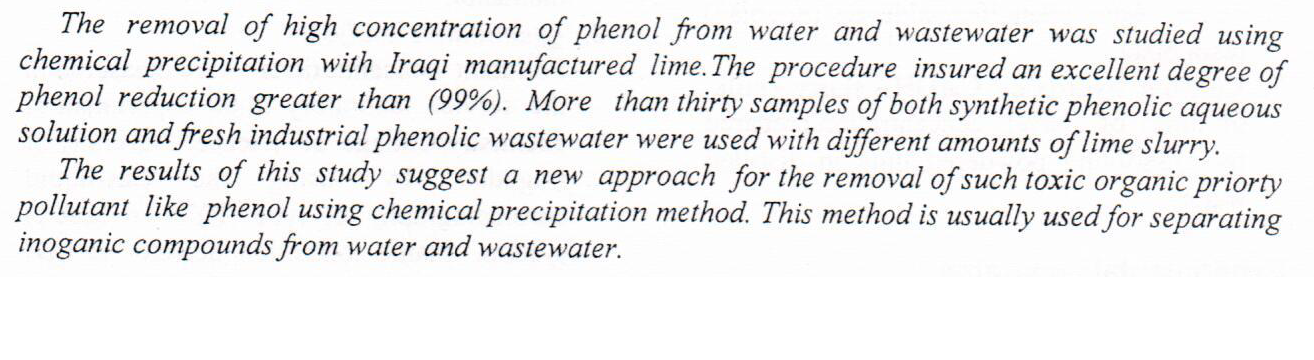
Removal of Phenol from Water and Wastewater by Chemical Precipitation with Lime

 (11)
(11)
 (5)
(5)


Background: Dentin removed during root canal system instrumentation for creating adequate geometry for the canal and cleaning the canal. A new instrument had been marketed with the aim of optimum shaping of all parts of the canal system, however, no information present about the amount of dentin removal compared to conventional rotary system. This study investigated the amount of dentin removal when the canal instrumented by SAF compared with ProTaper by using high resolution computed tomography (micro CT). Materials and Methods: Twenty extracted single canalled teeth were utilized for this study; and randomly divided into 2 groups. In the first group, the root canals were prepared by using protaper rotary system till F2 and the root canal
... Show MoreTo study the comparative use of some soil minerals (zeolite, bentonite, phosphate rock, and limestone) in the adsorption and release of lead and its removal rates from its aqueous solutions using adsorption equations. Two laboratory experiments were carried out for the adsorption and release of lead. The adsorption experiment took 0.5 g of some of the above soil minerals. Lead was added as Pb (NO3)2 at levels of 3.0, 2.0, 1.5, 1.0, 0.5, and 0.0 mmol L-1 containing a concentration of 0.01M of calcium chloride. The experimental unit’s number was 72, the concentration of dissolved lead in the equilibrium solution was estimated and the amount of lead adsorbed was calculated. As for the lead release experiment, samples fo
... Show More
(4)
Recently, increasing material prices coupled with more acute environmental awareness and the implementation of regulation has driven a strong movement toward the adoption of sustainable construction technology. In the pavement industry, using low temperature asphalt mixes and recycled concrete aggregate are viewed as effective engineering solutions to address the challenges posed by climate change and sustainable development. However, to date, no research has investigated these two factors simultaneously for pavement material. This paper reports on initial work which attempts to address this shortcoming. At first, a novel treatment method is used to improve the quality of recycled concrete coarse aggregates. Thereafter, the treated recycled
... Show More
(29)
The toxicological risks and lifetime cancer risks associated with exposure to disinfection by-products (DBPs) including Halloacetic acids (HAAs) and trihalomethanes (THMs) compounds by drinking water in several districts in Wassit Province were estimated. The seasonal variation of HAAs and THMs compounds in drinking water have indicated that the mean values for total HAAs (THAAs) and total THMs (TTHMs) ranged from 43.2 to 72.4 mg/l and from 40 to 115.5 mg/l, respectively. The World health organization index for additive toxicity approach was non-compliant with the WHO guideline value in summer and autumn seasons and this means that THMs concentration has adverse toxic health effects. The multi-pathway of lifetime hu
... Show More
(1)

A total of 96 stool samples were collected from children with bloody diarrhea from two hospitals in Baghdad. All samples were surveyed and examined for the presence of the Escherichia coli O157:H7 and differentiate it from other Non -Sorbitol Fermenting Escherichia coli (NSF E. coli). The Bacterial isolates were identifed by using morphological diagnostic methods, Samples were cultured on liquid enrichment medium, incubated at 37C? for 24 hrs, and then cultured on Cefixime Tellurite -Sorbitol MacConkey Agar (CT- SMAC). 32 non-sorbitol fermenting bacterial isolates were obtained of which 11 were identified as Escherichia coli by using traditional biochemical tests and API20E diagnostic system without differentiation between
... Show More
(3)
(3)
Most of the water pollutants with dyes are leftovers from industries, including textiles, wool and others. There are many ways to remove dyes such as sorption, oxidation, coagulation, filtration, and biodegradation, Chlorination, ozonation, chemical precipitation, adsorption, electrochemical processes, membrane approaches, and biological treatment are among the most widely used technologies for removing colors from wastewater. Dyes are divided into two types: natural dyes and synthetic dyes.
(5)