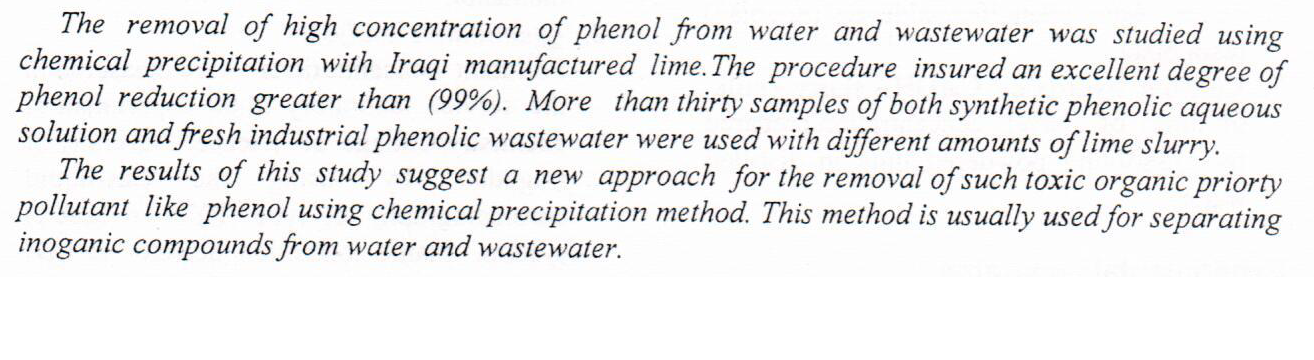
Removal of Phenol from Water and Wastewater by Chemical Precipitation with Lime

Indirect electrochemical oxidation of phenol and its derivatives was investigated by using MnO2 rotating cylinder electrode. Taguchi experimental design method was employed to find the best conditions for the removal efficiency of phenol and its derivatives generated during the process. Two main parameters were investigated, current density (C.D.) and electrolysis time. The removal efficiency was considered as a response for the phenol and other organics removal. An orthogonal array L16, the signal to noise (S/N) ratio, and the analysis of variance were used to test the effect of designated process factors and their levels on the performance of phenol and other organics removal efficiency. The results showed that th
... Show MoreThe current study was designed to remove Lead, Copper and Zinc from industrial wastewater using Lettuce leaves (Lactuca sativa) within three forms (fresh, dried and powdered) under some environmental factors such as pH, temperature and contact time. Current data show that Lettuce leaves are capable of removing Lead, Copper and Zinc ions at significant capacity. Furthermore, the powder of Lettuce leaves had highest capability in removing all metal ions. The highest capacity was for Lead then Copper and finally Zinc. However, some examined factors were found to have significant impacts upon bioremoval capacity of studied ions, where best biosorption capacity was found at pH 4, at temperature 50º C and contact time of 1 hour.
 (5)
(5)

 (30)
(20)
(30)
(20)


The use of biopolymer material Chitosan impregnated granular activated carbon CHGAC as adsorbent in the removal of lead ions pb.2+ from aqueous solution was studied using batch adsorption mode. The prepared CHGAC was characterized by Scanning Electronic Microscopy (SEM) and atomic-absorption pectrophotometer. The adsorption of lead ions onto Chitosan-impregnated granular activated carbon was examined as a function of adsorbent weight, pH and
contact time in Batch system. Langmuir and Freundlich models were employed to analyze the resulting experimental data demonstrated that better fitted by Langmuir isotherm model than Freundlich model, with good correlation coefficient. The maximum adsorption capacity calculated f
In this research, the removal of cadmium (Cd) from simulated wastewater was investigated by using a fixed bed bio-electrochemical reactor. The effects of the main controlling factors on the performance of the removal process such as applied cell voltage, initial Cd concentration, pH of the catholyte, and the mesh number of the cathode were investigated. The results showed that the applied cell voltage had the main impact on the removal efficiency of cadmium where increasing the applied voltage led to higher removal efficiency. Meanwhile increasing the applied voltage was found to be given lower current efficiency and higher energy consumption. No significant effect of initial Cd concentration on the removal efficie
... Show More
(8)
In this research, the removal of cadmium (Cd) from simulated wastewater was investigated by using a fixed bed bio-electrochemical reactor. The effects of the main controlling factors on the performance of the removal process such as applied cell voltage, initial Cd concentration, pH of the catholyte, and the mesh number of the cathode were investigated. The results showed that the applied cell voltage had the main impact on the removal efficiency of cadmium where increasing the applied voltage led to higher removal efficiency. Meanwhile increasing the applied voltage was found to be given lower current efficiency and higher energy consumption. No significant effect of initial Cd concentration on the removal efficiency of cadmium b
... Show More
(8)
The disposal of textile effluents to the surface water bodies represents the critical issue especially these effluents can have negative impacts on such bodies due to the presence of dyes in their composition. Biological remediation methods like constructed wetlands are more cost-effective and environmental friendly technique in comparison with traditional methods. The ability of vertical subsurface flow constructed wetlands units for treating of simulated wastewater polluted with Congo red dye has been studied in this work. The units were packed with waterworks sludge bed that either be unplanted or planted with Phragmites australis and Typha domingensis. The efficacy of present units was evaluated by monitoring of DO, Temperature, COD
... Show More
(7)
In order to scrutinize the impact of the decoration of Sc upon the sensing performance of an XN nanotube (X = Al or Ga, and XNNT) in detecting sarin (SN), the density functionals M06-2X, τ-HCTHhyb, and B3LYP were utilized. The interaction of the pristine XNNT with SN was a physical adsorption with the sensing response (SR) of approximately 5.4. Decoration of the Sc metal into the surface of the AlN and GaN led to an increase in the adsorption energy of SN from −3.4 to −18.9, and −3.8 to −20.1 kcal/mol, respectively. Also, there was a significant increase in the corresponding SR to 38.0 and 100.5, the sensitivity of metal decorated XNNT (metal@XNNT) is increased. So, we found that Sc-decorating more increases the sensitivity of GaNN
... Show More
(1)
(1)
In this study, the response and behavior of machine foundations resting on dry and saturated sand was investigated experimentally. In order to investigate the response of soil and footing to steady state dynamic loading, a physical model was manufactured. The manufactured physical model could be used to simulate steady state harmonic load at different operating frequencies. Total of (84) physical models were performed. The parameters that were taken into considerations include loading frequency, size of footing and different soil conditions. The footing parameters were related to the size of the rectangular footing and depth of embedment. Two sizes of rectangular steel model footing were used (100 200 12.5 mm) and (200 400 5.0 mm).
... Show More
(28)
The current study objective is to synthesize activated carbon (AC) from compressed wood using the ZnCl2 activating agent and to assess the ciprofloxacin (CIP) elimination efficiency in simulated wastewater. The produced AC was characterized using multiple techniques, including SEM, BET, FTIR, AFM, and XRD. The adsorbent demonstrates high adsorption performance, achieving 91% removal of CIP within 5 hours at an initial pollutant concentration of 100 mg/L with an AC dose of 2 g/L. Experimental data correspond to the Freundlich isotherm model (R² = 0.995) as well as the Langmuir competitive fitting (R² = 0.99), while the root mean square error (RMSE) equation best fits the Langmuir model. Moreover, the pseudo-second-order
... Show More