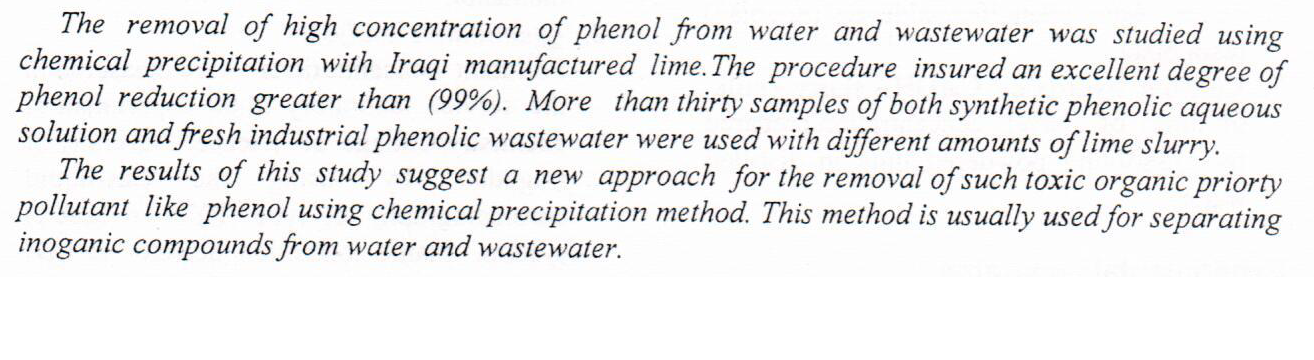
Removal of Phenol from Water and Wastewater by Chemical Precipitation with Lime

Activated carbon derived from Ficus Binjamina agro-waste synthesized by pyro carbonic acid microwave method and treated with silicon oxide (SiO2) was used to enhance the adsorption capability of the malachite green (MG) dye. Three factors of concentration of dye, time of mixing, and the amount of activated carbon with four levels were used to investigate their effect on the MG removal efficiency. The results show that 0.4 g/L dosage, 80 mg/L dye concentration, and 40 min adsorption duration were found as an optimum conditions for 99.13% removal efficiency. The results also reveal that Freundlich isotherm and the pseudo-second-order kinetic models were the best models to describe the equilibrium adsorption data.
 (7)
(7)
 (3)
(3)

 (3)
(5)
(3)
(5)
The properties of structural and optical of pure and doped nano titanium dioxide (TiO2) films, prepared using chemical spray pyrolysis (CPS) technique, with different nanosize nickel oxide (NiO) concentrations in the range (3-9)wt% have been studied. X-Ray diffraction (XRD) technique where using to analysis the structure properties of the prepared thin films. The results revealed that the structure properties of TiO2 have polycrystalline structure with anatase phase. The parameters, energy gap, extinction coefficient, refractive index, real and imaginary parts were studied using absorbance and transmittance measurements from a computerized ultraviolet visible spectrophotometer (Shimadzu UV-1601 PC) in the wavelength
... Show More
(4)
This study was carried out to measure the percentage of heavy metals pollution in the water of the Diyala river and to measure the percentage of contamination of these elements in the leafy vegetables grown on both sides of the Diyala river, which are irrigated by the contaminated river water (celery, radish, lepidium, green onions, beta vulgaris subsp, and malva). Laboratory analysis was achieved to measure the ratio of heavy element contamination (Pb, Fe, Ni, Cd, Zn and Cr) using flame atomic absorption spectrophotometer during the summer months of July and August for the year 2017. The study showed that the elements of zinc, chromium, nickel and cadmium were high concentrations and exceeded. The maximum concentration of these
... Show MoreDesign of experiments (DOE) was made by Minitab software for the study of three factors used in the precipitation process of the Sodium Aluminate solution prepared from digestion of α-Al2O3 to determine the optimum conditions to a produce Boehmite which is used in production of ɤ-Al2O3 during drying and calcination processes, the factors are; the temperature of the sodium aluminate solution, concentration of HCl acid added for the precipitation and the pH of the solution at which the precipitation was ended. The design of the experiments leads to 18 experiments.
The results show that the optimum conditions for the precipitation of the sodium aluminate solution which
... Show MoreThis paper was aimed to study the efficiency of forward osmosis (FO) process as a new application for the treatment of wastewater from textile effluent and the factors affecting the performance of forward osmosis process.
The draw solutions used were magnesium chloride (MgCl2), and aluminum sulphate (Al2 ( SO4)3 .18 H2O), and the feed solutions used were reactive red, and disperse blue dyes.
Experimental work were includes operating the forward osmosis process using thin film composite (TFC) membrane as flat sheet for different draw solutions and feed solutions. The operating parameters studied were : draw solutions concentration (10 – 90 g/l), feed solutions concentration (5 – 30 mg/l), draw solutions flow rate (10 – 50 l/hr
(2)
(5)
The research aimed to determine the role of the agricultural extension in educating farmers about the legislation on the protection of the rural environment from pollution with chemical pesticides working in the Department of Agricultural Extension and Training and the Department of Agricultural Extension in the directorates of agriculture of Najaf and Qadisiyah, and to determine the role of the agricultural extension in the axis of farmers' use of the correct methods to protect the rural environment from pollution with chemical pesticides and the axis of the reasons that lead farmers to pollute the rural environment with chemical pesticides, and to achieve the objectives of this research prepared A questionnaire in the light of rev
... Show More
High-performance liquid chromatographic methods are used for the determination of water-soluble vitamins with UV-Vis. Detector. A reversed-phase high-performance liquid chromatographic has been developed for determination of water-soluble vitamins. Identification of compounds was achieved by comparing their retention times and UV spectra with those of standards solution. Separation was performed on a C18 column, using an isocratic 30% (v/v) acetonitril in dionozed water as mobile phase at pH 3.5 and flow rate 1.0m/min. The method provides low detection and quantification limits, good linearity in a large concentration interval and good precision. The detection limits ranged from 0.01 to 0.025µg/ml. The accuracy of the method was
... Show More
(4)
An experiment was conducted in pots under field conditions during fall seasons of 2017 and 2018. This study aimed to improve a weak growth of seedlings under salt stress in sorghum. Three factors were studied. 1st factor was three cultivars (Inqath, Rabeh, and Buhoth70). 2nd factor was seed priming (primed and unprimed seed). Seed were primed by soaking for 12 hours in a solution containing 300 + 70 mg L−1 of gibberellic (GA3) and salicylic (SA) acids, respectively. 3rd factor was irrigation with saline water (6, 9 and 12 dS m−1) resulting from dissolving sodium chloride in distilled water in addition to control treatment (distilled water). Randomized complete block design was used with four replications. In both seasons: the results sh
... Show More
(32)
(25)
