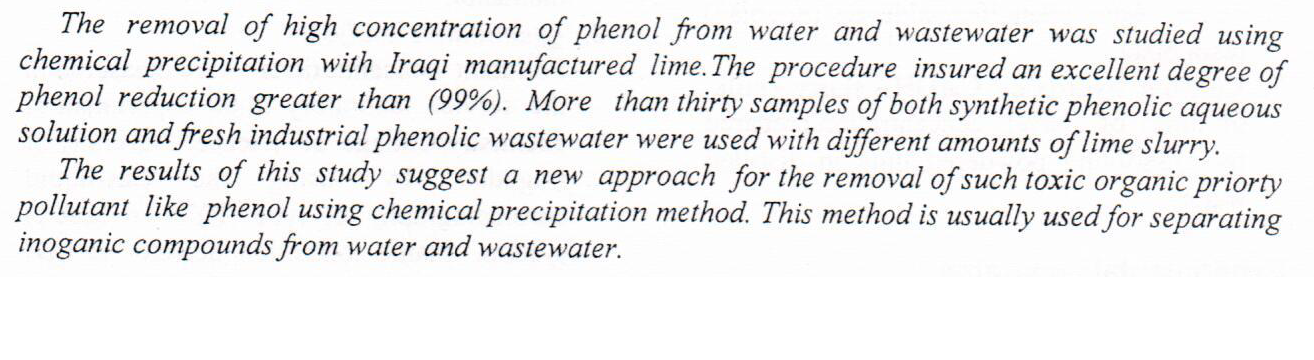
Removal of Phenol from Water and Wastewater by Chemical Precipitation with Lime

Silicon nitride nanostructures were prepared by reactive sputtering technique using silicon targets with different types of electrical conductivity (n-type and p-type) and Ar:N2 gas mixing ratio of 70:30. The optical microscopy and spectroscopic characteristics of these films were determined in order to introduce the effect of target conductivity type on these characteristics. The results showed that using p-type silicon target would produce Si3N4 films with lower tendency to adsorb water vapor and other constituents of the atmospheric air, higher absorbance in the visible range 400-700nm, and lower variation in the energy band gap with film thickness than the Si3N4 films prepared from n-type silicon target.
Reaction of  p-fluoro benzoic acid with the thiosemicarbazide and salcialdehyde gave the new bidentate ligand .The prepared ligand Identified by FT-I.R and U.V-Visible spectcopic technique .Treatment of the prepared   ligand   with following metal ions  M=Tb(III),Eu(III),Nd(III) and La(III) ,in ethanol with a (1:1) M:L ratio and at pH=7 yielded series of neutral complexes as the general formula  [M LCl (H O ]. The prepared complexes were characterized using (FT-IR, UV-Vis) spectra , melting point, molar conductivity measurements . chloride ion content were also evolution by (mhor method) . The proposed structure of the complexes using program , chem office 3D(2004) .
A survey of entomopathogenic and other opportunistic fungi isolated from soil samples collected from insect hibernation sites in different habitats in Kurdistan region of Iraq was carried out during October to December 2009. By using dilution plate method, two entomopathogenic species (Beauveria bassiana (Bals.) Vuill.and Isaria javanica (Friedrichs & Bally) Samson & Hywel-Jones) were detected with isolation percentage (38.46%) each. Other opportunistic fungi such as Alternaria alternata, Aspergillus flavus, A.niger, Penicillium glabrum, P. digitatum, Rhizopus stolonifer and Syncephalastratum racemosum
 (4)
(4)



Background. Endodontic infections caused by remaining biofilm following disinfection with chemical fluids encourage secondary bacterial infection; hence, employing laser pulses to activate the fluids is advised to improve microbial biofilm clearance. This study investigated the performance of Er,Cr:YSGG laser in photon-induced photoacoustic streaming (PIPS) agitation of 5.25% sodium hypochlorite (NaOCl) to enhance the removal of mature Enterococcus faecalis (E. faecalis) biofilms in complex root canal systems. Methods. The mesial roots of the lower first and second molars were separated and inoculated with E. faecalis bacteria for 30 days. The roots were irrigated with 5.25% NaOCl, some of them were agitated with passive ultrasonic
... Show More
(4)
 (4)
(4)
Some types of the fungus Aspergillus were isolated from some hospitals in the city of Baghdad (Imam Ali Hospital and Sadr General Hospital). The samples were taken by Transport media at a rate of three replicates of each place isolated from samples from different places within the hospital (waste, baths, the sick beds, corridors and room floors) for the purpose of isolating and diagnosing the fungus on the Czapeck Dox Agar media. It was noticed that the spread rate of fungus Aspergillus was 70% compared to other species that have emerged during the isolation process of the Sabouraud's Dextrose Agar media. The species A.niger (56.25%) was considered the most common type of fungus visible during the isolation process of the Imam Ali Hospit
... Show MorePrevious studies on the synthesis and characterization of metal chelates with uracil by elemental analysis, conductivity, IR, UV-Vis, NMR spectroscopy, and thermal analysis were covered in this review article. Reviewing these studies, we found that uracil can be coordinated through the electron pair on the N1, N3, O2, or O4 atoms. If the uracil was a mono-dentate ligand, it will be coordinated by one of the following atoms: N1, N3 or O2. But if the uracil was bi-dentate ligand, it will be coordinated by atoms N1 and O2, N3 and O2 or N3 and O4. However, when uracil forms complexes in the form of polymers, coordination occurs through the following atoms: N1 and N3 or N1 and O4.
(48)
(46)
(48)
(46)
Atenolol was used with ammonium molybdate to prove the efficiency, reliability and repeatability of the long distance chasing photometer (NAG-ADF-300-2) using continuous flow injection analysis. The method is based on reaction between atenolol and ammonium molybdate in an aqueous medium to obtain a dark brown precipitate. Optimum parameters was studied to increase the sensitivity for developed method. A linear range for calibration graph was 0.1-3.5 mmol/L for cell A and 0.3-3.5 mmol/L for cell B, and LOD 133.1680 ng/100 µL and 532.6720 ng/100 µL for cell A and cell B respectively with correlation coefficient (r) 0.9910 for cell A and 0.9901 for cell B, RSD% was lower than 1%, (n=8) for the determination of ate
... Show More
(7)
(4)