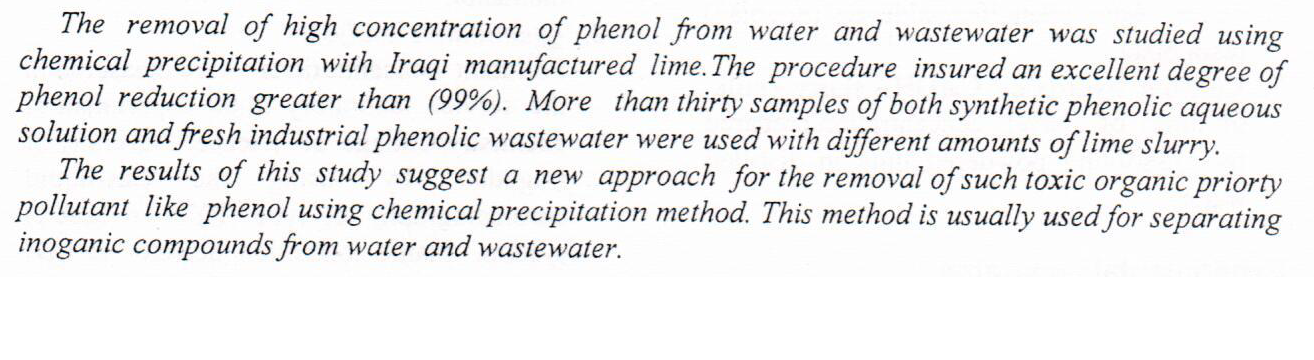
Removal of Phenol from Water and Wastewater by Chemical Precipitation with Lime

This research paper studies the use of an environmentally and not expensive method to degrade Orange G dye (OG) from the aqueous solution, where the extract of ficus leaves has been used to fabricate the green bimetallic iron/copper nanoparticles (G-Fe/Cu-NPs). The fabricated G‑Fe/Cu-NPs were characterized utilizing scanning electron microscopy, BET, atomic force microscopy, energy dispersive spectroscopy, Fourier-transform infrared spectroscopy and zeta potential. The rounded and shaped as like spherical nanoparticles were found for G-Fe/Cu‑NPs with the size ranged 32-59 nm and the surface area was 4.452 m2/g. Then the resultant nanoparticles were utilized as a Fenton-like oxidation catalyst. The degradation efficiency of
... Show More (31)
(31)
 (11)
(11)



The optimum conditions for production of fibrinolytic protease from an edible mushroom Pleurotus ostreatus grown on the solid medium , Sus medium, composed of Sus wastes (produced from extracted medicinal plant Glycyrrhiza glabra) were determined. Addition of 5% of Soya bean seeds meal in Sus medium recorded a maximum fibrinolytic protease activity resulting in 7.7 units / ml. The optimum moisture content of Sus medium supplemented with 5% Soya bean seeds meal was 60% resulting in 7.2 units / ml.Pleurotus ostreatus produced a maximum fibrinolytic protease activity when the spawn rate,pH of medium and incubation temperature were 2,6 and 30°C, respectively. The maximum fibrinolytic protease activity was 7.6 units / ml when incubat
... Show MoreObjective (s): To assess the QoL of children age from (8- lessthan13) years with acute lymphocytic leukemia undergoing chemotherapy and to find out the relationship between the QoL of children with acute lymphocytic leukemia and their illness history.
Methodology: A descriptive study included (40) children with acute lymphocytic leukemia who were ranged between (8 - less than 13 years) at the Hematology Center in Medical City for the period from 4th March 2021 to 1st September 2021. The sample was non-probability (purposive) sample of children (male and female). A questionnaire designed with 2 main parts was used. The first part focused on sociodemographic characterist
... Show MoreEvolution has become a feature of this era because of the speed that makes it open multiple horizons and many to identify everything that is new in different areas and also characterized by the competitive position of emotional attitudes changing depending on the positions of winning and defeat, and the use of training methods are the most important pillars of the game of wrestling, The methods contribute to raising the level of the wrestler and refining his physical and skill potential. The problem of the research is that the shooting exercises from above the chest are very important in Roman wrestling and can be terminated by the player. Through very personal interviews for coaches and concluded that there is a weakness in the level of fl
... Show MoreThis study was carrid out to produce animal gelatin from chicken skin. Gelatin was prepared by the chemical method using HCl 2% and extraction at the temperature degree 70, 80, 90 c° and at the period of time 4, 6, 8 hours, calculated the yield, functional and sensory characteristics were measured at. The result also demonstrated that the produced gelatin have good functional properties in solubility, viscosity, gelling capacity, water absorpation, lipid binding, emulsification. viscosity was higher in gelatin prepared at 70 c° and period of extraction 8 hours and reached 1.0846 cp. Gelatin prepared were featured by highe gelling capacity at 1% for all extraction time periods. The produced gelatin was characterized by good sensory qual
... Show MoreAdsorption studies were performed at different initial Tetracycline (TC) and Amoxicillin (AMO) concentration, different biomass dosage and type, contact time, agitation speed, and initial pH. In the batch mode were investigated. The optimum pH of solutions is 6.5 for TC and 5 for AMO, agitation speed 200 rpm and concentration 50 ppm. The results in FTIR showed that there were -OH and amides (N-H) and other functional groups on the surface of Cladophora and Spirulina algae. The equilibrium isotherm data were modeled with Freundlich, Temkin, and Langmuir isotherm models. The data best fitted with the Langmuir model. The maximal adsorption capacity from the Langmuir model was (9.86, 20. 5 mg/g) for TC and (7.89, 17.4 mg/g) for AMO on
... Show More
(7)
The aim of the present work is to develop a new class of natural fillers based polymer composites with sawdust (S.D) which used two particle sizes (1.2 μm & 2.3 μm) and different weight percentage from sawdust (10%, 15%, and 20%). The mechanical properties studied include hardness (shore D) for all samples at normal conditions (N.C). The unsaturated polyester (UPE) and its composites samples were immersed in water for 30 days to find the effect of particle size of sawdust (S.D) on the weight gain (Mt %) by water for all the samples, also to find the effect of water on their hardness. The results show that the composite materials of sawdust (S.D) fillers which has particle size (1.2 μm) better than (2.3 μm) particle size bef
... Show MoreThe performance of a synergistic combination of electrocoagulation (EC) and electro-oxidation (EO) for oilfield wastewater treatment has been studied. The effect of operative variables such as current density, pH, and electrolyte concentration on the reduction of chemical oxygen demand (COD) was studied and optimized based on Response Surface Methodology (RSM). The results showed that the current density had the highest impact on the COD removal with a contribution of 64.07% while pH, NaCl addition and other interactions affects account for only 34.67%. The optimized operating parameters were a current density of 26.77 mA/cm2 and a pH of 7.6 with no addition of NaCl which results in a COD removal efficiency of 93.43% and a specific energy c
... Show More
(41)
(33)
(41)
(33)
Flavonoids were extracted from Zizyphus spina-christi leaves by Ethyl acetate after acid digested and used as antioxidant. The dried extract was added separately to each sample of fat extracted from hallow cow and sheep bones as follows: T1 cow fat, T2 control for cow fat, T3 sheep fat and T4 control for sheep fat (the control T2 and T4 reffered to samples without added antioxidant).
Samples were stored at -18, 5, 25 and 55 °C for 28 days. The storage trials were conducted at -18, 5 and 25 °C for 28 days for T1, T2, T3 and T4. The chemical indices examined initially and at the end of storage period. PVs was 1.46, 1.46, 1.8 and 1.8 meq/ Kg oil respectively, FFA values were 0.245, 0.245, 0.244 and 0.244% respectively and TBA va