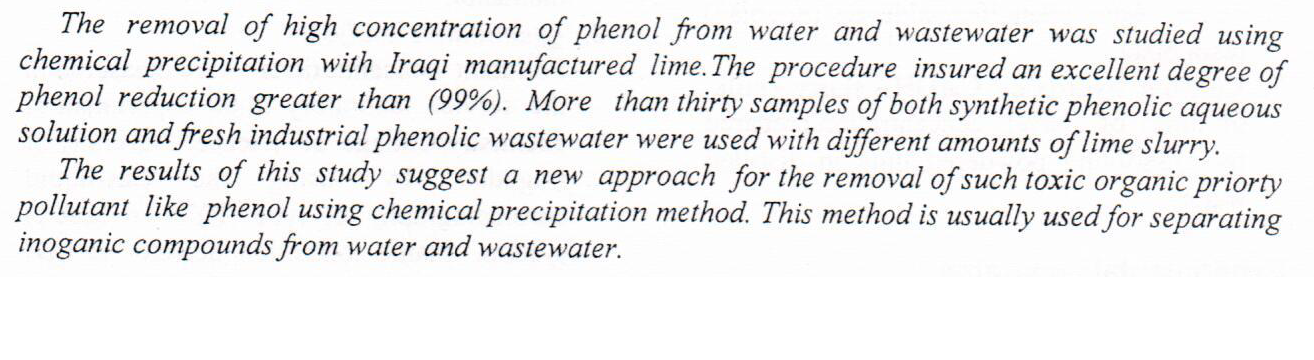
Removal of Phenol from Water and Wastewater by Chemical Precipitation with Lime

To reduce the effects of discharging heated water disposed into a river flow by a single thermal source, two parameters were changed to get the minimum effect using optimization. The first parameter is to distribute the total flow of the heated water between two disposal points (double source) instead of one and the second is to change the distance between these two points. In order to achieve the solution, a two dimensional numerical model was developed to simulate and predict the changes in temperature distribution in the river due to disposal of the heated water using these two points of disposal.
MATLAB-7 software was used to build a program that could solve the governing partial equations of thermal pollution in rivers by using t
Erbil city is located in the northern Iraq with a population of over one million people. Due to water crises farmers usually use wastewater and well water for the agricultural production. In this study six stations were designed to sample waste water and three from well water to define waste water and ground water characteristics. In this study, Residual Na+ Carbonate, Mg++ hazard, salinity hazard, Kelley index, %sodium, total hardness, permeability index, potential salinity, sodium adsorption ratio, and Irrigation Water Quality Index (IWQI) were determined. The order of average cation concentrations in water was Mg2+> Ca2+ > Na+ > K+. While the proportion of main
... Show More (4)
(4)


This study examines experimentally the performance of a horizontal triple concentric tube heat exchanger TCTHE made of copper metal using water as cooling fluid and oil-40 as hot fluid. Hot fluid enters the inner annular tube of the TCTHE in a direction at a temperature of 50, 60 and 70 oC and a flow rate of 20 l/hr. On the other hand, the cooling fluid enters the inner tube and the outer annular tube in the reverse direction (counter current flow) at a temperature of 25 oC and flow rates of 10, 15, 20, 25, 30 and 35 l/hr. The TCTHE is composed of three copper tubes with outer diameters of 34.925 mm, 22.25 mm, and 9.525 mm, and thicknesses of 1.27 mm, 1.143 mm, and 0.762 mm, respectively. TCTHE tube's length was 670
... Show More
(1)
 (2)
(2)
Sodium adsorption ratio (SAR) is considered as a measure of the water suitability for irrigation usage. This study examines the effect of the physicochemical parameters on water quality and SAR, which included Calcium(Ca+2), Magnesium(Mg+2), Sodium (Na+), Potassium (K), Chloride (Cl-), Sulfate(SO4-2), Carbonate (CO3-2), Bicarbonate (HCO3-), Nitrate (NO3-), Total Hardness (TH), Total Dissolved Salts (TDS), Electrical Conductivity (EC), degree of reaction (DR), Boron (B) and the monthly and annually flow discharge (Q). The water samples were collected from three stations across the Tigris River in Iraq, which flows through Samarra city (upstream), Baghdad city (central) and the end of Kut city (downstream) for the periods of 2016-201
... Show More
(43)
(34)

Due to severe scouring, many bridges failed worldwide. Therefore, the safety of the existing bridge (after contrition) mainly depends on the continuous monitoring of local scour at the substructure. However, the bridge's safety before construction mainly depends on the consideration of local scour estimation at the bridge substructure. Estimating the local scour at the bridge piers is usually done using the available formulae. Almost all the formulae used in estimating local scour at the bridge piers were derived from laboratory data. It is essential to test the performance of proposed local scour formulae using field data. In this study, the performance of selected bridge scours estimation formulae was validated and sta
... Show More
(2)
The increasing drinking water demand in many countries leads to an increase in the use of desalination plants, which are considered a great solution for water treatment processes. Reverse osmosis (RO) and electro-dialysis (ED) systems are the most popular membrane processes used to desalinate water at high salinity. Both systems work by separating the ionic contaminates and disposing of them as a brine solution, but ED uses electrical current as a driving force while RO uses osmotic pressure. A direct comparison of reverse osmosis and electro-dialysis systems is needed to highlight process development similarities and variances. This work aims to provide an overview of previous studies on reverse osmosis and electro-dial
... Show More
(14)
(12)