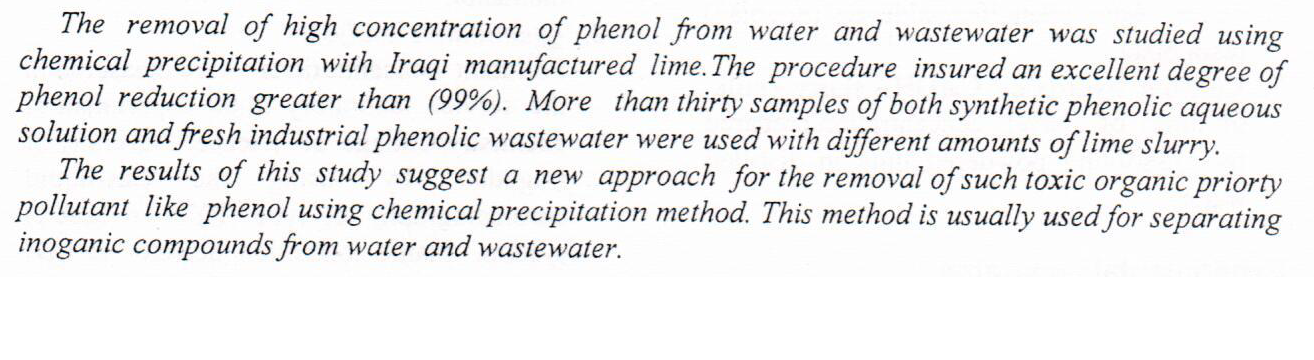
Removal of Phenol from Water and Wastewater by Chemical Precipitation with Lime

 (1)
(1)

A novel series of mixed-ligand complexes of the type, [ML 1 (L 2 ) 3 ]Cl x [M = Cr(III), Fe(III), Co(II),Ni(II), Cu(II), Cd(II) and Hg(II), n = 2, 3], was synthesized using Schiffbase (HL 1 ) as main ligand, nicotinamide (L 2 ) as secondary ligand, and the corresponding metal ions in 1:3:1 molar ratio. The main ligand, HL 1 was prepared by the interaction of ampicillin drug and 4-chlorobenzophenone. The synthesized mixed ligand complexes were characterized by elemental analysis, UV-Vis, FT-IR, 1 H-NMR, 13 C-NMR and TG/DTG studies. In the mixed-ligand complexes, the Schiffbase ligand, HL 1 showed coordination to the central metal ion in tridentate manner via azomethine nitrogen, β-lactam ring oxygen and deprotonated carboxylic oxy- gen atom
... Show MoreABSTRACT The antibacterial and antbiofilm activities of water extract of Calendula officinalis flowers against some of enteropathogenic bacteria was studied, also phytochemical screening and determination of antioxidant activity of the extract has been investigated. The results showed that the water extract of C. officinalis exhibited a good antibacterial activity against all pathogenic bacterial isolates (Salmonella, Shigella dysenteriae, Shigella flexneri, Shigella sonnei and E. coli) especially at concentration 100 µg/ml in contrast with the control cefotan antibiotic. S. sonnei was more sensitive to extract than other bacteria with highest inhibition zone (23 mm). The preliminary phytochemical tests results indicated the presence
... Show MoreThe present work aimed to study the efficiency of thermal osmosis process for recovery of water from organic wastewater solution and study the factors affecting the performance of the osmosis cell. The driving force in the thermo osmosis cell is provided by a difference in temperature across the membrane sides between the draw and feed solution. In this research used a cellulose triacetate (CTA), as flat sheet membranes for treatment of organic wastewater under orientation membrane of active layer facing feed solution (FS) and draw solution (DS) is placed against the support layer. The organic materials were phenol, toluene, xylene and BTX (benzene, toluene, and xylene) used as feed solution. The osmotic agent in draw solution was
... Show More
(5)
In this study, aluminum nanoparticles (Al NPs) were prepared using explosive strips method in double-distilled deionized water (DDDW), where the effect of five different currents (25, 50, 75, 100 and 125 A) on particle size and distribution was studied. Also, the explosive strips method was used to decorate zinc oxide particles with Al particles, where Al particles were prepared in suspended from zinc oxide with DDDW. Transmission electron microscopy (TEM), UV-visible absorption spectroscopy, and x-ray diffraction are used to characterize the nanoparticles. XRD pattern were examined for three samples of aluminum particles and DDDW prepared with three current values (25, 75 and 125 A) and three samples prepared with the same currents for zin
... Show More
In this study, Zinc oxide nanostructures were synthesized via a hydrothermal method by using zinc nitrate hexahydrate and sodium hydroxide as a precursor. Three different annealing temperatures were used to study their effect on ZnO NSs properties. The synthesized nanostructure was characterized by X-ray diffraction (XRD), field emission scanning electron microscopy (FESEM), Atomic force microscope (AFM), and Fourier Transform Infrared Spectroscopy (FTIR). Their optical properties were studied by using UV -visible spectroscopy. The XRD analysis confirms that all ZnO nanostructures have the hexagonal wurtzite structure with average crystallite size within the range of (30.59 - 34
... Show More
(1)
A Raman spectroscopy method was optimised to examine the chemical changes of aspirin tablets after interaction with helium temperatures. Several aspirin tablets were exposed to plasma-assisted desorption ionisation flame for different times (10, 30, 50, 60, 180 and 300s) and then analysed by Raman spectroscopy using optimal conditions. The changes in chemistry between exposed and fresh (without exposure to plasma) tablets were compared. The vibrational peaks of the aspirin molecule in the Raman spectrum were identified by checking the peak position. The results showed clear spectra with increases in intensity of vibrational peaks until 30s, whereas no spectra were measured for the exposed tablets to plasma flame after 50s. It can, the
... Show More (11)
(11)
Background: Fracture of different types of acrylic denture base is a common problem associated with dental prosthesis. Studies suggested that the repair strength may be improved by several means including surface treatment with chemical agents. The aim of the study was to evaluate the effect of surface treatment with acrybond-bonding agent and monomer on fractured denture base in respect to transverse, tensile and shear bond strength and evaluation of the mode of failure by light microscope. Materials and methods: Two hundred seventy specimens were prepared and divided into 3 groups according to the material used (regular conventional, rapid simplified and high impact) heat cure acrylic. The specimen in each groups were prepared specificall
... Show More