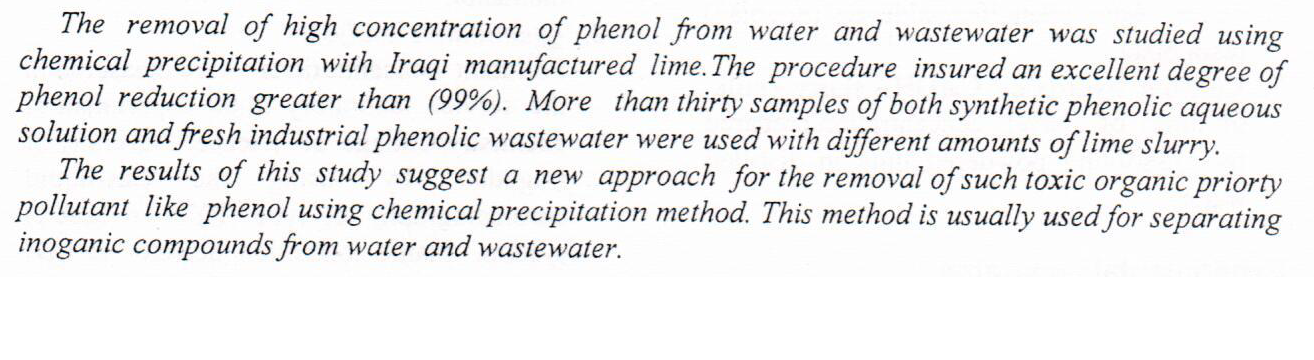
Removal of Phenol from Water and Wastewater by Chemical Precipitation with Lime

In this study an experimental work was done to study the possibility of using aluminum rubbish material as a coagulant to remove the colloidal particles from oily wastewater by dissolving this rubbish in sodium hydroxide solution. The experiments were carried out on simulated oily wastewater that was prepared at different oil concentrations and hardness levels (50, 250, 500, and 1000) ppm oil for (2000, 2500, 3000, and 3500) ppm CaCo3 respectively. The initial turbidity values were (203, 290, 770, and 1306) NTU, while the minimum values of turbidity that have been gained from the experiments in NTU units were (1.67, 1.95, 2.10, and 4.01) at best sodium aluminate dosages in milliliters (12, 20, 24, and 28) for
... Show MoreThe reaction of [Benzoyl hydrazine] with [Diphenyl mono oxime] and Glacial acetic acid was carried out in methanol gave a new tridentate ligand [Benzoic acid (2- hydroxyimino- 1, 2-diphyneylethylidene) - hydrazide]. This ligand was reacted with some metal ions (Fe(II), Co(II), Ni(II), and Cu(II)) in methanol with (1:1) metal : ligand ratio to give a series of new complexes of the general formula [M(L)Cl2.H2O], where M= Fe(11), Co(11), Ni(11) and Cu(11) . All compounds were characterized by spectroscopic methods (I.R, UV-Vis), elemental microanalysis (C.H.N), atomic absorption, magnetic susceptibility, and conductivity measurements. From the obtained data the proposed molecular structures were suggested for the complexes of Fe (II), Co (II)
... Show MoreThe reaction of [Benzoyl hydrazine] with [Diphenyl mono oxime] and Glacial acetic acid was carried out in methanol gave a new tridentate ligand [Benzoic acid (2-hydroxyimino- 1, 2-diphyneylethylidene) - hydrazide]. This ligand was reacted with some metal ions (Fe(II), Co(II), Ni(II), and Cu(II)) in methanol with (1:1) metal : ligand ratio to give a series of new complexes of the general formula [M(L)Cl2.H2O], where M= Fe(11), Co(11), Ni(11) and Cu(11). All compounds were characterized by spectroscopic methods (I.R, UV-Vis), elemental microanalysis (C.H.N), atomic absorption, magnetic susceptibility, and conductivity measurements. From the obtained data the proposed molecular structures were suggested for the complexes of Fe
... Show More (1)
(1)

Forty lower premolars with single root canals prepared with ProtaperNext files to size 25, and obturated with GP/sealer using lateral compaction. Teeth divided randomly into four groups (group n=10). Protaper universal retreatment kit (PUR), D-Race desobturation files (DRD), R-Endo retreatment kit (RE) and Hedstrom (H) files (control) were used to remove GP/sealer in each group. Removal effectiveness assessed by measuring the GP /sealer remnants in the roots after sectioning them into two halves. Stereomicroscope with a digital camera used to capture digital images. Images processed by ImageJ software to measure the percentage of GP/sealer remnants surface area in total, coronal, middle and apical areas of the canal. In the coronal area,
... Show More

The aim of this study is to explain methods to be followed for the recovery Alsnav Hor, who represents the northwest portion of the Hammar Marsh in the province of Dhi Qar, after the drought in which that happened in 2008. The study included description of the region before the drought, the description of its natural and human environments, the economic events and activities, then the study included drought throughout the region, the environmental impacts caused by drought, its impact on social reality, economic and healthy for its environment, and then reached to the problems of social and economic in the region, depending on the Field studies and documented in the specialized government departments, information analysis for the
... Show MoreA new derivative of PAM, acrylamide was copolymerized with succinic anhydride, and the reaction product reacted with three dyes, anthocyanin, bromophenol, and thymol. The prepared polymers were characterized by X-ray diffraction, FT-IR and UV-visible spectroscopy, proton nuclear magnetic resonance spectrometry, and thermal analysis. FT-IR spectroscopy showed the disappearance of two bands near 3450 and 3380 cm-1 for the stretching vibrations of the primary amine which indicates for the formation of amides. The UV-photolysis of aqueous solutions of different concentrations of the polymers was studied. Polyacrylamide-g-succinic anhydride showed an increase in polymerization under light. An increase of ~ 50% was observed for a 200 mg/L
... Show More

This work deals with thermal cracking of heavy vacuum gas oil which produced from the top of vacuum distillation unit at Al- DURA refinery, by continuous process. An experimental laboratory plant scale was constructed in laboratories of chemical engineering department, Al-Nahrain University and Baghdad University. The thermal cracking process was carried out at temperature ranges between 460-560oC and atmospheric pressure with liquid hourly space velocity (LHSV) equal to 15hr-1.The liquid product from thermal cracking unit was distilled by atmospheric distillation device according to ASTM D-86 in order to achieve two fractions, below 220oC as a gasoline fraction and above 220oC as light cycle o
... Show More
This paper describes the transport of Alkaloids through Rotating Discs Contactor (RDC) using n-decane as a liquid membrane. The transport of Pelletierine Alkaloid from a source phase through bulk liquid membrane to the receiving phase has been investigated. The general behaviour of Pertraction process indicates that% Extraction of pelletierine Alkaloid increased with increase in the number of stages and the agitation speed but high agitation speed was not favoured due to the increased risk of droplet formation during the operation. The pH of source and receiving phases were also investigated. The effect of organic solvent membrane on the extraction of Pelletierine was evaluated using ndecane, n-hexane and methyl cyclohexane. The results sho
... Show More