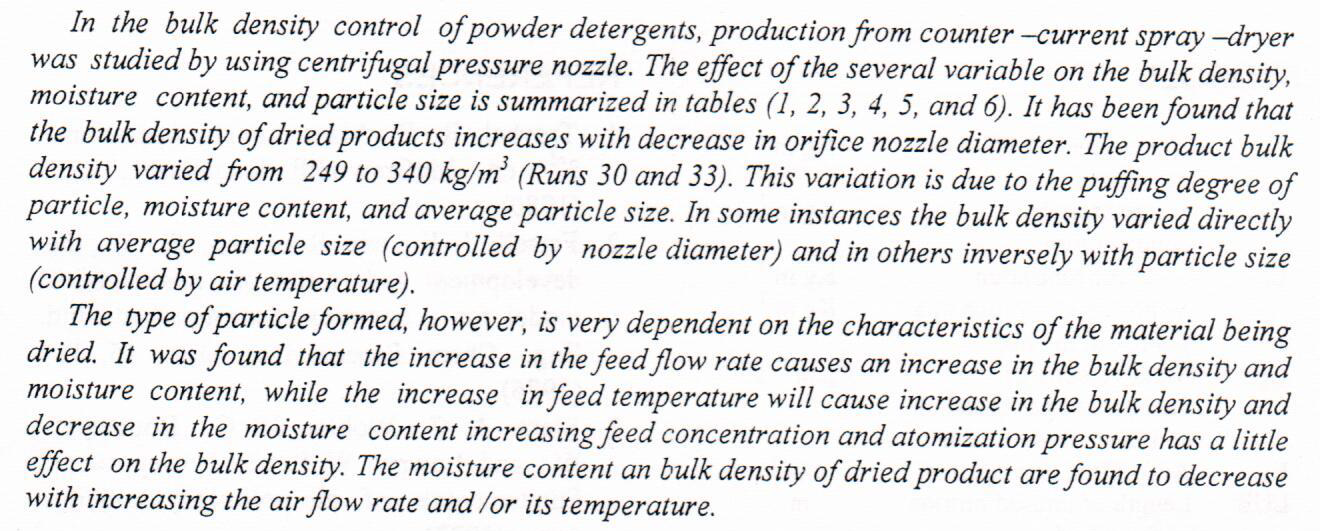
The Control of Powder Detergent Bulk Density by Means of Counter current Spray Dryer

Adsorption of Acetone and 2-Butanone on Iraqi siliceouns rocks powder have been investigated. UV technique has been used to determine the adsorption isotherms. The results showed that the adsorption isotherms obeyed Freundlich adsorption equation. The results showed that the adsorption increases with increasing acidity of solutions. The adsorption was exothermic process, increasing temperature leads to decreasing adsorption. H, S, G were calculated
This paper presents the theoretical and experimental results of drilling high density
polyethylene sheet with thickness of 1 mm using millisecond Nd:YAG pulsed laser. Effects of laser
parameters including laser energy, pulse duration and peak power were investigated. To describe and
understand the mechanism of the drilling process Comsol multiphysics package version 4.3b was used to
simulate the process. Both of the computational and experimental results indicated that the drilling
process has been carried out successfully and there are two phases introduced in the drilling process,
vaporization and melting. Each portion of these phases depend on the laser parameters used in the
drilling process
A simple reverse-phase high performance liquid chromatographic method for the simultaneous analysis (separation and quantification) of furosemide (FURO), carbamazepine (CARB), diazepam (DIAZ) and carvedilol (CARV) has been developed and validated. The method was carried out on a NUCLEODUR® 100-5 C18ec column (250 x 4.6 mm, i. d.5μm), with a mobile phase comprising of acetonitrile: deionized water (50: 50 v/v, pH adjusted to 3.6 ±0.05 with acetic acid) at a flow rate 1.5 mL.min-1 and the quantification was achieved at 226 nm. The retention times of FURO, CARB, DIAZ and CARV were found to be 1.90 min, 2.79 min, 5.39 min and 9.56 min respectively. The method was validated in terms of linearity, accuracy, precision, limit of detection and li
... Show More (2)
(2)
 (1)
(1)


Applications of nonlinear, time variant, and variable parameters represent a big challenge in a conventional control systems, the control strategy of the fuzzy systems may be represents a simple, a robust and an intelligent solution for such applications.
This paper presents a design of fuzzy control system that consists of three sub controllers; a fuzzy temperature controller (FC_T), a fuzzy humidity controller (FC_H) and a ventilation control system; to control the complicate environment of the greenhouse (GH) using a proposed multi-choice control system approach. However, to reduce the cost of the crop production in the GH, the first choice is using the ventilation system to control the temperature and humidit
... Show MoreIn all process industries, the process variables like flow, pressure, level, concentration
and temperature are the main parameters that need to be controlled in both set point
and load changes.
A control system of propylene glycol production in a non isothermal (CSTR) was
developed in this work where the dynamic and control system based on basic mass
and energy balance were carried out.
Inlet concentration and temperature are the two disturbances, while the inlet
volumetric flow rate and the coolant temperature are the two manipulations. The
objective is to maintain constant temperature and concentration within the CSTR.
A dynamic model for non isothermal CSTR is described by a first order plus dead
time (FO
KA Hadi, AH Asma’a, IJONS, 2018 - Cited by 1
(1)
(1)

The electronic properties (such as energy gap HOMO levels. LUMO levels, density of state and density of bonds in addition to spectroscopic properties like IR spectra, Raman spectra, force constant and reduced masses as a function of frequency) of coronene C24 and reduced graphene oxide C24OX , where x=1-5, were studied.. The methodology employed was Density Functional Theory (DFT) with Hybrid function B3LYP and 6-311G** basis sets. The energy gap was calculated for C24 to be 3.5 eV and for C24Ox was from 0.89 to 1.6862 eV for x=1-5 ,respectively. These energy gaps values are comparable to the measured gap of Graphene (1-2.2 eV). The spectroscopic properties were compared with experimental measurements, specificall
... Show More
(3)
(2)