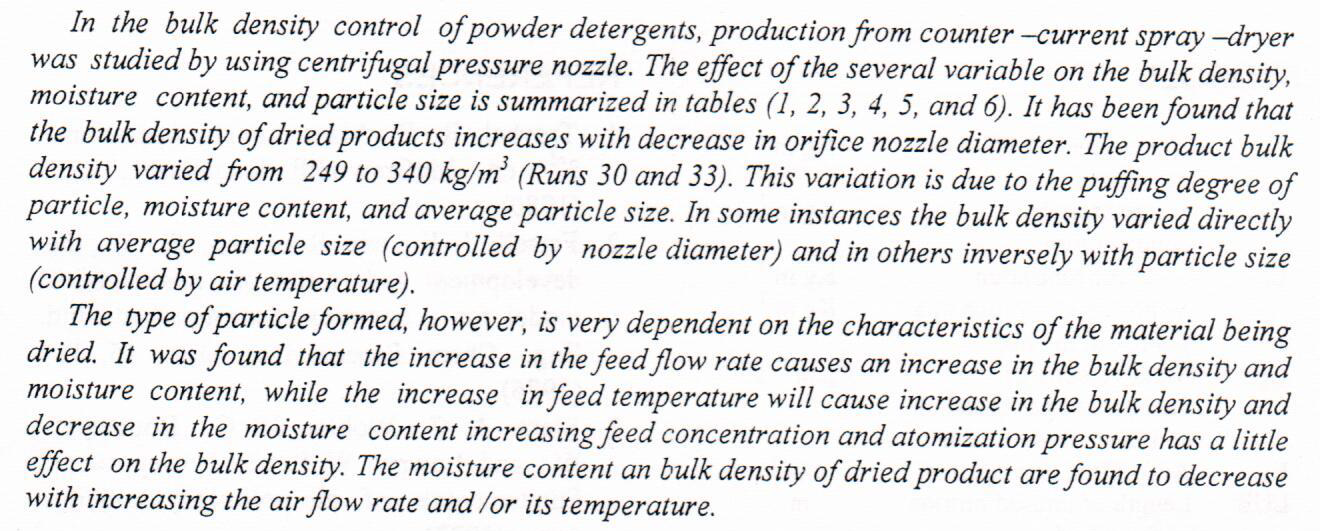
The Control of Powder Detergent Bulk Density by Means of Counter current Spray Dryer

In this study, iron was coupled with copper to form a bimetallic compound through a biosynthetic method, which was then used as a catalyst in the Fenton-like processes for removing direct Blue 15 dye (DB15) from aqueous solution. Characterization techniques were applied on the resultant nanoparticles such as SEM, BET, EDAX, FT-IR, XRD, and zeta potential. Specifically, the rounded and shaped as spherical nanoparticles were found for green synthesized iron/copper nanoparticles (G-Fe/Cu NPs) with the size ranging from 32-59 nm, and the surface area was 4.452 m2/g. The effect of different experimental factors was studied in both batch and continuous experiments. These factors were H2O2 concentration, G-Fe/CuNPs amount, pH, initial DB15
... Show More (13)
(13)
 (8)
(8)


The removal of heavy metal ions from wastewater by ion exchange resins ( zeolite and purolite C105), was investigated. The adsorption process, which is pH dependent, shows maximum removal of metal ions at pH 6 and 7 for zeolite and purolite C105 for initial metal ion
concentrations of 50-250 mg/l, with resin dose of 0.25-3 g. The maximum ion exchange capacity was found to be 9.74, 9.23 and 9.71 mg/g for Cu2+, Pb2+, and Ni2+ on zeolite respectively, while on purolite C105 the maximum ion exchange capacity was found to be 9.64 ,8.73 and 9.39 for Cu2+, Pb2+, and Ni2+ respectively. The maximum removal was 97-98% for Cu2+ and Ni2+ and 92- 93% for Pb2+ on zeolite, while it was 93-94% for Cu2+, 96-97% for Ni2+, and 87-88% for Pb2+ on puroli
(12)
(10)
(8)

Background: Aesthetic archwires are used to overcome the aesthetic problems of stainless steel wires but the color of the coating layer can be changed with time when exposed to oral environments. The aim of this study was to evaluate the degree of color change of different aesthetic archwires from different companies under different coloring solutions. Materials and Methods: One hundred fifty samples of coated archwires from three companies (Highland, G&H and Dany) were immersed in 5 solutions (artificial saliva, turmeric, tea, coffee and Miranda) to evaluate the degree of color changes after 7, 14 and 21 days using visible spectrophotometer. Data were collected and analyzed using one way ANOVA and post hoc Tukey’s tests. Resu
... Show More
(1)
(1)
(6)
(5)
A simple and novel membraneless paper-based microfluidic fuel cell was presented in this study. The occurrence of laminar flow was employed to ensure no mixing of the fuel and oxidant fluids along the bath of reaction. The acidic wastewater was used as a fuel. It was an air-breathing cell, so air and tab water were used as oxidants. Both the fuel and tab water flowed continuously under gravity. Whatman filter paper was used for preparation of the fuel cell channel and two carbon fibre electrodes were used and firmed on the edges of the cell. The performance of the cell was examined over three consecutive days. The results indicated that the present cell has the potential to generate electric power, but an extensive study is required to harv
... Show More
(4)
(3)
In the present work, HgBa2Can-1CunO2n+2+δ superconducting thin films with (100) nm thickness were (n=1, 2 and 3) prepared by Pulsed Laser Deposition technique on glass substrate at R.T (300) K, have been synthesize. The effect of Cu content on the structural, surface morphology, optical and electrical properties of HgBa2Can-1CunO2n+2+δ films were investigated and analyzed. The results of XRD analysis show that all samples are polycrystalline structure with orthorhombic phase, the change of Cu concentration in samples produce changes in the mass density, lattice parameter and the ratio (c/a). AFM techniques were used to examine the surface morphology of HgBa2Can-1CunO2n+2+δ superconducting films, the study showed the values of surface rou
... Show MoreModeling the microclimate of a greenhouse located in Baghdad under its weather conditions to calculate the heating and cooling loads by computer simulation. Solar collectors with a V-corrugated absorber plate and an auxiliary heat source were used as a heating system. A rotary silica gel desiccant dehumidifier, a sensible heat exchanger, and an evaporative cooler were added to the collectors to form an open-cycle solar assisted desiccant cooling system. A dynamic model was adopted to predict the inside air and the soil surface temperatures of the greenhouse. These temperatures are used to predict the greenhouse heating and cooling loads through an energy balance method which takes into account the soil heat gain. This is not included in
... Show More
(4)