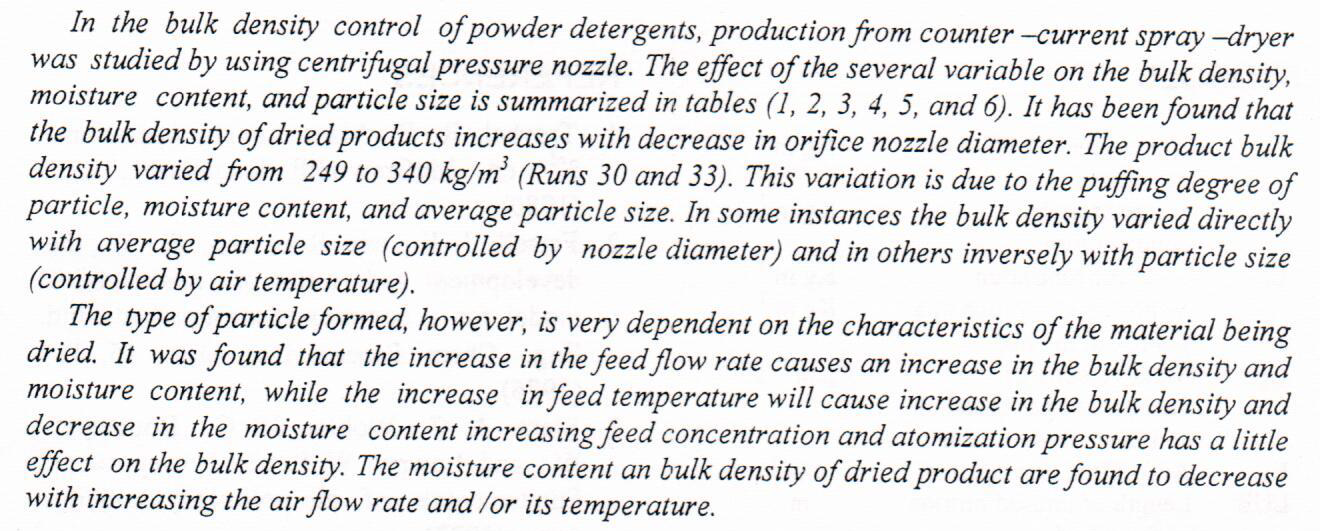
The Control of Powder Detergent Bulk Density by Means of Counter current Spray Dryer

This study aims to assess the water quality index (WQI) according to the Canadian Council of Ministers of the Environment's Water Quality Index method (CCME WQI). Four locations (measurement stations) are selected along the Tigris River, in Iraq. Two of them are located in the north near Mosul City, (Mosul Dam and Mosul city), and the other two are located in the south near Al-Amarah city, (Ali Garbi and Al-Amarah). The water data collected is for the period 2011 to 2013, including eleven water quality parameters. These are magnesium (Mg+2), calcium (Ca2+), potassium (K+), sodium (Na+), sulfate (SO42-), chloride (Cl-), nitrate (NO3<
... Show More (3)
(3)

 (16)
(16)
 (14)
(14)
Solid dispersion (SD) is one of the most widely used methods to resolve issues accompanied by poorly soluble drugs. The present study was carried out to enhance the solubility and dissolution rate of Aceclofenac (ACE), a BCS class II drug with pH-dependent solubility, by the SD method. Effervescent assisted fusion technique (EFSD) using different hydrophilic carriers (mannitol, urea, Soluplus®, poloxamer 188, and poloxamer 407) in the presence of an effervescent base (sodium bicarbonate and citric acid) in different drug: carrier: effervescent base ratio and the conventional fusion technique (FSD) were used to prepare ACE SD. Solubility, dissolution rate, Fourier transformation infrared spectroscopy (FTIR), PowderX-ray diffraction
... Show More
(11)
(5)
Pharmaceuticals have been widely remaining contaminants in wastewater, and diclofenac is the most common pharmaceutical pollutant. Therefore, the removal of diclofenac from aqueous solutions using activated carbon produced by pyrocarbonic acid and microwaves was investigated in this research. Apricot seed powder and pyrophosphoric acid (45 wt%) were selected as raw material and activator respectively, and microwave irradiation technique was used to prepare the activated carbon. The raw material was impregnated in pyrophosphoric acid at 80◦C with an impregnation ratio of 1: 3 (apricot seeds to phosphoric acid), the impregnation time was 4 h, whereas the power of the microwave was 700 watts with a radiation time of 20 min. A series o
... Show More
(20)
(114)
(102)

This research investigates manganese (Mn) extraction from Electric Arc Furnace Steel Slag (EAFS) by using the Liquid-liquid extraction (LLE) method. The chemical analysis was done on the slag using X-ray fluorescence, X-ray diffraction, and atomic absorption spectroscopy. This work consisted of two parts: the first was an extensive study of the effect of variables that can affect the leaching process rate for Mn element from slag (reaction time, nitric acid concentration, solid to liquid ratio, and stirring speed), and the second part evaluates the extraction of Mn element from leached solution. The results showed the possibility of leaching 83.5 % of Mn element from the slag at a temperature of 25°C, nitric acid co
... Show More
(2)
(1)
The complexity and partially defined nature of jet grouting make it hard to predict the performance of grouted piles. So the trials of cement injection at a location with similar soil properties as the erecting site are necessary to assess the performance of the grouted piles. Nevertheless, instead of executing trial-injected piles at the pilot site, which wastes money, time, and effort, the laboratory cement injection devices are essential alternatives for evaluating soil injection ability. This study assesses the performance of a low-pressure laboratory grouting device by improving loose sandy soil injected using binders formed of Silica Fume (SF) as a chemical admixture (10% of Ordinary Portland Cement OPC mass) to di
... Show More
(1)
(1)
The lead has adverse effects in contamination the aquatic environment, for this reason, a laboratory simulation was conducted using kaolinite collected from the Ga’ara Formation at western Iraq to be considered as a natural sorbent material that can be addressed Pb2+ from the aqueous environments. The Energy-Dispersive X-ray Spectroscopy and atomic absorption spectroscopy clarifying very fine grains and pure phase with a very little quantity of quartz and has a number of active sites for adsorption. The sorption of kaolinite for the Pb2+ has been carefully tested by several designed laboratory experiments. Five lead solutions of different concentrations (25, 50, 75, 100 and 125 ppm) were tested under different values of pH (1.3-9)
... Show More
(4)