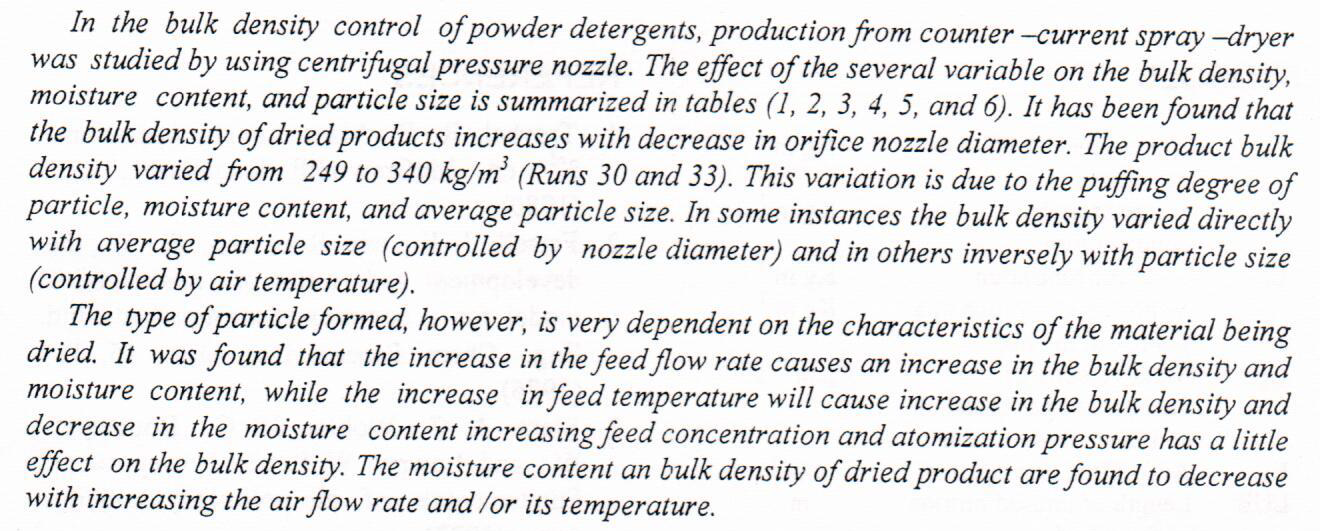
The Control of Powder Detergent Bulk Density by Means of Counter current Spray Dryer

Nathaniel Hawthorne (1804-1864) has been widely known for his special interest in the female characters. In many of his novels, he narrates the conditions, values, and the institutions that surround and control the life of women, leading them to be victims. In “Rappaccini’s Daughter” (1844), the heroine, Beatrice is created to be victimized by her loved ones (her father and lover). This paper focuses on the term “victim,” it shows its aspects through the development of Beatrice’s character. The paper also studies a female character in the male-dominated society, to show the cruelty done to her, and how she is considered to be a second rate person, who is unable to live normally, or at least to save herself from dea
... Show More
The reducing of erosion and the solubility of irrigation canals soils which constructed on gypsum soil is important in civil and water resources engineering. The main problem of gypsum soils is the presence of gypsum which represents one of most complex engineering problems, especially when accompanied by the moving of water which represent dynamic load along the canal. There are several solutions to this problem, in this research “Poly urethane” is used to give the gypsum soil sufficient hardness to reduce the solubility and erosion, after compacting the soil in the canal, percentages of Poly urethane was used to making cover to the soil by mixing percent of soil with Poly urethane, and the ratio was as follows: (5 and 10) % an
... Show More (1)
(1)
In the present work, pulsed laser deposition (PLD) technique was applied to a pellet of Chromium Oxide (99.999% pure) with 2.5 cm diameter and 3 mm thickness at a pressure of 5 Tons using a Hydraulic piston. The films were deposited using Nd: YAG laser λ= (4664) nm at 600 mJ and 400 number of shot on a glass substrate, The thickness of the film was (107 nm). Structural and morphological analysis showed that the films started to crystallize at annealing temperature greater than 400 oC. Absorbance and transmittance spectra were recorded in the wavelength range (300-
4400) nm before and after annealing. The effects of annealing temperature on absorption coefficient, refractive index, extinction coefficient, real and imaginary parts of d
(3)
 (8)
(8)

The concerns about water contaminants affect most developing countries bypassing rivers over them. The issue is challenging to introduce water quality within the allowed limits for drinking, industrial and agricultural purposes. In the present study, physical-chemical parameters measurements of water samples taken from eleven stations were collected during six months in 2020 through flow path along the whole length of Tigris River inside AL Kut city (center of Wassit government) were investigated for six parameters are total hardness TH, hydrogen ion pH, biological oxygen demand BOD5, total dissolved solids TDS, nitrate NO3, and sulfate SO4. The water quality analysis results were compared with the maximum allowable limit concentrat
... Show More
(7)
(4)
Theoretical calculation of the electronic current at N 3 contact with TiO 2 solar cell devices ARTICLES YOU MAY BE INTERESTED IN Theoretical studies of electronic transition characteristics of senstizer molecule dye N3-SnO 2 semiconductor interface AIP Conference. Available from: https://www.researchgate.net/publication/362813854_Theoretical_calculation_of_the_electronic_current_at_N_3_contact_with_TiO_2_solar_cell_devices_ARTICLES_YOU_MAY_BE_INTERESTED_IN_Theoretical_studies_of_electronic_transition_characteristics_of_senstiz [accessed May 01 2023].
(4)
The study of the " Speech act " in grammatical codes reveals great efforts in the study of the elements of linguistic communication contained in their efforts, and is part of the study of the linguistics of heritage, and the research has been designed to identify the verbal act in the blog of Ibn al-Khabaz (guiding the shine) by studying its sections comprehensively; To the spirit of grammatical discourse as well as the combination of the concept of the semantic act already verbal according to Searle, and its response in the form of indirect verbal acts more than direct acts, as well as the pure formulas of the opinions of the violators in the speech of Ibn al-Khabaz other than the proven verbal formulas Approval and approval, the class
... Show MoreThe aim of this study was to increasing natural carotenoides production by a locally isolate Rodotorula mucilagenosa M. by determination of the optimal conditions for growth and production of this agents, for encouragest to use it in food application permute artificial pigments which harmfull for consumer health and envieronmental. The optimal condition of carotenoides production from Rhodotorula mucilaginosa M were studied. The results shows the best carbon and nitrogen source were glucose and yeast extract. The carotenoids a mount production was 47430 microgram ̸ litter and 47460 microgram ̸ litter, respectively, and the optimum temperature was 30°C, PH 6, that the carotenoides a mount was 47470 microgram ̸ litter and 47670 microgr
... Show MoreIntroduction: This study aimed to assess the color change of human teeth with artificial enamel white spot lesions (WSLs) after sandblasting with bioactive glass, resin infiltration, and microabrasion and to test color stability after pH cycling. Methods: Fifty extracted human mandibular first molars were randomly assigned into five groups: Sound, WSLs (untreated), and WSLs sandblasted with bioactive glass (Sylc), WSLs treated by resin infiltration (ICON), and WSLs treated by microabrasion (Opalustre), respectively. All specimens underwent a pH cycling procedure. The color parameters for each specimen were assessed using an Easyshade dental spectrophotometer at different time stages then the color changes (ΔE) were calculated. Results: The
... Show MoreABSTRACT
The effect of adding raw bacteriocin produced by Lactobacillus bulgaricus to cheese curd at an amount of (5 and 10 and 15) mL/kg cheese as a biological preservative to prolong the shelf life of soft cheese, in addition to the control treatment, knowing that each 1 mL of bacteriocin filter contains 15 units/ mL of bacteriocin. The results of the physicochemical, microbial and sensory tests for cheese stored at refrigerator temperature for a period (zero) to (21) d of adding bacteriocin showed the superiority of the treatment of cheese added to 15 mL/kg cheese of bacteriocin over the rest of the other treatments during the storage period, wh
... Show More