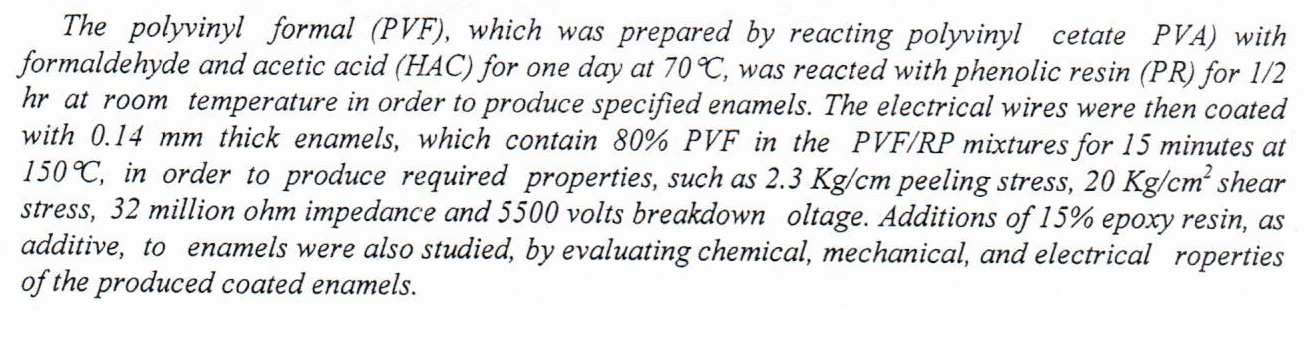
Copper Wires Coated with Enamel

KE Sharquie, AA Noaimi, RA Flayih, Am J Clin Res Rev, 2020 - Cited by 4



Alopecia areata is a common disorder, hypothesized to be autoimmune in etiology. Cortisone taken orally may stimulate new hair growth. Prednisone (orally administered steroid (has proved effective for patients with alopecia areata, but its potential side effects include weight gain, metabolic abnormalities, acne and menstrual problems.
This clinical study was designed to assess the clinical significance of the nutrient antioxidants (vitamin A, vitamin E and vitamin C) in reducing the dose of corticosteroids (prednisolone), and as a consequence, their side effects in patient with alopecia. The results of this study reveal the potential clinical significance of the therapy for two months with these antioxidants in reducing the dose
... Show More
Spin coating technique has been applied in this work to prepared Xerogel films doped with Rhodamine 6G laser dyes. The solid host of laser dye modifies its spectroscopic properties with respect to liquid host. During the spin coating process the dye molecules suffer from changing their environment. The effects of three parameters were studied here: the spinning speed, multilayer coating and formaldehyde addition
Objective(s): To assess parents' attitude toward immunization and its relation with their compliance and to find out the relationship between parents' attitude and their socio-demographic characteristics.
Methodology: A descriptive design is conducted from the period of 19th September 2020 to the 6th of March 2021. A non-probability (convenient) sample of (292) parents was selected from (5) primary health care centers in Karbala city. These centers are distributed throughout (2) primary health care sectors selected randomly as (20%) from each sectors. The questionnaire is developed and composed of three parts: First part: parent's socio-demographic characteristics, Second part: parents' attitude domain, which involves (13 items), and
CD40 is a type 1 transmembrane protein composed of 277 amino acids, and it belongs to the tumor necrosis factor receptor (TNFR) superfamily. It is expressed in a variety of cell types, including normal B cells, macrophages, dendritic cells, and endothelial cells, as a costimulatory molecule. This study aims to summarize the CD40 polymorphism effect and its susceptibility to immune-related disorders. The CD40 gene polymorphisms showed a significant association with different immune-related disorders and act as a risk factor for increased susceptibility to these diseases.