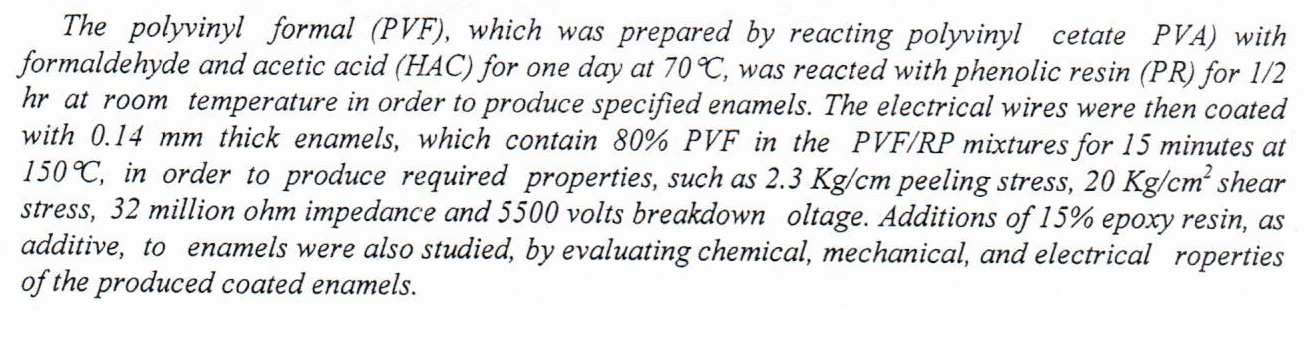
Copper Wires Coated with Enamel

 (6)
(6)
 (5)
(5)



An abstract is a brief summary of a research article, thesis, Schiff base ligand (L) was prepared by the reaction of 4-aminantipyrine with o-phenylenediamine, the prepared ligand characterized by Micro elemental Analysis, FT. IR, UV-Vis, and 1H,13C-NMR spectroscopy.complexes of Mn(II), Co(II), Ni(II), Cu(II) and Hg(II) with Schiff base and 1,10-phenanthroline (Phen) have been investigated in aqueous ethanol with (1:1:1) (M:L:Phen). The prepared complexes were characterized using flame atomic absorption, (C. H. N) Analysis, FT. IR and UV-Vis spectroscopic methods as well as magnetic susceptibility and conductivity measurements. From the obtained data the octahedral structure was suggested for all complexes. The biological screening effects o
... Show MoreRates of zinc consumption during cathodic protection of a copper pipeline carrying saline water were measured by the loss in weight technique. The study of sacrificial anode cathodic protection of short copper tube using zinc strip extended axially in the pipe revealed that : (i) The increase of zinc consumption with time of exposure (1-3 h's) at different flow rates (turbulent flow) (300-600 l/hr) while the temperature , solution concentration and the pH were fixed at 20ºC, 3.5%wt NaCl, and pH=8 respectively in absence and presence of bacteria.(ii)Increase of zinc consumption with flow rates (300-600 l/hr) at different temperatures (10-40ºC) while solution concentration and time of exposure were fixed at 3.5 %wt NaCl and 3hr's respective
... Show More
يصف هذا البحث الإنتاج الصديق للبيئة لجسيمات النحاس النانوية باستخدام مستخلص نبات الجرجير والحرق عند درجة حرارة 400 درجة مئوية لمدة 3 ساعات. تم استخدام SEM و TEM لتحليل حجم الجسيمات النانوية المحضرة. تم استخدام حيود الأشعة السينية لتحديد الهيكل البلوري. كشف التحليل الطيفي للأشعة السينية المشتتة للطاقة لهيكل المنتج الذي تم إنشاؤه عن مكونات النحاس والأكسجين فقط ، مما يدل على نقاء المادة المحضرة. استخدمت الماد
... Show More
(2)
(2)
The effect of irradiation and exposure time of laser light on the fluorescence emission of DCM dye in PMMA polymer contained in the composition mold using different metals have been investigated. It was found that the fluorescence intensity decreases as the exposure time increases and then reaches stabilization at long times. The effect of the incident laser power on fluorescence intensity of DCM dye in PMMA polymer at 10-3 M and 20% mixing ratio, using copper disks of composition molds, has been studied too. It was observed that there is an upward knick in the curve at laser intensity of 19.2 W/cm2, which may be associated with the threshold for amplified spontaneous emission (ASE) or laser action. And at intensity higher than about 88.
... Show MoreThis work demonstrated a simple and environmentally friendly method for synthesizing silica-supported copper nanocubes (CuNCs/SiO2). The copper nanocubes, with a size of 15 ± 5 nm, were synthesized using green reagents and conditions. Ascorbic acid, water, and di-n-butyl sulfide were employed as reducing agent, solvent, and stabilizing ligand, respectively. The designed nanoscale catalyst was utilized for the esterification of acetic acid to methyl acetate at room temperature. The catalyst exhibited high efficiency, converting 80% of the reactant to the desired product (methyl acetate) after 24 hours of reaction at room temperature. The size and shape of copper nanocubes were characterized by transmission electron microsco
... Show More
(1)
An agricultural waste (walnut shell) was undertaken to remove Cu(II) from aqueous solutions in batch and continuous fluidized bed processes. Walnut shell was found to be effective in batch reaching 75.55% at 20 and 200 rpm, when pH of the solution adjusted to 7. The equilibrium was achieved after 6 h of contacting time. The maximum uptake was 11.94mg/g. The isotherm models indicated that the highest determination coefficient belongs to Langmuir model. Cu (II) uptake process in kinetic rate model followed the pseudo-second-order with determination coefficient of 0.9972. More than 95% of the Cu(II) were adsorbed on the walnut shells within 6 h at optimum agitation speed of 800 rpm. The main functional groups responsible for biosorption of
... Show More
(1)
Influence of metal nanoparticles synthesized by microorganisms upon soil-borne microscopic fungus Aspergillus terreus K-8 was studied. It was established that the metal nanoparticles synthesized by microorganisms affect the enzymatic activity of the studied culture. Silver nanoparticles lead to a decrease in cellulase activity and completely suppress the amylase activity of the fungus, while copper nanoparticles completely inhibit the activity of both the cellulase complex and amylase. The obtained results imply that the large-scale use of silver and copper nanoparticles may disrupt biological processes in the soil and cause change in the physiological and biochemical state of soil-borne microorganisms as well.
(10)
(4)
In current research Copper was employed for preparing a ternary system of Al–Si alloy in different (0.2–2.5 wt. %) the best was taken is (1.5%wt) of copper that circumstances of solidification for improving the mechanical performance of the available in aluminium alloy. Cast iron molds were prepared to obtain tensile strength testing specimens. Alloys were prepared by employing gas furnaces. The molten metal was poured into a preheated cast-iron mold. The obtained alloy structures were studied using an X-ray diffractometer and optical microscopy. The mechanical performance of the prepared alloys was examined under the influence of different hardening conditions in both heat and non-heat-treated conditions. The outcomes showed at the
... Show More
(2)