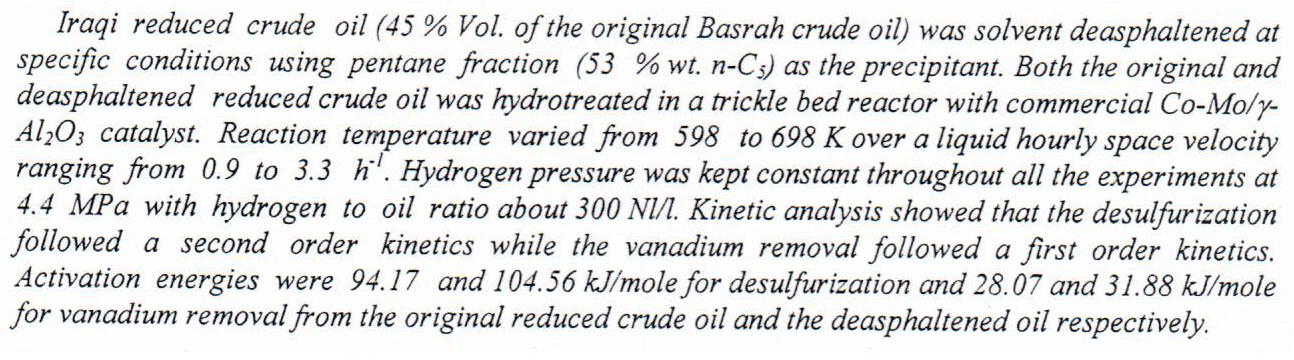
The Effect of Asphaltenes Removal on the Kinetics of Iraqi Reduced Crude Oil Hydrotreating

Although allowable amounts of glycol contamination in diesel engine oil, no research has been conducted on how these levels and varying loads affect engine performance. The research used a four-stroke diesel engine to investigate the effect of different glycol contamination levels (0, 120, and 220 ppm) under two engine loads (4.5 and 9 kW). Brake specific fuel consumption, brake thermal efficiency, friction power, and exhaust gas temperature were measured to determine the engine performance. The experiment used the factorial arrangement in a completely randomized design (CRD) with three replicates. Increasing the contamination levels from 0 to 120 and then to 220 ppm under constant engine load significantly increased brake specific fuel con
... Show More
Net pay is one of the most important parameters used in determining initial oil in place of a reservoir. It can be delineated through the using of limiting values of the petrophysical properties of the reservoir. Those limiting values are named as the cutoff. This paper provides an insight into the application of regression line method in estimating porosity, clay volume and water saturation cutoff values in Mishrif reservoir/ Missan oil fields. The study included 29 wells distributed in seven oilfields of Halfaya, Buzurgan, Dujaila, Noor, Fauqi, Amara and Kumait.
This study is carried out by applying two types of linear regressions: Least square and Reduce Major Axis Regression.
The Mishrif formation was
... Show More (4)
(4)

Spatial data analysis is performed in order to remove the skewness, a measure of the asymmetry of the probablitiy distribution. It also improve the normality, a key concept of statistics from the concept of normal distribution “bell shape”, of the properties like improving the normality porosity, permeability and saturation which can be are visualized by using histograms. Three steps of spatial analysis are involved here; exploratory data analysis, variogram analysis and finally distributing the properties by using geostatistical algorithms for the properties. Mishrif Formation (unit MB1) in Nasiriya Oil Field was chosen to analyze and model the data for the first eight wells. The field is an anticline structure with northwest- south
... Show More (8)
(5)
(8)
(5)
The purpose of this paper is to model and forecast the white oil during the period (2012-2019) using volatility GARCH-class. After showing that squared returns of white oil have a significant long memory in the volatility, the return series based on fractional GARCH models are estimated and forecasted for the mean and volatility by quasi maximum likelihood QML as a traditional method. While the competition includes machine learning approaches using Support Vector Regression (SVR). Results showed that the best appropriate model among many other models to forecast the volatility, depending on the lowest value of Akaike information criterion and Schwartz information criterion, also the parameters must be significant. In addition, the residuals
... Show More
Visualization of subsurface geology is mainly considered as the framework of the required structure to provide distribution of petrophysical properties. The geological model helps to understand the behavior of the fluid flow in the porous media that is affected by heterogeneity of the reservoir and helps in calculating the initial oil in place as well as selecting accurate new well location. In this study, a geological model is built for Qaiyarah field, tertiary reservoir, relying on well data from 48 wells, including the location of wells, formation tops and contour map. The structural model is constructed for the tertiary reservoir, which is an asymmetrical anticline consisting of two domes separated by a saddle. It is found that
... Show More
Fourier Transform-Infrared (FT-IR) spectroscopy was used to analyze gasoline engine oil (SAE 5W20) samples that were exposed to seven different oxidation times (0 h, 24 h, 48 h, 72 h, 96 h, 120 h, and 144 h) to determine the best wavenumbers and wavenumber ranges for the discrimination of the oxidation times. The thermal oxidation process generated oil samples with varying total base number (TBN) levels. Each wavenumber (400–3900 cm−1) and wavenumber ranges identified from the literature and this study were statistically analyzed to determine which wavenumbers and wavenumber ranges could discriminate among all oxidation times. Linear regression was used with the best wavenumbers and wavenumber ranges to predict oxidation time.
... Show More
(21)
(20)
 (4)
(5)
(3)
(4)
(5)
(3)
The growing demand for sustainable and high-performance asphalt binders has prompted the exploration of waste-derived modifiers. This study investigates the performance enhancement of Natural Asphalt (NA) using Sugarcane Molasses (SM) and Waste Engine Oil (WEO). The modified blends were prepared by partially replacing 50 % NA with varying proportions of SM and WEO ranging from 10 % to 40 % of the total weight of NA. Comprehensive testing was conducted, including penetration, softening point, ductility, viscosity, Bending Beam Rheometer (BBR), Multiple Stress Creep Recovery (MSCR), Energy Dispersive X-ray Spectroscopy (EDX), Fourier Transform Infrared (FTIR) spectroscopy, and Scanning Electron Microscopy (SEM). The results demonstrated that
... Show More
(2)
(2)