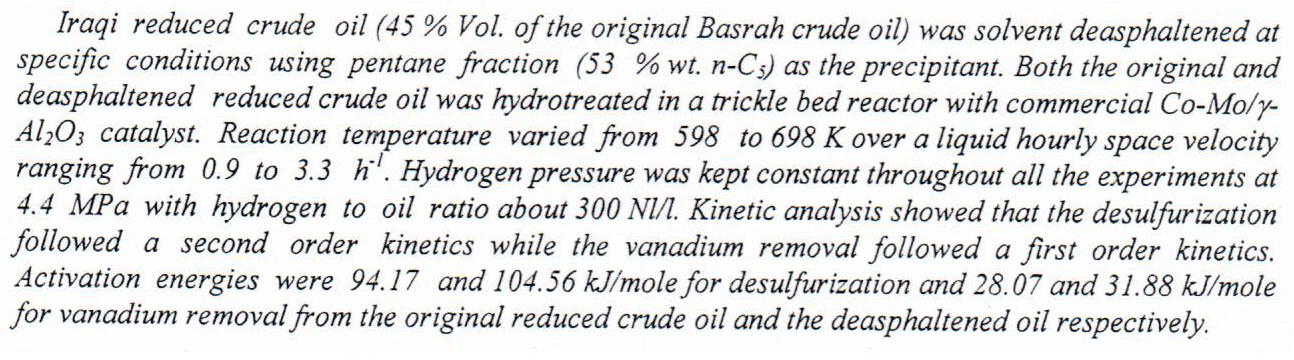
The Effect of Asphaltenes Removal on the Kinetics of Iraqi Reduced Crude Oil Hydrotreating

Objectives. This study aimed to evaluate the impact of nonnutritive sucking habits on the presence of oral Escherichia coli. Methods. One hundred and twenty children aged 3–5 years old were enrolled in the present case-control study, as follows: 60 children with continuous pacifier and thumb sucking habits (study group) and 60 children without any sucking habits (control group). The children in the two groups were matched in terms of age and gender. Information was gathered from the parents concerning their children using a special sheet. Sterile swabs were taken from both groups and cultured on agar plates. Then, they were subjected to further biochemical tests to identify E. coli species. The mean of the E. coli count was determ
... Show More (3)
(3)
 (2)
(2)



Recently, interest in the use of projectiles in research on recycling waste materials for construction applications has grown. Using recycled materials for the construction of asphalt concrete pavement, in the meantime, has become a topic of research due to its significant benefits, such as cost savings and reduced environmental impacts. This study reports on comprehensive experimental research conducted using a typical mechanical milling waste, iron filing waste (IFW), as an alternative fine aggregate for warm mix asphalt (WMA) for pavement wearing surface applications. A type of IFW from a local machine workshop was used to replace the conventional fine aggregate, fine natural sand (FNS), at percentages of 25%, 50% 75%, and 100% b
... Show More
(20)
(32)
(28)
Recently, interest in the use of projectiles in research on recycling waste materials for construction applications has grown. Using recycled materials for the construction of asphalt concrete pavement, in the meantime, has become a topic of research due to its significant benefits, such as cost savings and reduced environmental impacts. This study reports on comprehensive experimental research conducted using a typical mechanical milling waste, iron filing waste (IFW), as an alternative fine aggregate for warm mix asphalt (WMA) for pavement wearing surface applications. A type of IFW from a local machine workshop was used to replace the conventional fine aggregate, fine natural sand (FNS), at percentages of 25%, 50% 75%, and 100% b
... Show More
(21)
(20)
Cultured fruits of theCorundum Coriandrum sativum were sown On 11/11 / 2008 in basins containing 15 kg of soil (Silty Loam) .Fruits were divided into two parts the first was soaked in normanl water and the second was magnetized for a period of 24 hours Irrigation was up to (75% of capacity field.Two types of water (normal water and magnetized water)with three repetitions were used the access to magnetic water was supplied from a special electric device. Recorded measurements were plant height the number of stems / plant, weight of plant, number of flowers, 1000 seed weight) during the cultivation period, which ended on 11/5/2009. Results indicated the absence of any effect of magnetic water on plant growth of Fenugreek while seeds tre
... Show More
The research aims to develop physical exercises with auxiliary training tools that work to develop the explosive power of the arms and legs, and then find out their effect on the accuracy of shooting from free throw and correction from jumping of advanced basketball players, as the researchers found a problem that these players have weakness in the skill of throwing Free throwing and shooting by jumping calculated with two points as a result of adopting unhealthy physical and technical positions, which led to a lack of focus and accuracy, and thus negatively affected the performance technique of free throw and jump shot, as most teams use traditional exercises without the use of auxiliary training tools, and this topic gave researchers the
... Show MoreThe catalytic cracking of three feeds of extract lubricating oil, that produced as a by-product from the process of furfural extraction of lubricating oil base stock in AL-Dura refinery at different operating condition, were carried out at a fixed bed laboratory reactor. The initial boiling point for these feeds was 140 ºC for sample (1), 86 ºC for sample (2) and 80 ºC for sample (3). The catalytic cracking processes were carried out at temperature range 325-400 ºC and initially at atmospheric pressure after 30 minutes over 9.88 % HY-zeolite catalyst load. The comparison between the conversion at different operating conditions of catalytic cracking processes indicates that a high yield was obtained at 375°C, according to gasoline pr
... Show MoreThis work deals with thermal cracking of heavy vacuum gas oil which produced from the top of vacuum distillation unit at Al- DURA refinery, by continuous process. An experimental laboratory plant scale was constructed in laboratories of chemical engineering department, Al-Nahrain University and Baghdad University. The thermal cracking process was carried out at temperature ranges between 460-560oC and atmospheric pressure with liquid hourly space velocity (LHSV) equal to 15hr-1.The liquid product from thermal cracking unit was distilled by atmospheric distillation device according to ASTM D-86 in order to achieve two fractions, below 220oC as a gasoline fraction and above 220oC as light cycle o
... Show More
This thesis aims to study the effect of addition polymer materials on mechanical properties of self-compacting concrete, and also to assess the influence of petroleum products (kerosene and gas oil) on mechanical properties of polymer modified self-compacting concrete (PMSCC) after different exposure periods of (30 ,60 ,90 ,and 180 days).
Two type of curing are used; 28 days in water for SCC and 2 days in water followed 26 days in air for PMSCC.
The test results show that the PMSCC (15% P/C ratio) which is exposed to oil products recorded a lower deterioration in compressive strength's values than reference concrete. The percentages of reduction in compressive strength values of PMSCC (15% P/C ratio) was
... Show MoreIn this study, sulfur was removed from imitation oil using oxidative desulfurization process. Silicoaluminophosphate (SAPO-11) was prepared using the hydrothermal method with a concentration of carbon nanotubes (CNT) of 0% and 7.5% at 190 °C crystallization temperature. The final molar composition of the as-prepared SAPO-11 was Al2O3: 0.93P2O5: 0.414SiO2. 4% MO/SAPO-11 was prepared using impregnation methods. The produced SAPO-11 was described using X-ray diffraction (XRD) and Brunauer-Emmet-Teller (N2 adsorption–desorption isotherms). It was found that the addition of CNT increased the crystallinity of SAPO-11. The results showed that the surface area of SAPO-11 containing 7.5% CNT was 179.54 m2/g, and the pore volume was 0.31
... Show More
(7)