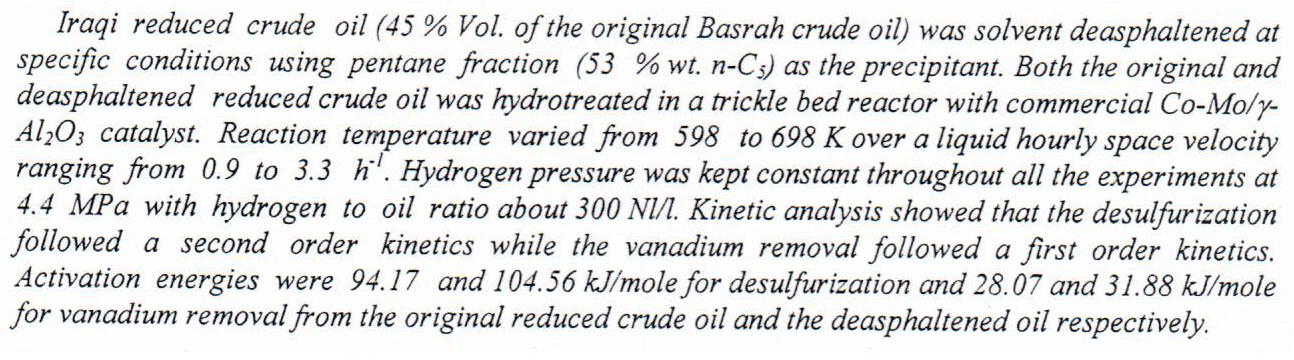
The Effect of Asphaltenes Removal on the Kinetics of Iraqi Reduced Crude Oil Hydrotreating

This study evaluated the influence of administering different levels of L-arginine into eggs of 0-day-old Japanese quail embryos. On day 0 of incubation, 480 eggs (120 for each treatment group) were injected with 0% arginine (C group), 1% arginine (T1), 2% arginine (T2) or 3% arginine (T3). After hatching, 336 quail chicks (84 chicks produced from each in ovo injection treatment) were placed in an experimental quail house and allocated to four treatment groups of three replicates, with 16 quail chicks for each replicate. Traits involved in this study were hatchability rate, initial body weight (7 days of age), final body weight (42 days old), feed intake, weight gain, feed conversion ratio and blood serum glucose, protein, cholesterol, tota
... Show More (47)
(47)

Abstract : Tin oxide SnO2 films were prepared by atmospheric chemical vapor deposition (APCVD) technique. Our study focus on prepare SnO2 films by using capillary tube as deposition nozzle and the effect of these tubes on the structural properties and optical properties of the prepared samples. X-ray diffraction (XRD) was employed to find the crystallite size. (XRD) studies show that the structure of a thin films changes from polycrystalline to amorphous by increasing the number of capillary tubes used in sample preparation. Maximum transmission can be measured is (95%) at three capillary tube. (AFM) where use to analyze the morphology of the tin oxides surface. Roughness and average grain size for different number of capillary tubes have b
... Show More (5)
(5)

Background: Poly (methylmethacrylate) is not ideal in every aspect and has disadvantages such as insufficient surface hardness, increase water sorption and poor impact resistance and the latter being the primary cause of fracture of denture base resins. The aim of this study was to evaluate the effect of addition of silanized nano- hydroxyapatite (HA) on some properties of heat cured acrylic denture base material. Materials and methods: HA nano particles were first silanized with ï§MPS (tri methacryloxypropyletrimethoxy silane coupling agent) then ultrasonicated with methylmethacrylate (monomer) to disperse agglomerated nano particles and mixed with polymer. 2% by wt of HA nano particles was selected as the best concentration that add
... Show More
(7)
The research aims to study the effect of adding (Li2O) to an alkaline glaze containing (K2O, Na2O). Although all the alkaline oxides have common properties, each oxide has something that distinguishes it. The molecular weight of (Li2O) is two times less than that of (Na2O) and three times that of (K2O). Therefore, it is added in small proportions. In addition, it is a very strong flux, so it is not used alone, but rather replaces a part of other alkaline oxides. It was added to an alkali glass that matured at a temperature of 980CO in proportions (2.0,1.4,1.2,0.8,0.4%) instead of (Na2O), using lithium carbonate (Li2CO3) as an oxide source. The glazes mixtures were applied to a white pottery body, and the samples were fired and cooled acc
... Show More
Exploding wire Technique is a way for production metal and its compound nanoparticle that is capable of production of bulk amount at low cost semiconductor. In this work a copper iodine nanoparticles were fabricate by exploding copper wires with different currents in iodine solution. The produced samples were examined by XRD, FTIR, SEM and TEM to characterize their properties. The XRD proved the Nano-size for producer. The crystalline size increases with increasing current. FTIR measurements show a peaks located at 638.92 for Cu-I stretch bond indicate on formation of copper iodide compound and the peaks intensities increase with increasing current. The SEM and TEM measurements show that the thin films have nanostructures.
In this study, method for experimentally determining the electron density (ne) and the electron temperature (Te) in the atmospheric Argon plasma jet is used; it is based on optical emission spectroscopy (OES). Boltzmann plot method used to calculate these parameters measured for different values of gas flow rate. The results show that the electron temperature decreasing with the increase of gas flow rate also indicates an increasing in the electron density of plasma jet with increasing of gas flow rate.
(3)
Background: A Temporomandibular joint (TMJ) internal derangement (TMJID) is a disruption within the internal aspects of the TMJ in which the disc is displaced from its normal functional relationship with the mandibular condyle, after which the articular portion of the temporal bone causes joint dysfunction, joint sound, malocclusion, and locking of the mouth. Conservative and invasive techniques can be used for the treatment of TMJID. A platelet-rich plasma (PRP) injection is a simple, less invasive surgical procedure for the treatment of internal derangement. The objective of this study was to evaluate the efficacy of PRP injections in decreasing or eliminating pain, clicking, and limitation of mouth opening in patients with TMJID after th
... Show More
(1)
Stevia rebaudiana Bertoni contains diterpenoid steviol glycosides that have no adverse impact on blood sugar levels despite being 300 times sweeter than sugar. This study aimed to investigate the rate of callus induction from stevia leaves and the content of glycosides when changing the sucrose percentage in the culture medium.. Murashige and Skoog (MS) culture medium supported by 4.0 mg/l naphthalene acetic acid (NAA) and 1.0 mg/l benzyl adenine (BA) was used, and different concentrations of sucrose (2, 3, 4, 5 and 6%) were tested .The extraction of glycosides from leaf and callus tissues was performed by using methanol. Extracted glycosides were analyzed by high-performance liquid chromatography (HPLC). The results showed signific
... Show MorePulsed liquid laser ablation is considered a green method for the synthesis of nanostructures because there are no byproducts formed after the ablation. In this paper, a fiber laser of wavelength 1.064 µm, peak power of 1 mJ, pulse duration of 120 ns, and repetition rate of 20 kHz, was used to produce carbon nanostructures including carbon nanospheres and carbon nanorods from the ablation of asphalt in ethanol at ablation speeds of (100, 75, 50, 10 mm/s). The morphology, composition and optical properties of the synthesized samples were studied experimentally using FESEM, HRTEM, EDS, and UV-vis spectrophotometer. Results showed that the band gap energy decreased with decreasing the ablation speed (increasing the ablation time), the mi
... Show More
(3)
(1)