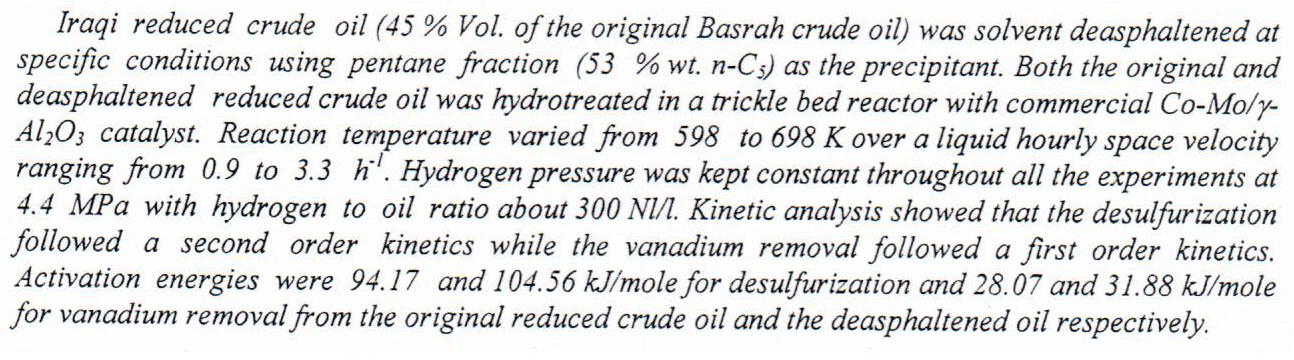
The Effect of Asphaltenes Removal on the Kinetics of Iraqi Reduced Crude Oil Hydrotreating

The research aims to determine what a photograph intends to convey as a visual text. Photographs are not captured randomly, especially those of politicians. Each photograph carries a message, even if interpretations of that message vary from person to person. The research adopts a methodology based on semiotic analysis, applying Laurent Gervero's model to analyze a photograph of the Iraqi Prime Minister Mustafa Al-Kadhimi's visit to Fallujah on the anniversary of the victory over ISIS. The photographs in question constitute a visual language built upon a sequence of iconic symbols and signs. These elements coalesce to give rise to an image centered around a particular theme, one designed to convey a precise messag
... Show More (1)
(1)

The tax base is one of the bases of the technical organizing of taxes, and that a good selection of the tax base effects the outcome of the tax and its fairness, and with the expansion of the tax range results a dangerous phenomenon called tax evasion, which became threaten the economies of countries and this phenomenon prevents the achievement of the state to its economic, political and social objectives which seeks to resolve this phenomenon and identifying all human and material potential and realize the real reasons that lie behind it. The researcher found that tax authorities are weak in terms of it the technical material and financial abilities, the analysis of data show that then is a significant reve
... Show More
Adsorption of lead ions from wastewater by native agricultural waste, precisely tea waste. After the activation and carbonization of tea waste, there was a substantial improvement in surface area and other physical characteristics which include density, bulk density, and porosity. FTIR analysis indicates that the functional groups in tea waste adsorbent are aromatic and carboxylic. It can be concluded that the tea waste could be a good sorbent for the removal of Lead ions from wastewater. Different dosages of the adsorbents were used in the batch studies. A random series of experiments indicated a removal degree efficiency of lead reaching (95 %) at 5 ppm optimum concentration, with adsorbents R2 =97.75% for tea. Three mo
... Show More
(1)
The removal of heavy metal ions from wastewater by sorptive flotation using Amberlite IR120 as a resin, and flotation column, was investigated. A combined two-stage process is proposed as an alternative of the heavy metals removal from aqueous solutions. The first stage is the sorption of heavy metals onto Amberlite IR120 followed by dispersed-air flotation. The sorption of metal ions on the resin, depending on contact time, pH, resin dosage, and initial metal concentration was studied in batch method .Various parameters such as pH, air flow rate, and surfactant concentration were investigated in the flotation stage. Sodium lauryl sulfate (SLS) and Hexadecyltrimethyl ammonium bromide (HTAB) were used as anionic and cationic surfactant re
... Show More
In this study, a packed bed was used to remove pathogenic bacteria from synthetic contaminated water. Two types of packing material substrates, sand and zeolite, were used. These substrates were coated with silver nanoparticles (AgNPs), which were prepared by decomposition of Ag ions from AgNO3 solution. The prepared coated packings were characterized using scanning electron microscopy, energy-dispersive X-ray spectroscopy and transmission electron microscopy. The packed column consisted of a PVC cylinder of 2 cm diameter and 20 cm in length. The column was packed with silver nanoparticlecoated substrates (sand or zeolite) at a depth of 10 cm. Four types of bacteria were studied: Escherichia coli, Shigella dysenteriae, Pseudomonas aerugi
... Show More
(5)
The degradation of Toluidine Blue dye in aqueous solution under UV irradiation is investigated by using photo-Fenton oxidation (UV/H2O2/Fe+). The effect of initial dye concentration, initial ferrous ion concentration, pH, initial hydrogen peroxide dosage, and irradiation time are studied. It is found put that the removal rate increases as the initial concentration of H2O2 and ferrous ion increase to optimum value ,where in we get more than 99% removal efficiency of dye at pH = 4 when the [H2O2] = 500mg / L, [Fe + 2 = 150mg / L]. Complete degradation was achieved in the relatively short time of 75 minutes. Faster decolonization is achieved at low pH, with the optimal value at pH 4 .The concentrations of degradation dye are detected by spectr
... Show More
In this study, the potential of adsorption of amoxicillin antibiotic (AMOX) from aqueous solutions using prepared activated carbon (AC) was studied. The used AC was prepared from an inexpensive and available precursor (sunflower seed hulls (SSH)) and activated by potassium hydroxide (KOH). The prepared AC was examined for its ability to remove AMOX from aqueous contaminated solutions and characterized with the aid of N2 -adsorption/desorption isotherm Brunauer–Emmett– Teller, scanning electron microscopy, energy-dispersive X-ray spectroscopy and Fourier-transform infrared. Zeta potential of the prepared activated carbon from sunflower seed hulls (SSHAC) were studied in relation to AMOX adsorption. The physical and chemical propert
... Show More
(8)

 (53)
(46)
(53)
(46)

A comparative study was done on the adsorption of methyl orange dye (MO) using non-activated and activated corn leaves with hydrochloric acid as an adsorbent material. Scanning electron microscopy (SEM) and Fourier Transform Infrared spectroscopy (FTIR) were utilized to specify the properties of adsorbent material. The effect of several variables (pH, initial dye concentration, temperature, amount of adsorbent and contact time) on the removal efficiency was studied and the results indicated that the adsorption efficiency increases with the increase in the concentration of dye, adsorbent dosage and contact time, while inversely proportional to the increase in pH and temperature for both the treated and untreated corn leaves. The equi
... Show More
(24)
(17)
(15)