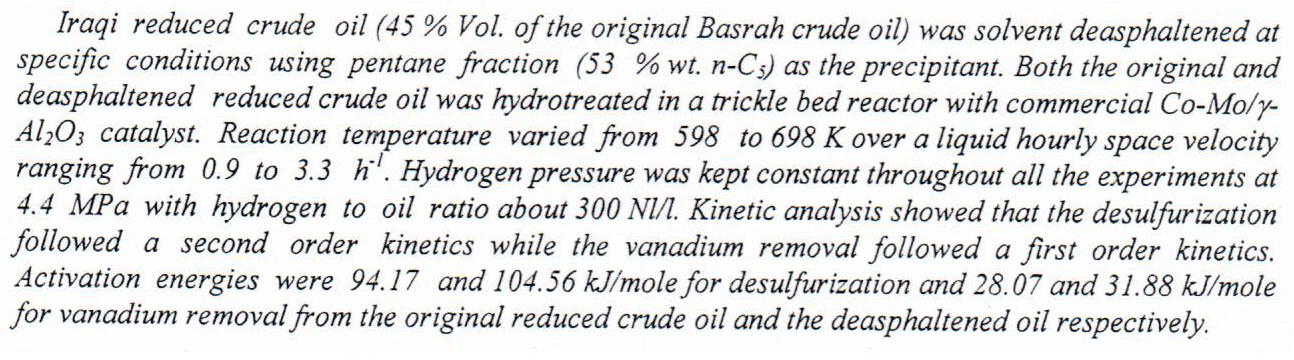
The Effect of Asphaltenes Removal on the Kinetics of Iraqi Reduced Crude Oil Hydrotreating

Large quantities of petroleum-contaminated soil are generated with increased global energy consumption and crude oil production. This theoretical study evaluates the treatment of 1 ton of petroleum-contaminated soil using seven methods: incineration, physical washing, chemical washing, thermal pyrolysis, Fenton-oxidation-pyrolysis, the biological treatment, and asphaltenes. Data were based on experimental results from the Nahran Bin Omar oil lake in Basra Governorate, Iraq, (2019–2021). The methods were compared by waste generation, treatment cost, and duration. Results indicate that using petroleum-contaminated soil as a raw material for asphalt manufacturing is most beneficial since it is sold as a raw material. Incineration is faster a
... Show More

In this paper investigate the influences of dissolved CO2/H2S gases, crude oil velocity and temperature on the rate of corrosion of crude oil transmission pipelines of Maysan oil fields southern Iraq. The Potentiostatic corrosion test technique was conducted into two types of carbon steel pipeline (materials API 5L X60 and API 5L X80). The computer software ECE electronic corrosion engineer was used to predict the influences of CO2 partial pressure, the composition of crude oil, flow velocity of crude oil and percentage of material elements of carbon steel on the rate of corrosion. As a result, the carbon steel API 5L X80 indicates good and appropriate resistance to corrosion compared to carbon steel API
... Show More (3)
(3)
As the major role of oil sector in financing and development of Iraqi economy this study tried to research on the factors which influencing the future of oil production in Iraq and for that study addressed the hypothesis (the production and export of crude oil in Iraq , influenced by many factors divided into internal and external factors this factors shared the effect varies in the size of their participation and runs from different sectors economic , political and social , in order to test the study hypothesis study addressed the subject of three axes(an overview of the history and facts of crude oil production in Iraq and factors internal Affecting the future of oil production in Iraq and external factors affecting the future
... Show More
Reuse of spent hydrodesulphurization (HDS) of middle petroleum fractions catalyst CoMo/γAl2O3 was accomplished via removal of coke and contaminants such as vanadium, Iron, Nickel, and sulfur. Three processes were adopted; extraction, leaching, decoking. Soluble and insoluble coke was removed. Leaching step used three different solvents (oxalic acid, ammonium peroxydisulfate and oxalic acid + H2O2) in separate in order to remove contaminant metals (V, S, Ni and Fe).
The effect of soluble coke removal on leaching step was studied. It was found that the removal of soluble coke significantly enhances the leaching of contaminants and barely affected the removal of active metals
... Show More
(5)
 (12)
(11)
(12)
(11)

The current study examines the combined impacts of ultrasonic waves and nano silica (NS) on reducing the viscosity Sharqy Baghdad heavy crude oil with an API gravity of 20.32. NS of an average particle size of 59.93 nm and 563.23 m²/g surface area were produced utilizing the sol-gel technique from Iraqi sand. The XRD analysis indicates the existence of an amorphous silica, the SEM analysis showed that NS tends to agglomerate, and the FTIR spectra exhibited the presence of siloxane and silanol groups. In addition, the TGA analysis demonstrated a total weight loss of 15.62%, validating the thermal stability of the NS. The experiments included a study of the impact of ultrasonic power, exposure time, duty cycle, temperature, and the c
... Show More
(3)
The current study examines the combined impacts of ultrasonic waves and nano silica (NS) on reducing the viscosity Sharqy Baghdad heavy crude oil with an API gravity of 20.32. NS of an average particle size of 59.93 nm and 563.23 m²/g surface area were produced utilizing the sol-gel technique from Iraqi sand. The XRD analysis indicates the existence of an amorphous silica, the SEM analysis showed that NS tends to agglomerate, and the FTIR spectra exhibited the presence of siloxane and silanol groups. In addition, the TGA analysis demonstrated a total weight loss of 15.62%, validating the thermal stability of the NS. The experiments included a study of the impact of ultrasonic power, exposure time, duty cycle, temperature, and the c
... Show More
(3)
The study involved the removal of acidity from free fatty acid via the esterification reaction of oleic acid with ethanol. The reaction was done in a batch reactor using commercial 13X zeolite as a catalyst. The effects of temperatures (40 to 70 °C) and reaction time (up to 120 minutes) were studied using 6:1 mole ratio of pure ethanol to oleic acid and 5 wt. % of the catalyst. The results showed that acid removed increased with increasing temperature and reaction time. Also, the acidity removal rises sharply during the first reaction period and then changes slightly afterward. The highest acidity removal value was 67 % recorded at 110 minutes and 70 °C. An apparent homogeneous reversible reaction kinetic model has been proposed a
... Show More
(2)
