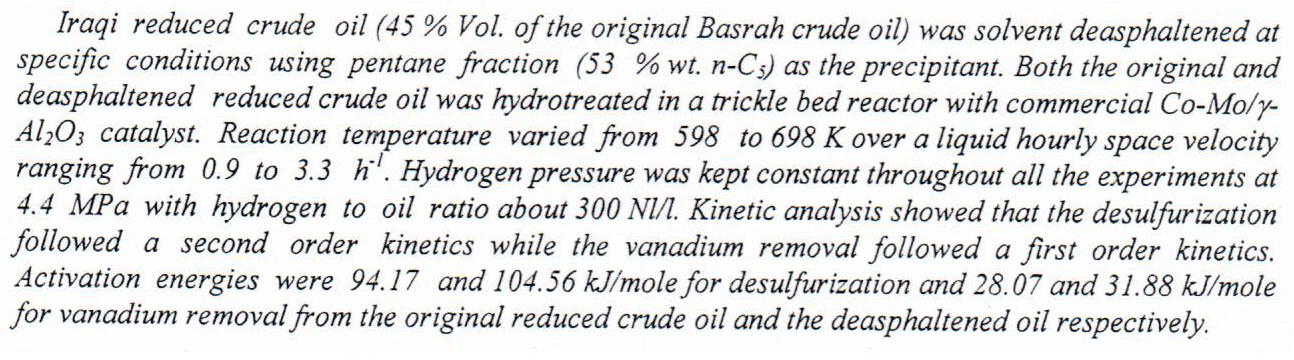
The Effect of Asphaltenes Removal on the Kinetics of Iraqi Reduced Crude Oil Hydrotreating

 (32)
(32)
 (19)
(19)


The presence of dyes in wastewater has become a major issue all over the world. The discharge of dyes in the environment is concerned for both toxicological and esthetical reasons. In this study, the removal of dyes from aqueous solution by electrocoagulation using aluminum electrodes as cathode and anode were investigated with the electrocoagulation cell of 1litter. The study included: the impact of various operating parameters on the dyes removal efficiency like pH, NaCl concentration, distance between electrodes, voltage, initial dyes concentration and type of electrodes. The dye (congo red) concentrations were (50, 100, 150, and 200 ppm), stirring speed was 120 rpm at room temperature. pH used was maintained constant
... Show More
(9)
In the present study, a low cost adsorbent is developed from the naturally available sawdust
which is biodegradable. The removal capacity of chromium(VI) from the synthetically prepared
industrial effluent of electroplating and tannery industrial is obtained.
Two modes of operation are used, batch mode and fixed bed mode. In batch experiment the
effect of Sawdust dose (4- 24g/L) with constant initial chromium(VI) concentration of 50 mg/L and
constant particle size less than1.8 mm were studied.
Batch kinetics experiments showed that the adsorption rate of chromium(VI) ion by Sawdust
was rapid and reached equilibrium within 120 min. The three models (Freundlich, Langmuir and
Freundlich-Langmuir) were fitted to exper
(1)
Industrial wastewater containing nickel, lead, and copper can be produced by many industries. The reverse osmosis (RO) membrane technologies are very efficient for the treatment of industrial wastewater containing nickel, lead, and copper ions to reduce water consumption and preserving the environment. Synthetic industrial wastewater samples containing Ni(II), Pb(II), and Cu(II) ions at various concentrations (50 to 200 ppm), pressures (1 to 4 bar), temperatures (10 to 40 oC), pH (2 to 5.5), and flow rates (10 to 40 L/hr), were prepared and subjected to treatment by RO system in the laboratory. The results showed that high removal efficiency of the heavy metals could be achieved by RO process (98.5%, 97.5% and 96% for Ni(II),
... Show MoreThe removal of Anit-Inflammatory drugs, namely; Acetaminophen (ACTP), from wastewater by bulk liquid membrane (BLM) process using Aliquat 336 (QCl) as a carrier was investigated. The effects of several parameters on the extraction efficiency were studied in this research, such as the initial feed phase concentration (10-50) ppm of ACTP, stripping phase (NaCl) concentration (0.3,0.5,0.7 M), temperature (30-50oC), the volume ratio of feed phase to membrane phase (200-400ml/80ml), agitation speed of the feed phase (75-125 rpm), membrane stirring speed (0, 100, 150 rpm), carrier concentration (1, 5, 9 wt%), the pH of feed (2, 4, 6, 8, 10), and solvent type (CCl4 and n-Heptane). The study shows that high ext
... Show More
(3)
The present study aims to remove nickel ions from solution of the simulated wastewater using (Laminaria saccharina) algae as a biosorbent material. Effects of experimental parameters such as temperature at (20 - 40) C⁰, pH at (3 - 7) at time (10 - 120) min on the removal efficiency were studied.
Box-Wilson method was adopted to obtain a relationship between the above three experimental parameters and removal percentage of the nickel ions. The experimental data were fitted to second order polynomial model, and the optimum conditions for the removal process of nickel ions were obtained.
The highest removal percentage of nickel ions obtained was 98.8 %, at best operating conditions (Temperature 35 C⁰, pH 5 and Time 10 min).
The current work discusses the removal of brilliant dyes. These dyes were Brilliant Cresyl Blue (BCB) and Brilliant Green (BG) by the use of poly acrylic acid hydrogel beads (PAA). We examined the adsorption isotherms and found that the factors preferring it are temperature and salt, shaking effects, wet PAA, (BCB) and (BG) follows Freundlich equation more than other equations. Based on the results, there is a positive correlation between adsorption of dyes (BCB and BG) and temperature (Endothermic process). We calculated the thermodynamic functions (ΔG, ΔS, and ΔH). The ion strength effects on the adsorptions at (20 °C) increased adsorption if the salt concentrations is high. We treated the kinetics outcomes based on Lagergren Equation
... Show More
(1)
In this paper waste natural material (date seed) and polymer particles(UF) were used for investigation of removal dye of the potassium permanganate. Also study effect some variables such as pH, dye concentration and adsorbent concentration on dye removal. 15 experimental runs were done using the itemized conditions designed established on the Box-Wilson design employed to optimize dye removal. The optimum conditions for the dye removal were found: (pH) 12, (dye con.) 2.38 ppm, (adsorbant con.) 0.0816 gm for date seed with 95.22% removal and for UF (pH) 12, (dye con.) 18 ppm, (adsorbant con.) 0.2235 gm with 91.43%. The value of R-square was 85.47% for Date seed and (88.77%) for UF.
... Show More
The performance of a batch undivided electrochemical reactor with a rotating cylinder electrode of woven-wire (60 mesh size), stainless steel 316, is examined for the removal of copper from synthetic solution of o.5 M sodium chloride containing 125 ppm at pH ≈ 3.5. The effect of total applied current, rotation speed on the figures of merit of the reactor is analyzed. For an applied current of 300 mA at 100 rpm, the copper concentration decreased from 125 to mg l-1 after 60 min of electrolysis with a specific energy consumption of 1.75 kWh kg-1 and a normalized space velocity of 1.62 h-1. The change in concentration was higher when the total applied currents were increased because of the turbulence
... Show More