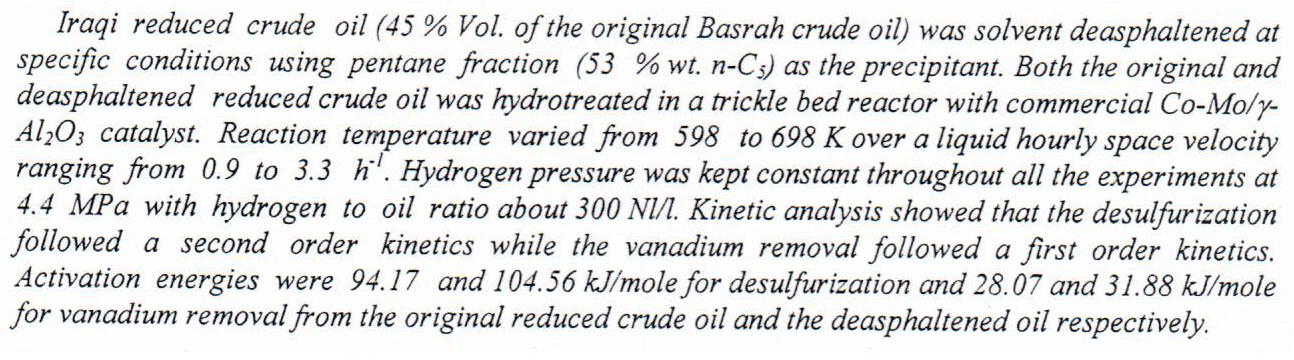
The Effect of Asphaltenes Removal on the Kinetics of Iraqi Reduced Crude Oil Hydrotreating

Background Microorganisms and fungal growth especially Candida albicans, on soft denture lining material are the most common problem which can lead to chronic mucosal inflammation. The aim of this study was to evaluate the effect of zirconium nanoparticles into acrylic-based heat cured soft denture lining material against Candida albicans, and the amount of zirconium ion release of soft liner/ZrNPs composite. Furthermore, evaluate shear bond strength after ZrNPs addition to soft liner. Materials and methods: Zirconium nanoparticles were added into acrylic-based soft denture liner in various percentages (1%, and 1.5% by weight). Two hundred and fifty specimens were arranged and isolated into four groups as per the test to be done The antifu
... Show More (16)
(16)

This study aims to assess the removal efficiency andestablish the BOD5 and COD statisticalcorrelation of the sewage flowing in Al-Diwaniyah wastewater treatment plant in Iraq during the study period (2005-2016). The strength of the influent wastewater entering the plant varied from medium to high in strength. High concentrations of BOD5 and COD in the effluent were obtained due to the poor performance of the plant. This was observed from the BOD5 /COD ratios that did not confirm with the typical ratios for the treated sewage. To improve the performance of this plant, regression equations for BOD5 and COD removal percentages were suggested which can be used to facilitate evaluation of liquid waste and optimal control process. The equations
... Show MoreAzo dyes like methyl orange (MO) are very toxic components due to their recalcitrant properties which makes their removal from wastewater of textile industries a significant issue. The present study aimed to study their removal by utilizing aluminum and Ni foam (NiF) as anodes besides Fe foam electrodes as cathodes in an electrocoagulation (EC) system. Primary experiments were conducted using two Al anodes, two NiF anodes, or Al-NiF anodes to predict their advantages and drawbacks. It was concluded that the Al-NiF anodes were very effective in removing MO dye without long time of treatment or Ni leaching at in the case of adopting the Al-Al or NiF-NiF anodes, respectively. The structure and surface morphology of the NiF electrode were inves
... Show More

Electrochemical oxidation in the presence of sodium chloride used for removal of phenol and any other organic by products formed during the electrolysis by using MnO2/graphite electrode. The performance of the electrode was evaluated in terms fraction of phenol and the formed organic by products removed during the electrolysis process. The results showed that the electrochemical oxidation process was very effective in the removal of phenol and the other organics, where the removal percentage of phenol was 97.33%, and the final value of TOC was 6.985 ppm after 4 hours and by using a speed of rotation of the MnO2 electrode equal to 200 rpm.
 (6)
(3)
(6)
(3)
The effect ©? acid and alkility for the dichromate solution and the thicknness of gelatin layer on the effecincy of the film , also the time period between the recording and the reconstraction processes . the last effecincy was 90% for PH=5.6 and 95% for d=110 ?? . the highe effeciny for time period was 82% for 48 h .
That less duration takes larva mature into a virgin under field conditions is one day during Alguetrh from April to October and last longer to more than a day during Alguetrh from November to February and up to nine days in January when low minimum temperature to zero degreespercentage that these larvae can not be a high percentage in the field ranging from 90-100% reduced Hessian Alnsphaly 85% during the months of July and Cape
The purpose of this study is to examine the dimensions of strategic intent (SI; see Appendix 1) according to the Hamel and Prahalad model as a building for the future, relying on today’s knowledge-based and proactive strategic directions of management as long-term and deep-perspective creative directions, objective vision and rational analysis, integrative in work, survival structure and comprehensiveness in perception.
The quantitative approach was used based on research, detection and proof, as data were collected from leader
(5)
(5)
The stratigraphic sequence of Cenomanian-Early Turonian is composed of Ahmadi, Rumaila, and Mishrif formations in the Rifai, Noor and Halfaya Oil Fields within the Mesopotamian Zone of Iraq, which is bounded at top and bottom by unconformity surfaces. The microfacies analysis of the study wells assisted the recognition of five main environments (open marine, basinal, shallow open marine, Rudist biostrome, and lagoon); these microfacies were indicative of a normal lateral change facies from shallow water facies to deeper water and open marine sediments.
Ahmadi Formation (Early Cenomanian) is characterized by open marine sediments during the transgressive conditions, and would be
... Show More
(4)
(2)
Emulsion Liquid Membrane (ELM) is an emerging technology that removes contaminants from water and industrial wastewater. This study investigated the stability and extraction efficiency of ELM for the removal of Chlorpyrifos Pesticide (CP) from wastewater. The stability was studied in terms of emulsion breakage. The proposed ELM included n-hexane as a diluent, span-80 as a surfactant, and hydrochloric acid (HCl) as a stripping agent. Parameters such as mixing speed, aqueous feed solution pH, internal-to-organic membrane volume ratio, and external-to-emulsion volume ratio were investigated. A minimum emulsion breakage of 0.66% coupled with a maximum chlorpyrifos extraction and stripping efficiency were achieved at 96.1% and 95.7% at b
... Show More
(7)