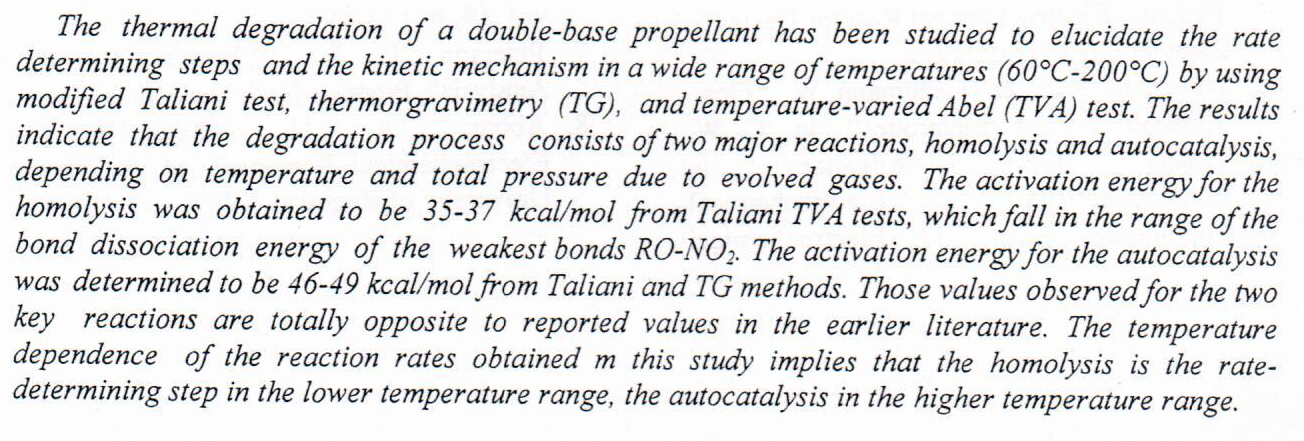
Kinetic Mechanism on Thermal Degradation of a Nitrate Ester Propellant

This work is concerned with building a three-dimensional (3D) ab-initio models that is capable of predicting the thermal distribution of laser direct joining processes between Polymethylmethacrylate (PMMA) and stainless steel 304(st.st.304). ANSYS® simulation based on finite element analysis (FEA) was implemented for materials joining in two modes; laser transmission joining (LTJ) and conduction joining (CJ). ANSYS® simulator was used to explore the thermal environment of the joints during joining (heating time) and after joining (cooling time). For both modes, the investigation is carried out when the laser spot is at the middle of the joint width, at 15 mm from the commencement point (joint edge) at traveling time of 3.75 s. Process par
... Show More (48)
(48)
 (44)
(44)



With the continuous downscaling of semiconductor processes, the growing power density and thermal issues in multicore processors become more and more challenging, thus reliable dynamic thermal management (DTM) is required to prevent severe challenges in system performance. The accuracy of the thermal profile, delivered to the DTM manager, plays a critical role in the efficiency and reliability of DTM, different sources of noise and variations in deep submicron (DSM) technologies severely affecting the thermal data that can lead to significant degradation of DTM performance. In this article, we propose a novel fault-tolerance scheme exploiting approximate computing to mitigate the DSM effects on DTM efficiency. Approximate computing in hardw
... Show More
(7)
(6)
<span lang="EN-US">In the last years, the self-balancing platform has become one of the most common candidates to use in many applications such as flight, biomedical fields, and industry. In this paper, the physical prototype of a proposed self-balancing platform that described the self-balancing attitude in the (X-axis, Y-axis, or biaxial) under the influence of road disturbance has been introduced. In the physical prototype, the inertial measurement unit (IMU) sensor will sense the disturbance in (X-axis, Y-axis, and biaxial). With the determined error, the corresponding electronic circuit, DC servo motors, and the Arduino software, the platform overcame the tilt angle(disturbance). Optimization of the proportional-integral-
... Show More
(6)
(3)
In this article, the lattice Boltzmann method with two relaxation time (TRT) for the D2Q9 model is used to investigate numerical results for 2D flow. The problem is performed to show the dissipation of the kinetic energy rate and its relationship with the enstrophy growth for 2D dipole wall collision. The investigation is carried out for normal collision and oblique incidents at an angle of . We prove the accuracy of moment -based boundary conditions with slip and Navier-Maxwell slip conditions to simulate this flow. These conditions are under the effect of Burnett-order stress conditions that are consistent with the discrete Boltzmann equation. Stable results are found by using this kind of boundary condition where d
... Show More
This study sought to determine malformation caused by Ochratoxin-A (OTA) on mouse embryos. Twenty adult female white Swiss mice (mus msculus) were divided into four groups, with five females per group, and with one male placed with two females in a cage. Avaginal plug was observed in the early morning and the day of mating was considered as day of pregnancy followed by the first day of pregnancy. Three sub lethal concentrations of OTA were applied to the respective groups (other than the control), 1mg/kg, 2mg/kg and 4mg/kg. The animals were given 0.1 ml per 10 gm body weight per concentration of OTA once a day during days 7-14 of pregnancy. The control group animals were given distilled water. The pregnant mice were dissected, and the embry
... Show More
(4)
(3)
This work deals with thermal cracking of three samples of extract lubricating oil produced as a by-product from furfural extraction process of lubricating oil base stock in AL-Dura refinery. The thermal cracking processes were carried out at a temperature range of 325-400 ºC and atmospheric pressure by batch laboratory reactor. The distillation of cracking liquid products was achieved by general ASTM distillation (ASTM D -86) for separation of gasoline fraction up to 220 ºC from light cycle oil fraction above 220 ºC. The comparison between the conversions at different operating conditions of thermal cracking processes indicates that a high conversion was obtained at 375°C, according to gasoline production. According to gasoline produ
... Show More
(1)
(15)
(8)
12 membered Schiff base macrocyclic ligands, 6,7,14,15-tetra phenyl-1,2,3,4, 4a,8a, 9,10, 11,12, 12a,16a-dodecahydro dibenzo [b,h] [1,4,7,10] tetraazacyclododecine L1, and 14 membered Schiff base macrocyclic ligands, 6,8,15,17-tetramethyl-1,2,3,4, 4a,7,9a, 10,11,12,13,13a,16,18a-tetra decahydro dibenzo[b,i] [1, 4,8,11] cyclotetradecine tetraaza L2, 7,16-bis(2,4- dichloro benz ylidene)-6,8,15,17-tetra methyl-1,2,3,4, 4a,7,9a, 10, 11,12, 13, 13a,16,18a-tetra deca hydro dibenzo [b,i] [1,4,8,11] tetra azacyclo tetra decine L3 and 6,8,15, 17-tetramethyl-1,2,3, 4,4a,9a,10, 11,12,13,13a,18a-dodecahydro dibenzo [b,i] [1,4,8, 11] tetraazacyclo tetradecine (7,16-diylidene) bis(methanylyli dene) bis (N,N-dimethylaniline) L4 were synthesized by condens
... Show MoreA detailed methodology is presented in this paper for the calculation of nucleate boiling safety margin (NBSM) in nuclear research reactors using a temperature function with three different thermal-hydraulic hot-spot analyses: nominal, cumulative and statistical for normal operating condition and coolant flow variation. A computer simulation program is developed for applying the methodology to the IRT-5000 reactor based on experimental core data. According to cumulative analysis as the overconservative approach, the NBSM at normal operating condition of thermal power 5 MW and coolant velocity 1.672 m/s was 2.3% with reactor power limit 5.13 MW. However, during power or coolant flow trip condition, transient nucleate boiling would occur for
... Show More
A new set of metal complexes by the general formula [M(P)2(H2O)2]Cl2 has been prepared through the interaction of the new Ligand [N1, N4-bis(4-methoxyphenyl)succinamide] (P) derived from succinyl chloride with p-anisidine with the transition metal ions [Cu(II), Mn(II), Cd(II), Co(II) and Ni(II)]. Compounds diagnosed by TGA, 1 H, 13CNMR and Mass spectra (for (P)), Fourier-transform infrared and Electronic spectrum, Magnetic measurement, molar conduct, (%M, %C, %H, %N). These measurements indicate that (P) is associated with the metal ion in a bi-dentate fashion by nitrogen atoms (the amide group), and the octahedral composition of these complexes is suggested. Staphylococcus Aureus (+) and Escherichia Coli (–) were studied for the antibact
... Show More